
Optimize Scalable Learning and Teaching
Bring the 1Cademy AI Assistant to your e-books and course curriculum.
Dive into the future of education
Personalized Daily Retrieval Practice
1Cademy AI Assistant integrates learners' previous responses with the knowledge graph's prerequisite relations. Correct answers guide learners toward more advanced topics, whereas incorrect answers trigger a review of the prerequisites. Learners earn daily points to motivate spaced practice. The 1Cademy knowledge graph, personalized practice, and daily point incentives foster learners' long-term learning, with controlled studies showing significant gains on assessments, especially among learners with lower baseline performance.
Course-specific Question Answering
1Cademy AI Assistant provides answers exclusively based on its knowledge graph, populated with learning-lead-curated course content. It closely examines each learner's response history and prerequisite topic relationships, helping identify root learning gaps. Furthermore, it visualizes prerequisite pathways to deepen learners' understanding. 1Cademy also offers learning leads comprehensive learner conversation reports, enabling more effective coaching and facilitation.
AI-Enhanced Assignments/Assessments
1Cademy empowers learning leads to efficiently manage assignments and assessments by offering tools to create, schedule, review, and auto-grade them, all under their control. It enables learning leads to personalize questions, assign points, and tag or revise them. Learners benefit from completing assignments, receiving instant constructive feedback, and reviewing results with metacognitive learning analytics, fostering transparency in the learning process.
Positive Reinforcement
The 1Cademy Assistant engages learners in recognizing their progress by providing immediate feedback, celebrating correct answers, and tracking their progress throughout their learning journey. This feedback cycle, embedded at critical moments within the learning material interactions, utilizes interactive, concise, and encouraging animations illustrated by the 1Cademy Assistant character. On completing each piece of micro-content, learners receive an enhanced level of positive reinforcement through awards and reputation points, keeping the brain engaged and facilitating increased learning through consistent encouragement for small achievements.
Micro-content Generation
1Cademy aims to simplify and facilitate comprehension by translating complex scientific content into easily digestible microlearning modules. Current research indicates a trend towards learners' preference for micro-content delivery methods such as flashcards, over traditional lengthy text-based learning. 1Cademy actively aids learning leads and learners in working together to break down learning content into smaller segments of micro-content, each embodying a single concept. These bite-sized learning modules can be applied across numerous learning contexts and goals. To assist in this task, 1Cademy employs a three-way collaboration between learning leads, learners, and its customized AI Assistant, whereby invaluable information from myriad sources is consolidated into compact, clear-cut pieces of micro-content. This diverse collaboration ensures the micro-content is relevant to a broader spectrum of learners covering the same topics, extending beyond a single term or cohort.
Linking
For learning to be effective, the content must be progressive. 1Cademy offers a large-scale, asynchronous collaborative mechanism that allows learning leads and learners, with the assistance of the 1Cademy AI Assistant, to build an extensive prerequisite knowledge graph using the micro-content modules. With unique learning pathways established for each learning objective, learners can seek out various prerequisite learning routes. Each pathway could better suit a different learner, considering their prior knowledge base, preferred learning styles, and specific learning requirements. Once an objective is achieved, learners can delve into more advanced topics, furthering their Zone of Proximal Development. This collective generation of learning pathways, under the guidance of learning leads, equips learners with optimized mechanisms for understanding each concept.
Evaluating
Ensuring the quality of the knowledge graph and study pathways requires crucial oversight by learning leads. To assist learning leads in saving their time, an AI-enhanced peer-review process has been implemented. Learning leads, learners, and the 1Cademy AI Assistant collaboratively evaluate each micro-content segment, and a collective score determines the need for modification or deletion. Learners' upvotes help in identifying helpful content, earning the author reputation points. Conversely, downvotes indicate the need for improvement, and it leads to loss of points for the author. Unlike conventional classroom or training settings where learners compete to acquire more knowledge, here, the competition lies in being more beneficial to the learner's community, motivating learners to earn higher reputation points. It fosters a sense of accomplishment among learners, giving them pride in contributing to society even as they pursue their learning goals.
Improving
Evolving in conjunction with all stakeholders, 1Cademy notebooks are structured knowledge graphs of micro-content pieces along with their prerequisite learning pathways. Learning leads and learners from various institutions, who are teaching or learning the same topics, ensure that the content stays updated and improved over time. The AI Assistant also supports this continual improvement process. Multiple versions of each micro-content piece, proposed by different learners across various organizations, cover an array of viewpoints and use-cases. Learning leads can provide their inputs about these different versions, by acceptance, rejection, or providing suggestions for improvement. 1Cademy then visualizes these versions side-by-side, granting learners the freedom to select the most suitable learning pathway, depending on their prerequisites, learning styles, and needs.
Explore our courses
Browse AI-powered courses designed for effective learning. Enroll as a learner to start practicing, or join as a learning lead to manage course content.
Research Communities
1Cademy has fostered the development of communities of enthusiasts for various scientific subjects, comprising individuals from diverse educational institutions and research organizations. These enthusiasts share their discoveries and insights on 1Cademy and come together on a weekly basis to delve deeper into their areas of interest. Through these interactions, we gain insight into the cutting-edge research and learning taking place at our collaborators' institutions and are able to draw connections that inspire new research ideas.

2,011
Learners and Researchers
Over the past two years joined 1Cademy.
267
Institutions
Have participated in a large-scale collaboration effort through 1Cademy
72,268
Nodes
Are generated through this large-scale collaboration.
374,166
Prerequisite links
Are connected between nodes.
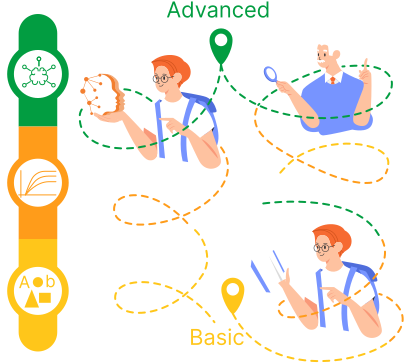
The traditional learning approach for learners is to start with foundational concepts and gradually work towards more complex topics. On the other hand, researchers often prefer to begin with the advanced topics and work backwards to gain a deeper understanding of the underlying prerequisites. 1Cademy offers an innovative approach to learning by enabling learners to emulate the research method and start with advanced topics, then delve into the prerequisites as needed. This approach allows learners to learn in a more targeted and efficient manner, similar to the way researchers approach learning.
The process of meticulously considering the prerequisites for each concept when adding them to 1Cademy not only improves the quality of our learning, but also helps us uncover novel learning pathways to grasp complex concepts that we previously thought were unattainable.
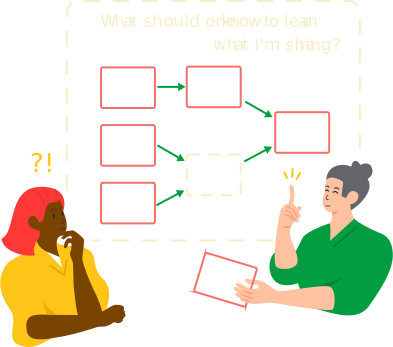
1Cademy members are constantly evaluating the efficacy of the content and learning pathways. If a member discovers a more straightforward method for defining or explaining a concept, they can propose it on 1Cademy for community review. Through this process, the community collectively decides which approach is most effective for learning that particular concept. As a result, the learning experience through 1Cademy continually improves, becoming both more efficient and enjoyable over time.
While information on any topic is readily available on the internet, many people still choose structured learning resources and courses because they provide step-by-step pathways to achieve learning objectives. However, traditional resources and courses are limited by the perspectives of a few authors and are infrequently updated or improved. 1Cademy offers a solution to this by providing a collaborative platform for learners, learning leads, and researchers to design and share learning pathways on any topic, all within the framework of a shared knowledge graph.

Similar to Wikipedia, 1Cademy is built through a collaborative effort on a large scale. However, while Wikipedia is the most comprehensive encyclopedia, 1Cademy's goal is to tap into the collective intelligence of its users to uncover the most efficient learning pathways for any given topic by identifying the most effective prerequisite connections.

Ample research in cognitive psychology has demonstrated that the act of learning with the intention of teaching others is more effective than learning for the sole purpose of being assessed. On 1Cademy, we condense and depict our learning pathways with the objective of enhancing the learning experience for our collaborators. In the process, our understanding of the topics deepens as we contemplate ways to make them more accessible for others to learn.

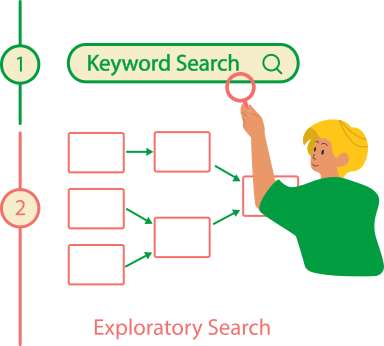
Have you ever encountered difficulty finding relevant content to learn something, because you're not sure what the appropriate keywords are? For instance, what would you search for to learn how to create the web animations featured on a particular website? Simply searching a phrase might not yield the most helpful results. 1Cademy offers a solution to this challenge by providing both a factual search engine and a mechanism for creating a personalized view of the shared knowledge graph to facilitate exploratory search. This way, even without having the exact keywords, one can navigate through the hierarchical structure of concepts and their prerequisite links to facilitate learning.
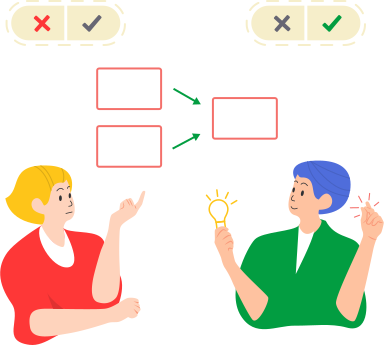
These days, we see political, sexual, ethnic, or even scientific polarization everywhere on the Internet. Echo chambers are formed where a group of people only accept thoughts and ideas that are aligned with their perspectives, ignoring alternatives views. 1Cademy provides us with a consensus-based collaboration mechanism where alternative or even competing perspectives are placed side-by-side so that one can easily compare and contrast them to learn and rationalize each topic in different contexts.

Our Team
Paul Resnick is the Michael D. Cohen Collegiate Professor of Information at the University of Michigan School of Information and a former Associate Dean for Research and Innovation. He is a pioneering researcher in recommender systems, reputation systems, and online communities, and was part of the GroupLens collaborative filtering team that received the 2010 ACM Software System Award.
Resnick received the University of Michigan Distinguished Faculty Achievement Award, the SIGCHI CHI Academy Award, and ACM Fellowship for contributions to recommender systems, economics and computation, and online communities. His book Building Successful Online Communities, co-authored with Robert Kraut, is a foundational reference for evidence-based community design.
He has advised 1Cademy since its earliest stages, helping shape its research grounding in social computing, collective intelligence, incentives, and scalable learning communities.
1Cademy Advisor
Paul Resnick
Joel Podolny is the CEO of Honor Education and a sociologist whose career bridges organizational learning, leadership education, and higher education strategy. He previously served as Vice President at Apple and founding Dean of Apple University, where he led Apple's internal education organization for employees and executives.
Earlier, Podolny served as Dean and Professor of Management at the Yale School of Management and held faculty roles at Harvard Business School and Stanford Graduate School of Business. His advising helps connect 1Cademy's learning infrastructure to rigorous leadership education, organizational practice, and scalable professional learning.
1Cademy Advisor
Joel Podolny
Roby Harrington is the former Vice Chairman of W. W. Norton & Company and former director of Norton's college department, where he spent decades shaping influential educational publishing programs across the social sciences, humanities, and sciences. He has also served as chairman of the Camphill Foundation and as a fellow at the Center for Advanced Study in the Behavioral Sciences at Stanford.
Harrington advises 1Cademy from the perspective of durable educational content, editorial quality, and public access to learning. He is also an advisor to CORE Econ and a member of the board of governors at Stanford University Press.
1Cademy Advisor
Roby Harrington
Sponsors


Related Research
These studies are largely from higher education, and the learning principles also apply to workplace training.
Collaborative question generation and mapping by learners has been shown to improve learners' active (engaged) and meaningful learning. In implementing these methods into a course that enabled high levels of autonomy (as recommended by Self-determination theory), we found procrastination to be a persistent problem. Since learner contribution tends to wane over the course of a term, the efficacy of a curriculum reliant on content generation similarly wanes. We describe our efforts in reducing procrastination in a course focused on collaborative question generation and mapping, using an iterative design research methodology, over eight months across two terms. To encourage learners to create high-quality questions, we implemented a voting system that scored contributions based on the number of facilitator up-votes given to questions they created. While this reduced procrastination early on, learners found ways to take advantage of the autonomy provided by the course curriculum, leading them to resume procrastinating. To address this issue, we adjusted the scoring schema for the second term by counting both learners' and facilitators' up-votes, while also allowing learners to present their created content in optional weekly meetings. The introduction of optional weekly meetings had the greatest effect toward decreasing procrastination. End-of-term surveys reported that: 1) while learners enjoyed both terms, they gave more positive feedback for the second term; 2) learner-led discussions for personally created content, when combined with the autonomy to choose both the topic and time to study, helped their learning and time management skills.

Desirable difficulties such as retrieval practice (testing) and spacing (distributed studying) are shown to improve long-term learning. Despite their knowledge about the benefits of retrieval practice, learners struggle with application. We propose a mechanism of embedding desirable difficulties in learning sessions called "retrieval-based teaching." We define it as asking learners many ungraded, granular questions during sessions. We hypothesized that this method could motivate learners to (1) study more and (2) increase the spacing of their studying. We tested these two hypotheses through a quasi-experiment in an introductory programming course. We compared 684 learners' granular activities with an interactive eBook between the discussion sections where the intervention was implemented and the control sections. Over four terms, there were a total of 17 graduate-level facilitators who led the discussion sections. Each term, there were five discussion sections, each led by a distinct facilitator. Only one of the five per term implemented the treatment in their section(s) by dedicating most of the session time to retrieval-based teaching. Our analysis of these data collected over four consecutive terms shows that retrieval-based teaching motivated learners to space their studying over an average of 3.78 more days, but it did not significantly increase the amount they studied. Learners in the treatment group earned an average of 2.36 percentage points higher in course scores. Our mediation analysis indicates that spacing was the main factor in increasing the treated learners' scores.
Prior literature suggests that computer science education (CSE) was less affected by the pandemic than other disciplines. However, it is unclear how the pandemic affected the quality and quantity of learners' studying in CSE. We measure the impact of the pandemic on the amount and spacing of learners' studying in a large introductory computer science course. Spacing is defined as the distribution of studying over multiple sessions, which is shown to improve long-term learning. Using multiple regression models, we analyzed the total number of learners' interactions with the eBook and the number of days they used it, as a proxy for studying amount and spacing, respectively. We compared two sequential winter terms of the course, one during (Winter 2021) and one prior to the pandemic (Winter 2020). After controlling for possible confounders, the results show that learners had 1,345.87 fewer eBook interactions and distributed their studying on 2.36 fewer days during the pandemic when compared to the previous term prior to the pandemic. We also compared four terms prior to the pandemic (Fall and Winter of 2018 and 2019) to two terms during the pandemic (Fall 2020 and Winter 2021). We found, on average, learners had 3,376.30 fewer interactions with the eBook and studied the eBook on 16.35 fewer days during the pandemic. Contrary to prior studies, our results indicate that the pandemic negatively affected the amount and spacing of studying in an introductory computer science course, which may have a negative impact on learning outcomes.
Spacing and procrastination are often thought of as opposites. It is possible, however, for a learner to space their studying by doing something every day throughout the term and still procrastinate by waiting until late in the term to increase their amount of studying. To analyze the relationship between spacing and procrastination, we examined 674 learners' interactions with a course eBook over four terms of an introductory programming course. We measured each learner's term-level spacing as the number of days they interacted with the eBook, and each learner's term-level procrastination as the average delay from the start of the term for all their eBook interactions. Surprisingly, there was a small, yet positive, correlation between the two measures. Which, then, matters for course performance: studying over more days or studying earlier in the term? When controlling for total amount of studying, as well as a number of background and demographic characteristics in an SEM analysis, we find a strong positive effect of spacing but no significant effect of procrastination on final assessment scores.
Extensive prior research shows that spacing - the distribution of studying over multiple sessions - significantly improves long-term learning in many disciplines. However, in computer science education, it is unclear if 1) spacing is effective in an incentivized, non-imposed setting and 2) when incentivized, female and male learners space their studying differently. To investigate these research questions, we examined how learners in an introductory computer science course (378 female and 310 male) spaced their studying. A retrieval practice tool in the course (worth 5% of the course score) incentivized learners to space their studying by awarding a point per day of usage. To measure how much each learner spaced, we examined their interactions with the course eBook, which served as their primary learning resource. Specifically, when comparing two learners with the same background and demographic characteristics, the same measure of course easiness, and the same amount of content studied, we considered the learner who distributed their studying over more days to be the one who spaced more. Using this definition, our structural equation modeling (SEM) results show that, 1) on average, learners who spaced their studying over 14.516 more days (one standard deviation) got 2.25% higher final assessment scores; and 2) female learners spaced their studying over 4.331 more days than their male counterparts. These results suggest that, in an introductory computer science course, incentivized spacing is effective. Notably, when compared to their male counterparts, female learners both exhibited more spacing and obtained higher final assessment scores through spacing.
Generating multiple-choice questions is known to improve learners' critical thinking and deep learning. Visualizing relationships between concepts enhances meaningful learning, learners' ability to relate new concepts to previously learned concepts. We designed and deployed a collaborative learning process through which learners generate multiple-choice questions and represent the prerequisite knowledge structure between questions as visual links in a shared map, using a variation of Concept Maps that we call "QMap." We conducted a four-month study with 19 undergraduate learners. Learners sustained voluntary contributions, creating 992 good questions, and drawing 1,255 meaningful links between the questions. Through analyzing self-reports, observations, and usage data, we report on the technical and social design features that led learners to sustain their motivation.
Retrieval practice, spacing, and interleaving are known to enhance long-term learning and transfer, but reduce short-term performance. It can be difficult to get both learners and facilitators to use these techniques since they perceive them as impeding initial learning. We leveraged user experience design and research techniques, including survey and participant observation, to improve the design of a practice tool during a term of use in a large introductory Python programming course. In this paper, we describe the design features that made the tool effective for learning as well as motivating. These include requiring spacing by giving credit for each day that a learner answered a minimum number of questions, adapting a spaced repetition algorithm to schedule topics rather than specific questions, providing a visual representation of the evolving schedule in order to support meta-cognition, and providing several gameful design elements. To assess effectiveness, we estimated a regression model: each hour spent using the practice tool over the course of a term was associated with an increase in final assessment scores of 1.04%, even after controlling for many potential confounds. To assess motivation, we report on the amount of practice tool use: 62 of the 193 learners (32%) voluntarily used the tool more than the required 45 days. This provides evidence that the design of the tool successfully overcame the typically negative perceptions of retrieval practice, spacing, and interleaving.
In an introductory Python programming course intended for non-majors with little prior CS experience, with 85 male and 108 female learners, we were able to capture electronic traces of learners' studying and problem-solving. There was no significant difference in final assessment scores by gender but we found that female learners spent 12.1 more hours studying over the term while male learners on average earned 2.7 more points per hour of solving problem set questions over the first half of the term. We were able to capture their learning behavior because learners studied using the Runestone interactive textbook and completed weekly problem sets in the same platform for the first half of the term. We analyzed these logs to determine three quantities for each learner. One is study time, as measured by total use of Runestone outside of weekly assignments. The second is speed, as measured by the number of points learners earned per hour working on problem sets. The third is earliness, as measured by how far before the deadlines they worked on weekly assignments. We conclude that male learners were faster at completing problem sets early in the term but that female learners found an alternative pathway to success.
The Runestone ebook platform is open source, extensible, and already serves over 25,000 learners a day. The site currently hosts 18 free ebooks for computing courses. Facilitators can create a custom course from any of the existing ebooks on the site and can have their learners register for that custom course. Facilitators can create assignments from the existing material in each ebook, evaluate assignments, and visualize learner progress. Facilitators can even create new content for assignments. The Runestone ebooks contain instructional material and a variety of practice problem types with immediate feedback. One of the practice types, Parsons problems, is also adaptive, which means that the difficulty of the problem is based on the learner’s performance. Learner interaction is recorded and can be analyzed. This paper presents the history of Runestone, describes the interactive features, summarizes the previous research studies, and provides detail on the recorded data. Interaction data can be shared with other learning environments through the Learning Tools Interoperability Standard (LTI).