
Learn Before
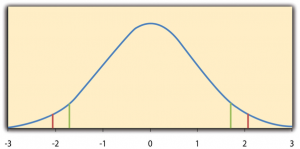
A clinical researcher predicts that a new mindfulness app will reduce stress scores (, ). After the study, they calculate a -score of . Based on the critical values shown as green vertical lines in the provided distribution image, the researcher should reject the null hypothesis.
0
1
Tags
KPU
Research Methods in Psychology - 4th American Edition @ KPU
Related
When a researcher uses a one-tailed test and their sample mean differs in the unexpected direction, what is the outcome regarding the null hypothesis?
Using the provided distribution for a one-tailed test (, ), match each research scenario or concept with its correct statistical description or consequence.
A clinical researcher predicts that a new mindfulness app will reduce stress scores (, ). After the study, they calculate a -score of . Based on the critical values shown as green vertical lines in the provided distribution image, the researcher should reject the null hypothesis.
A researcher uses the provided distribution to conduct a one-tailed test (, ) with a hypothesis predicting an increase in scores (critical value = ). Rank the following -statistics from the strongest evidence for the predicted increase (top) to the weakest evidence (bottom).
A researcher is developing a study protocol to investigate if a new relaxation technique decreases resting heart rate (). They decide to implement a statistical design that places the entire .05 alpha level into a single tail to maximize the sensitivity for finding this specific reduction. Using the provided distribution as a guide, which of the following blueprints correctly constructs the statistical framework for this study?
In the example of a one-tailed test with degrees of freedom and an alpha of .05, the researcher selects only a single critical value (either or 1.711) based on their pre-registered directional hypothesis.
When evaluating the trade-offs of the one-tailed test scenario described (, ), the researcher chooses to use a _____ (more/less) severe critical value of 1.711 to increase the probability of rejecting the null hypothesis in the hypothesized direction, while accepting that any result in the unexpected direction will be considered nonsignificant.
A researcher conducts a one-tailed t-test (, ) and must apply the correct decision rule. Match each scenario on the left to its correct statistical outcome or setup on the right.
In a one-tailed test (, ) where the researcher predicts a higher sample mean, the critical value is set at rather than a larger value because the entire rejection region is concentrated in _____ tail of the distribution, rather than being split equally across both ends.
A research methods instructor is evaluating whether a student followed proper one-tailed test procedure (, ). Place the following steps in the correct order that a researcher must follow to validly conduct and interpret a one-tailed test.
Based on the example of a one-tailed test with degrees of freedom and an alpha level of .05, identify the critical values associated with each direction of prediction. Then, recall and explain the primary advantage and the primary disadvantage of using a one-tailed test in this scenario.
Explain why the researcher is unable to reject the null hypothesis in this scenario. In your answer, demonstrate your comprehension of how redefining 'extreme' to one tail impacts the critical value and the consequences of a result falling in the unexpected direction.
A researcher conducts a one-tailed test with degrees of freedom and an alpha level of .05. They pre-register a directional hypothesis predicting a higher sample mean, which sets their critical value at 1.711. If their calculated test statistic is 1.85, state whether they can reject the null hypothesis and justify your decision based on the critical value.