
Learn Before
Contract Insurance and Bond Requirement Intake
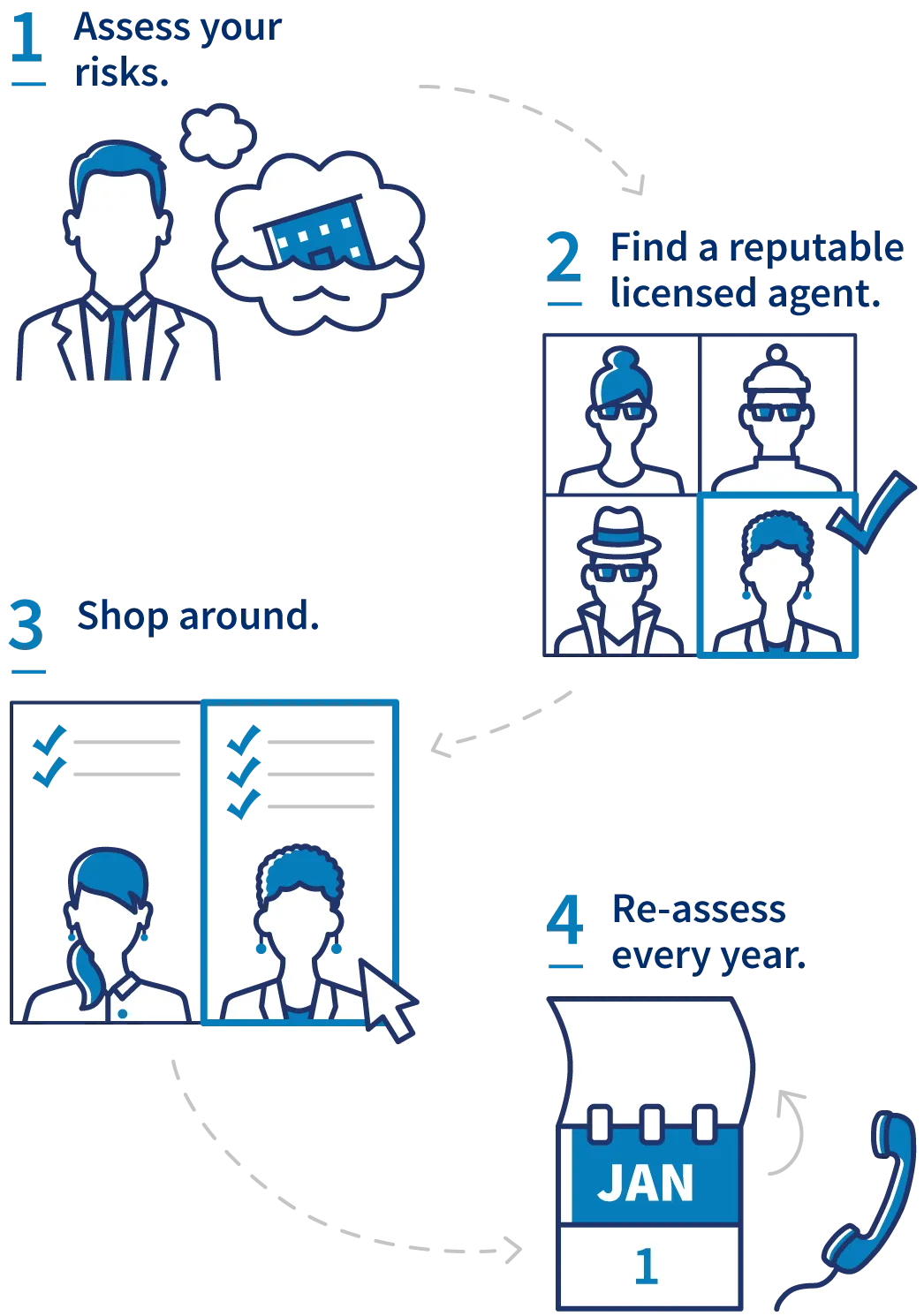
Contract insurance and bond requirement intake is the step of reading bid and contract requirements before pricing or signing, then routing insurance limits, additional insured requests, employee coverage questions, vehicle-use questions, tool exposures, and contract surety bond requirements to the appropriate licensed insurance or surety professional. This prevents discovering coverage or bonding requirements only after the contractor has promised the work.
0
1
Tags
Electrical Contracting Business Operations
Running an Electrical Contracting Business Course
Related
Contract Insurance and Bond Requirement Intake
Business Insurance Review With a Licensed Agent
Surety Bonds for Electrical Contractor Contract Access
A Practical Cybersecurity Framework for Small Organizations
Match each type of insurance or bonding an electrical contractor may need with its primary purpose.
As an electrical contractor, you will often encounter requirements for various types of coverage before starting a job. Which of the following best summarizes the primary difference between general liability insurance and a surety bond?
Your electrical contracting business is expanding, and you just purchased a new van dedicated to transporting tools, conduit, and materials to your job sites. To save money, you can safely rely on your existing personal auto insurance policy to cover the van in the event of an accident, provided you are the only person who drives it.
You are preparing to take on a complex commercial electrical project that involves new operational risks. Arrange the following steps in the most logical sequence to effectively analyze, manage, and transfer your business risks before beginning the work.
You are evaluating a colleague's proposed risk management plan for a new municipal electrical contract. The colleague suggests that purchasing a $2 million general liability policy will perfectly satisfy the city's requirement for a guarantee that the electrical work will be completed according to the blueprints. You reject this plan because you know liability insurance only covers accidental damages; to properly satisfy a requirement that guarantees project completion, you determine the busine
You are launching your electrical contracting business and have just hired your first employee, purchased a dedicated work van, and signed a commercial contract that requires a guarantee the project will be completed per the agreed specifications. You need to design a complete coverage package that addresses every one of these new exposures. Which combination of coverages correctly matches all three exposures?
You are launching a new electrical contracting business and must select a risk management strategy. You plan to hire one full-time helper and occasionally use subcontractors for larger projects. Evaluate which of the following strategies provides the most robust protection for your business's long-term financial survival.
A colleague who also runs a small electrical business suggests that you can significantly lower your overhead by hiring only 'Exempt' solo-operator subcontractors. He claims that since these individuals do not carry Workers' Compensation insurance for themselves, they are legally responsible for their own injuries and your business faces zero financial risk if they get hurt on your job site. Evaluate the validity of this colleague's advice.
You are subcontracting the trenching and underground conduit work for a new shopping center to a local excavating company. To effectively apply the principle of risk transfer to this situation, which action should you take before the subcontractor begins work?
You are an electrical contractor acting as the prime contractor on a warehouse renovation project. You hire a subcontractor to assist with the installation and request their Certificate of Insurance (COI). Upon reviewing the COI, you notice the subcontractor has General Liability insurance, but the 'Exclusions' section specifically lists 'Commercial Construction and Renovations.'
Analyze this situation to determine the most likely consequence if the subcontractor accidentally causes a major el
Match each type of business protection or guarantee with the specific risk it is designed to address for an electrical contractor.
An electrical contractor is explaining their business protections to a new client. Which of the following best describes the fundamental difference between the 'General Liability Insurance' they carry and the 'Performance Bond' they obtained for the project?
You are an electrical contractor hiring a subcontractor for a large commercial renovation. To protect your business from being held financially responsible for the subcontractor's potential mistakes, you must follow a standard 'risk transfer' process. Arrange the following steps in the correct order, from the initial contract phase to the start of field work.
True or False: An electrical contractor has successfully achieved complete 'risk transfer' once they have included a legal clause in their contract where a subcontractor promises to pay for their own mistakes, even if the contractor has not verified that the subcontractor has their own insurance policy.
You are evaluating the risk management documents for a project where a subcontractor is performing high-voltage work. To judge that you have successfully shifted the legal and financial liability to the subcontractor's insurance carrier, you must verify that your business is listed as a(n) ____ on their policy endorsement, rather than relying solely on a certificate of insurance.
Which term describes the business practice of shifting financial and legal responsibility for potential project losses to another party, typically through insurance policies or contract clauses?
True or False: Because Workers' Compensation is a 'no-fault' system, it provides medical benefits to an injured employee even if the injury was caused by the employee's own mistake on the job.
As an electrical contractor, you must manage various risks by selecting the correct insurance or bond. Match each real-world business scenario with the specific type of protection required to address it.
Analyze the following scenario: An electrical contractor completes a high-quality installation, but fails to pay their wire supplier. Even though the 'Performance' bond is satisfied because the work is finished, the supplier can still make a financial claim against the contractor's ____ bond to recover the cost of the materials.
Evaluate the financial protection levels in the following business scenarios for a $25,000 electrical project. Rank the scenarios from the 'MOST secure' (highest level of protection for your contracting business) to the 'LEAST secure' (lowest level of protection).
Learn After
Contract Insurance Limit Requirement Review
It is acceptable to wait until after submitting your bid price to review a contract's insurance limits, additional insured requests, and surety bond requirements.
Arrange the steps of the contract insurance and bond requirement intake process in the correct logical order to protect an electrical contracting business during the bidding phase.
You are an electrical contractor preparing a bid for a new commercial office build-out. The general contractor has provided a project manual containing several pages of insurance minimums, a request for a waiver of subrogation, and a performance bond requirement. What is your most appropriate next step before finalizing and submitting your bid price?
Analyze the following contract clauses discovered during the intake process and match each with the specific business risk it presents if the electrical contractor fails to route it to an insurance or surety professional before finalizing their bid price.
You are critiquing a junior estimator's workflow for a new commercial project. The estimator spent 40 hours detailing the material and labor costs, submitted the final bid price, and only then began reviewing the project's performance bond and additional insured requirements. You judge this workflow as highly risky because these clauses should be routed to a licensed professional before any estimating begins. This critical early-stage evaluation of risk documents is known as contract insurance a
Based on the expert's advice in the video (363s–375s) that insurance needs are not 'one-size-fits-all' and depend on the client and type of work, you are designing a new 'Risk Intake and Routing Protocol' for your electrical business. Which of the following integrated procedures represents the most effective design for this protocol to ensure that project-specific insurance and bonding costs are always captured before a contract is signed?
An electrical contractor receives a bid package for a large commercial renovation project. Before calculating any material or labor costs, a colleague suggests setting aside the contract's insurance and bonding pages until after the bid price is finalized. Which statement best explains why this approach is problematic?
An electrical contractor bidding on a new project reads the contract requirements and notices clauses related to 'vehicle-use' and 'tool exposures'. Because the contractor recently completed a similar project without needing extra coverage, they decide to skip routing these clauses to their insurance professional and proceed directly to pricing the bid.
Review the provided video segment. Analyzing the contractor's decision against the expert's advice, which of the following best explains why th
An electrical contractor is establishing new risk-management protocols for their bidding process. Match each proposed contractor decision with the most accurate professional critique of its underlying logic.
During the 'intake' phase of a new project bid, an electrical contractor identifies a requirement for a 'Surety Bond' and specialized 'Vehicle-Use' insurance limits in the contract manual. Which action demonstrates a correct understanding of the 'routing' step for these requirements?
What is the primary function of the 'Contract Insurance and Bond Requirement Intake' step for an electrical contractor?
To avoid discovering expensive insurance or bonding requirements after you have already promised to do the work, an electrical contractor must follow a specific process. Arrange the following steps in the correct order to ensure these requirements are handled properly during the bidding phase.
Imagine you are an electrical contractor reviewing a bid package for a new office renovation. You are performing an 'Intake' of the insurance and bond requirements. Match each specific clause found in the contract to the correct action or professional you should route it to before submitting your final price.
True or False: If an electrical contractor with a $1,000,000 liability policy reviews a bid requiring $5,000,000 in coverage, the 'Contract Insurance and Bond Requirement Intake' step is the analytical process used to identify this discrepancy and determine the cost of the coverage gap before submitting a final price.
An electrical contractor is reviewing a bid for a complex project that requires a $5,000,000 performance bond and a $10,000,000 liability policy. To properly judge if the business can handle these specific risks, the contractor must perform an intake review to ____ the financial feasibility of the project before submitting a binding price.
You are developing the Standard Operating Procedure (SOP) for your new electrical company's bidding department. To ensure the 'Contract Insurance and Bond Requirement Intake' process is effective, which set of functional components must you design and integrate into your new SOP to prevent discovering unbudgeted insurance or bonding costs after a contract is signed?
In the video, the speaker states that 'there is no true one-size-fits-all answer' for contractor insurance. Which of the following best explains why this principle makes the 'Contract Insurance and Bond Requirement Intake' process necessary for an electrical contractor?
An electrical contractor is reviewing a bid for a commercial warehouse project that requires a $2,000,000 performance bond and specific 'additional insured' language in the liability policy. What is the primary reason for performing the 'Contract Insurance and Bond Requirement Intake' at this stage of the bidding process?
During the 'Contract Insurance and Bond Requirement Intake' step, which set of items is an electrical contractor expected to identify and route to a professional for review?
An electrical contractor is reviewing a bid that requires both a $500,000 'Performance Bond' and an 'Additional Insured' endorsement for the project owner. Which of the following best analyzes why the 'Contract Insurance and Bond Requirement Intake' process requires routing these two items to different specialized professionals?