
In the context of a two-tailed test with an alpha level of .05 and 24 degrees of freedom, match each statistical value or conclusion with its corresponding role in the hypothesis testing process.
0
1
Tags
KPU
Research Methods in Psychology - 4th American Edition @ KPU
Related
In a two-tailed test with an alpha level of .05 and critical values of -2.064 and 2.064, what conclusion is drawn if a sample's computed t score falls below -2.064 or above 2.064?
In the context of a two-tailed test with an alpha level of .05 and 24 degrees of freedom, match each statistical value or conclusion with its corresponding role in the hypothesis testing process.
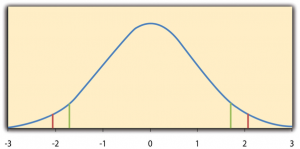
A researcher conducting a two-tailed test with 24 degrees of freedom and an alpha level of .05 (critical values of 2.064 and -2.064) computes a sample t-score of -2.05. This result falls in the extreme outer region of the distribution, providing sufficient evidence to reject the null hypothesis.
A researcher is conducting a two-tailed test with 24 degrees of freedom and an alpha level (α) of .05. After calculating a sample t-score of 2.50, they must determine its significance. Arrange the following steps in the correct logical order to analyze this result and reach a statistical conclusion.
You are designing a 'Statistical Interpretation Guide' for a psychology research project that utilizes a two-tailed test with degrees of freedom and an alpha level of .05. Using the provided distribution as a visual template, which of the following instructions should you create to ensure your research assistants accurately identify statistically significant results?
In a two-tailed test, if a sample's computed score falls into either of the extreme outer regions of the distribution, it provides sufficient statistical evidence for the researcher to reject the null hypothesis.
A researcher conducts a two-tailed -test with and . The critical values are . The computed score is 2.06. The evidence is _____ to reject the null hypothesis, because the computed value does not exceed the critical boundary.
A researcher conducts a two-tailed -test with and (critical values: ). Match each computed score or outcome description to the correct interpretation.
A researcher computes a score of with . In a two-tailed test at (critical values ), this score falls below the lower critical value, placing it in the most extreme _____ of the distribution—the portion that, together with the equivalent upper tail, constitutes the entire rejection region.
A researcher wants to determine whether a new memory intervention has any effect but has no basis for predicting the direction of that effect. Arrange the following steps in the order that reflects the most defensible two-tailed hypothesis-testing procedure, from first to last.
For a two-tailed hypothesis test with degrees of freedom and an alpha level of .05, recall the critical values, explain the percentage of the distribution represented in each tail, and state the general rule for when a computed score leads to rejecting the null hypothesis.
Based on the case context, determine whether the psychologist should reject the null hypothesis. Explain your decision by referencing the critical values, the distribution tails, and the resulting -value.
A researcher is conducting a two-tailed test with degrees of freedom and an alpha level of .05, where the critical values are and 2.064. If the computed score for their sample is , state whether the researcher should reject the null hypothesis and justify this decision using the critical values.