
Learn Before
Example of a Two-Tailed Test with 24 Degrees of Freedom
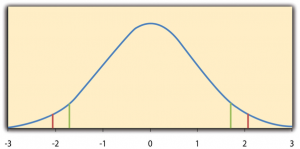
To illustrate a two-tailed test, consider a scenario with degrees of freedom where the critical values for an alpha level of are 2.064 and (represented by red vertical lines in the accompanying distribution). Any computed score falling below (the lowest 2.5% of the distribution) or above 2.064 (the highest 2.5% of the distribution) is considered extreme. If a sample's score falls into either of these outer regions, the resulting -value is less than 0.05, providing sufficient statistical evidence for the researcher to reject the null hypothesis.
0
1
Tags
KPU
Research Methods in Psychology - 4th American Edition @ KPU
Related
One-Tailed Test
A researcher is exploring whether a new background noise level changes the time it takes for participants to complete a puzzle. Because they are unsure if the noise will make participants faster or slower, they choose to use a Two-Tailed Test. Based on this choice, when will the researcher reject the null hypothesis?
A clinical psychologist is conducting a study to see if a new mindfulness exercise changes the average number of hours patients sleep per night. They expect a difference but do not know if sleep will increase or decrease, so they opt for a two-tailed test. Arrange the following steps of their hypothesis testing process in the correct chronological order.
A psychology researcher is analyzing the effects of a new therapy on anxiety scores using a two-tailed test. Match each statistical component with the description that accurately analyzes its functional role in the structure of this non-directional hypothesis test.
A psychologist evaluating the efficacy of a new antidepressant uses a two-tailed test. Although they expect the drug to reduce symptoms, they justify the two-tailed approach as being more scientifically rigorous because it allows for the statistical detection of an unexpected increase in symptoms. This justification is methodologically sound because, at a fixed significance level of , the two-tailed test requires a more extreme result to justify rejecting the null hypothesis in
In the context of hypothesis testing, how many distinct critical values are typically utilized to establish the rejection regions for a two-tailed test?
A researcher should only use a two-tailed test if they have a strong theoretical justification for predicting that the experimental results will be significantly higher than the hypothesized population mean.
An approach to hypothesis testing where researchers reject the null hypothesis if their calculated test statistic falls into the extreme regions of either the positive or negative tail of the distribution is called a _____ test.
A clinical psychologist is evaluating whether a new mindfulness training program changes the average duration of deep sleep in adults. Since they do not have a strong prediction regarding the direction of the change, they conduct a two-tailed test with an alpha level of , which yields critical values of and . After collecting and analyzing data, the psychologist obtains a test statistic of . Because this statistic falls into the negative tail, the
A psychologist is analyzing the results of an experiment on a new anxiety-reduction therapy. They decide to use a two-tailed t-test with a significance level of . During their analysis, they compare the structure of their chosen test to a hypothetical one-tailed test with the same that assumes the therapy will reduce anxiety. Which of the following statements accurately analyzes the relationships, critical boundaries, and error rates of these two testing approa
Match each researcher's justification for their choice of a two-tailed test with the most appropriate methodological evaluation of that decision.
Example of a Two-Tailed Test with 24 Degrees of Freedom
Learn After
In a two-tailed test with an alpha level of .05 and critical values of -2.064 and 2.064, what conclusion is drawn if a sample's computed t score falls below -2.064 or above 2.064?
In the context of a two-tailed test with an alpha level of .05 and 24 degrees of freedom, match each statistical value or conclusion with its corresponding role in the hypothesis testing process.
A researcher conducting a two-tailed test with 24 degrees of freedom and an alpha level of .05 (critical values of 2.064 and -2.064) computes a sample t-score of -2.05. This result falls in the extreme outer region of the distribution, providing sufficient evidence to reject the null hypothesis.
A researcher is conducting a two-tailed test with 24 degrees of freedom and an alpha level (α) of .05. After calculating a sample t-score of 2.50, they must determine its significance. Arrange the following steps in the correct logical order to analyze this result and reach a statistical conclusion.
You are designing a 'Statistical Interpretation Guide' for a psychology research project that utilizes a two-tailed test with degrees of freedom and an alpha level of .05. Using the provided distribution as a visual template, which of the following instructions should you create to ensure your research assistants accurately identify statistically significant results?
In a two-tailed test, if a sample's computed score falls into either of the extreme outer regions of the distribution, it provides sufficient statistical evidence for the researcher to reject the null hypothesis.
A researcher conducts a two-tailed -test with and . The critical values are . The computed score is 2.06. The evidence is _____ to reject the null hypothesis, because the computed value does not exceed the critical boundary.
A researcher conducts a two-tailed -test with and (critical values: ). Match each computed score or outcome description to the correct interpretation.
A researcher computes a score of with . In a two-tailed test at (critical values ), this score falls below the lower critical value, placing it in the most extreme _____ of the distribution—the portion that, together with the equivalent upper tail, constitutes the entire rejection region.
A researcher wants to determine whether a new memory intervention has any effect but has no basis for predicting the direction of that effect. Arrange the following steps in the order that reflects the most defensible two-tailed hypothesis-testing procedure, from first to last.
For a two-tailed hypothesis test with degrees of freedom and an alpha level of .05, recall the critical values, explain the percentage of the distribution represented in each tail, and state the general rule for when a computed score leads to rejecting the null hypothesis.
Based on the case context, determine whether the psychologist should reject the null hypothesis. Explain your decision by referencing the critical values, the distribution tails, and the resulting -value.
A researcher is conducting a two-tailed test with degrees of freedom and an alpha level of .05, where the critical values are and 2.064. If the computed score for their sample is , state whether the researcher should reject the null hypothesis and justify this decision using the critical values.