
Learn Before
Per-Job Truck Stock Usage Tracking
Every time a technician uses a truck-stock item on a service call, the item description and quantity must be recorded against that call's job number. This step feeds the company's job-costing system so the true material cost of each job is visible. Without per-job tracking, truck-stock consumption becomes invisible overhead—materials are purchased but never charged to the jobs that consumed them. Leftover materials from one job should be returned to inventory rather than informally transferred to another job, which would obscure true costs.
0
1
Tags
Electrical Contracting Business Operations
Running an Electrical Contracting Business Course
Related
Per-Job Truck Stock Usage Tracking
When restocking a service truck on its regular replenishment schedule, arrange the steps of the replenishment cycle in the correct order.
What is the primary operational benefit of implementing a scheduled weekly or bi-weekly truck stock replenishment cycle?
A company operates on a scheduled weekly truck stock replenishment cycle. If a technician frequently runs out of 15-amp receptacles by Thursday, the correct application of the system is to instruct the technician to make an unbillable supply-house run every Thursday to finish the week's jobs.
Analyze the following inventory management practices and match each with its most direct operational impact on an electrical service business.
As an electrical contractor, you are evaluating the financial efficiency of your inventory processes. You observe that relying on technicians to restock their trucks 'as needed' results in frequent mid-week supply-house visits, whereas implementing a scheduled replenishment cycle keeps trucks fully stocked based on par levels. You conclude that the scheduled system is vastly superior, justifying the policy change by emphasizing that unplanned supply-house runs are too costly because they directl
As you establish your electrical business, you are creating a Standard Operating Procedure (SOP) to ensure your field team never loses billable time to unplanned supply-house runs. Which of the following comprehensive plans should you implement as the company's official Truck Stock Replenishment Cycle?
To effectively manage a growing electrical business, you must understand the different components of the Truck Stock Replenishment Cycle. Match each term with its specific role in the inventory management process.
As you establish your new electrical contracting business, you must architect a 'Truck Stock Replenishment Cycle' to protect your company's profitability and efficiency. To build a robust system, match each specific business objective with the policy design choice that creates a functional, self-sustaining replenishment framework.
In an electrical service business, what is the standard recommended frequency for scheduling a truck stock replenishment cycle to ensure vehicles are consistently restocked before they are depleted?
Why is it standard practice in an electrical service business to use a checklist to bring every truck-stock item back to its 'par level' during a scheduled replenishment cycle, even if the items are not yet completely gone?
Learn After
Cash Impact of Truck Stock Levels
When a technician has leftover truck-stock materials after completing a service call, those materials should be returned to inventory rather than informally transferred to the next job.
If an electrical contracting business fails to track the specific truck-stock items used on a per-job basis, what is the most likely consequence for the company?
Match each technician's action regarding van inventory with its direct impact on the electrical company's job-costing system.
Analyze how a failure in per-job tracking impacts business finances by arranging the following events to demonstrate how truck-stock materials become 'invisible overhead.'
You are evaluating the accuracy of an electrical company's financial reports and discover that true material costs are heavily obscured because technicians routinely transfer leftover materials from one site directly to the next. You determine that this flawed practice creates invisible overhead. To ensure the job-costing system can accurately assess the profitability of each individual service call, you mandate that every truck-stock item used must be explicitly recorded against that specific c
Every time a technician uses a truck-stock item on a service call, the item description and quantity must be recorded against that call's ____.
A technician completes a service call and uses several wire nuts and a circuit breaker directly from their truck stock. However, they forget to record these specific items against the job number. What is the primary consequence of this omission for the electrical contracting business?
While reviewing field operations, a technician tells you that they often take leftover wire and breakers from one completed job and immediately use them on their next service call without recording those items against the second job's ticket. As an electrical contractor, you should encourage this practice because it efficiently utilizes paid-for materials and gets the next job done faster.
Analyze the impact of different truck-stock management practices. Match each technician action with its corresponding effect on the company's job-costing system.
You are evaluating the systemic financial risks of poor inventory habits within an electrical contracting business. Arrange the following sequence of events to demonstrate how a technician's informal transfer of leftover materials ultimately destroys the visibility of true job costs.
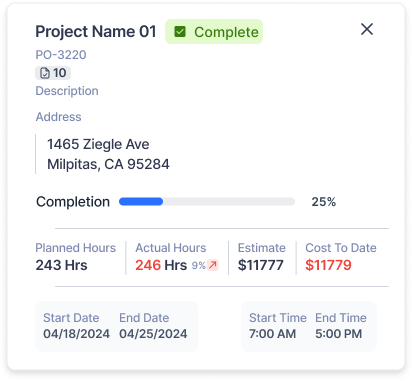
To help your business match estimated costs with actual results (as shown in the provided image), you are constructing a mandatory material-usage protocol for your field technicians. Arrange these procedural steps to create a sequence that ensures all truck-stock consumption is properly job-costed and that no materials become 'invisible overhead'.
According to the Per-Job Truck Stock Usage Tracking protocol, what should a technician do with materials that are left over after completing a service call?
You are reviewing an 'Actual vs. Estimate' report (see image) for a week of service calls. You notice that Job #402 shows a much higher profit margin than expected because the recorded material costs are near zero, yet your warehouse records show the truck was replenished for $200 worth of breakers and wire that same week. What is the most likely cause of this discrepancy?
When a technician informally transfers leftover materials from a finished job directly to a new service call, why does this create a problem for the company's financial records?
The 'Actual vs. Estimate' report (shown in the image) is a key tool for managing an electrical business. Match each business term from the tracking protocol with its correct role in ensuring these reports accurately reflect project costs.