
Learn Before
Cash Flow as a Real-Time Liquidity Measure for Contractors
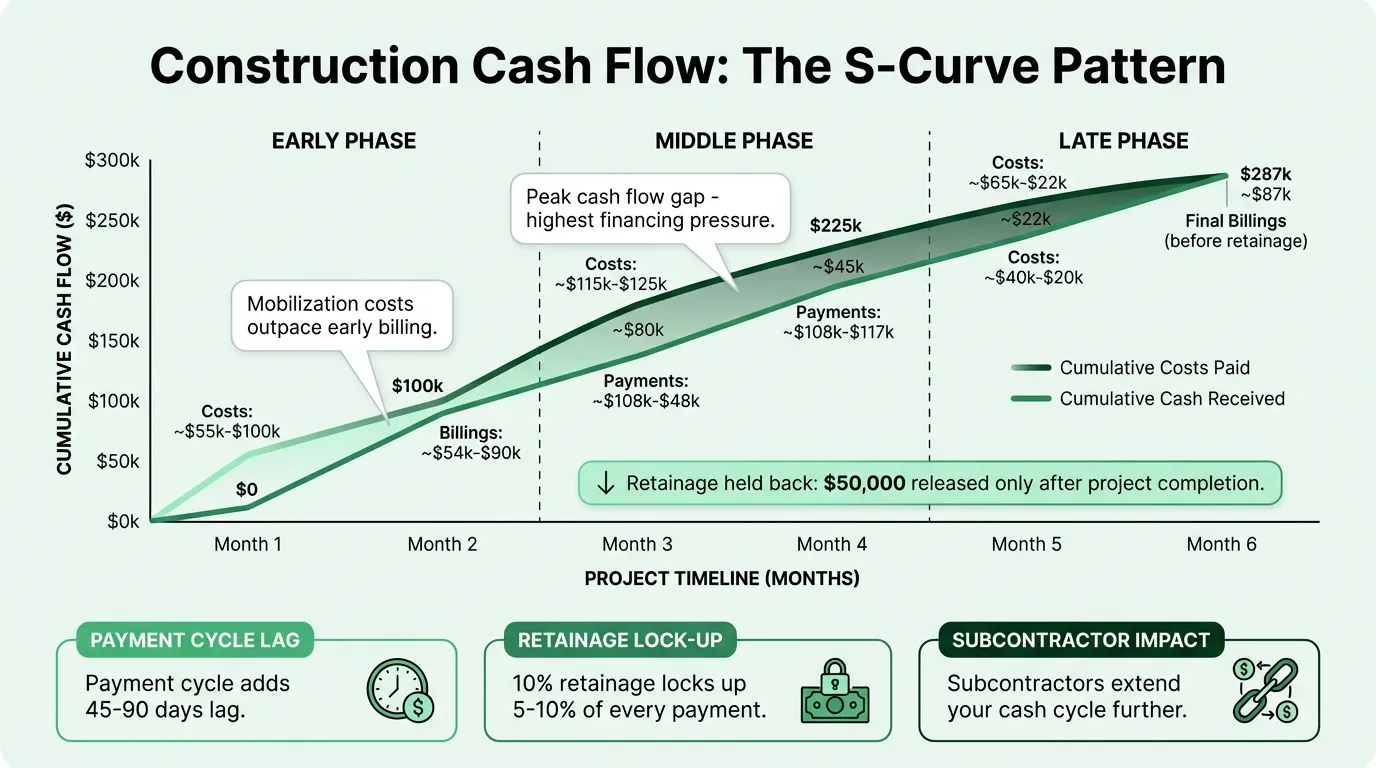
Cash flow tracks the actual movement of money into and out of a contractor's bank account on specific dates. Payroll may be due every Friday, supplier invoices on net-30, and insurance premiums on the first of the month. If collected payments have not yet arrived when those obligations hit, the contractor faces a shortfall — regardless of whether the job is profitable overall. Cash flow answers, "Can I pay what I owe today?"
0
1
Tags
Electrical Contracting Business Operations
Running an Electrical Contracting Business Course
Related
Cash Flow as a Real-Time Liquidity Measure for Contractors
A contractor who shows a healthy profit margin on a completed electrical job could not have experienced any periods of cash shortage during that same job.
An electrical contractor completes a commercial lighting upgrade and calculates a healthy profit margin for the job. However, during the third week of the project, they barely had enough money in the bank to make payroll. Which statement best explains this situation based on how profit is measured?
An electrical contractor is reviewing a recently completed commercial lighting project. Arrange the following events in the correct chronological order to demonstrate how the contractor experiences real-time cash flow versus how they ultimately calculate profit as an after-the-fact measure.
An electrical contractor is analyzing their project finances to differentiate between real-time cash availability and final profitability. Match each financial scenario or metric to its correct analytical description.
Evaluate this business scenario: An electrical contractor determines that a recent commercial build was a 'complete success' because, upon closeout, subtracting all labor, materials, and overhead from the total revenue left a highly lucrative $20,000 surplus. However, during month two of the project, the contractor's bank account was overdrawn for two weeks while waiting for a progress payment. The contractor's assessment of success is dangerously narrow because they are judging the job's overa
As a new electrical business owner, you are designing a 'Project Financial Audit' procedure to determine the ultimate success of your jobs. To ensure this process correctly treats Profit as an after-the-fact accounting measure (rather than a real-time bank balance), arrange these steps into the correct logical sequence for your workflow.
An electrical contractor completes a $5,000 commercial lighting project and receives the final payment from the customer. They have already paid $2,000 in wages to their crew. However, they are still waiting for a $500 invoice from the supply house for the fixtures and have not yet accounted for the $250 in project-specific overhead. Which action correctly applies the principle of profit as an after-the-fact measure?
In electrical contracting, why is 'Profit' defined as an 'after-the-fact' measure rather than a real-time indicator of business health?
Based on the principle that profit is an 'after-the-fact' measure, why does the provided infographic show 'Profit/Loss' as the final result at the end of the project timeline rather than as a line that is tracked daily?
Which of the following scenarios best illustrates the principle that profit in electrical contracting is an 'after-the-fact' measure?
Learn After
Progress-Billing Timing Gap Example on a $500K Electrical Project
Cash flow tracks the actual movement of money into and out of a contractor's bank account and answers the question: 'Can I pay what I owe ____?'
You just completed a commercial lighting upgrade that is highly profitable on paper. However, the general contractor has a net-60 payment term, meaning you will not receive your funds for two months. Meanwhile, your materials supplier invoice is due in 30 days, and your electricians' payroll is due this Friday. Based on the concept of cash flow, how would you describe this situation?
As an electrical contractor, you must evaluate how daily events impact your ability to pay obligations. Apply your understanding of cash flow by matching each real-time liquidity status with the business scenario it best describes.
Analyze the timeline of cash inflows and outflows on a typical project. Arrange the following events in chronological order to illustrate how an electrical contractor can experience a real-time liquidity shortfall despite the project being profitable overall.
An electrical contractor secures a 3-month project with an exceptionally high profit margin, though the client contract stipulates a single lump-sum payment 60 days after project completion. Meanwhile, the contractor must cover weekly payroll and net-30 supplier invoices. Because the project is guaranteed to be highly profitable overall, it is a sound financial judgment for the contractor to conclude that their real-time liquidity is secure and they will have sufficient funds to meet their immed
Examine the 'Construction Cash Flow Example' infographic. The red area illustrates a 'cash shortfall' where the contractor’s bank account drops below zero because project expenses hit before client payments arrive. As a business owner, you must create a new company-wide billing strategy to prevent this specific failure. Which of the following contract structures would you design to ensure your real-time liquidity remains positive throughout the entire project?
You are launching a new electrical contracting business and want to build a cash flow management protocol from scratch to prevent real-time liquidity shortfalls. Arrange the following steps in the order you would design and implement them to create the most effective protection against running out of money to meet weekly payroll and monthly supplier invoices.
Your electrical contracting business currently has $3,000 in the bank. This week, you have a $1,000 supplier invoice due on Wednesday and a $4,500 payroll for your electricians due on Friday. Although you are owed $10,000 for a job you finished last week, that payment is not scheduled to arrive for another 20 days.
Which of the following business decisions directly applies the concept of cash flow to solve this immediate liquidity problem?
In the context of running an electrical contracting business, what does the financial metric 'cash flow' primarily track?
Your electrical contracting business has $5,000 in its bank account on Monday morning. You have the following financial events scheduled for the week:
- Tuesday: A $2,000 business insurance payment is auto-drafted.
- Wednesday: You must pay a $4,000 supplier invoice for wire and conduit.
- Thursday: A client's $3,000 payment for a completed project is deposited.
- Friday: You must pay $3,500 in weekly payroll for your crew.
Applying the concept of cash flow as a real-time liquidity measur