
Contractor Profit as an After-the-Fact Measure
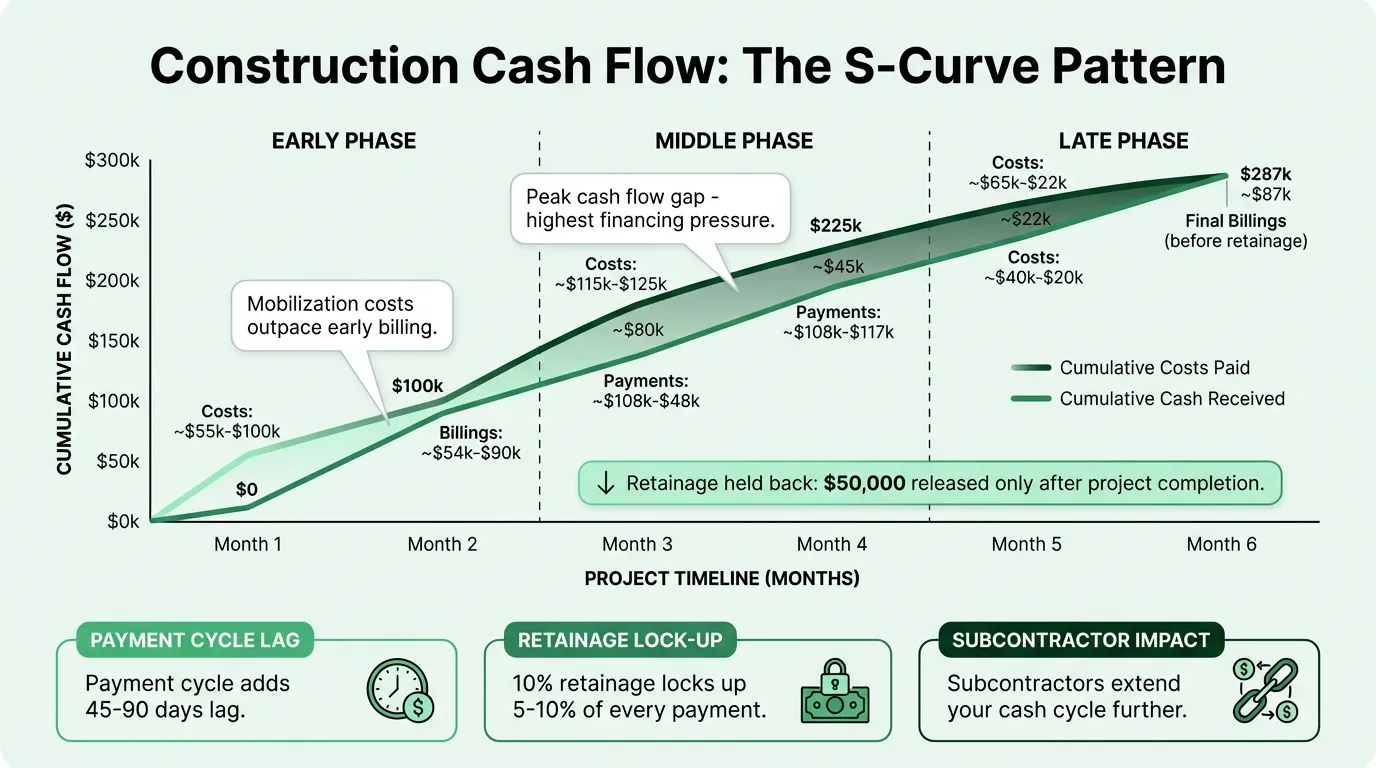
Profit is calculated only after a job is finished and every cost — labor, materials, subcontractors, permits, overhead — has been subtracted from total revenue. It is an accounting result, not a real-time bank balance. A contractor may show a healthy margin on a completed project yet have faced weeks during that project when expenses exceeded cash on hand. Profit answers the question, "Did we make money?" but says nothing about when that money was available to spend.
0
1
Tags
Electrical Contracting Business Operations
Running an Electrical Contracting Business Course
Related
Contractor Profit as an After-the-Fact Measure
A job that is profitable on paper will always generate enough cash to cover a contractor's bills, payroll, and supplier invoices on the dates those payments are due.
An electrical contractor successfully finishes a large residential rewire. The total price charged to the homeowner is $15,000, and the total cost for materials and labor is $10,000. However, the homeowner withholds the final $8,000 payment for several weeks. Meanwhile, the contractor's supplier bills and employee paychecks are due this Friday. Which statement accurately describes the contractor's situation?
Match each practical business scenario to the financial condition it best illustrates for an electrical contractor.
Analyze the financial timeline of a profitable $20,000 electrical service upgrade. Arrange the following events in chronological order to demonstrate how a contractor can experience a severe cash flow deficit despite the project's overall profitability.
A new electrical contractor reviews her first quarter results and finds that every completed job earned a healthy profit margin. However, she was forced to pay two late-payment penalties to her electrical supplier and had to delay employee paychecks twice because customer payments consistently arrived weeks after her expenses were due. When judging the most urgent financial threat to her company's survival, she should conclude that poor ____ management—not insufficient profitability—is the prima
You are designing the 'Standard Payment Terms' for your new electrical contracting business. Looking at the provided infographic, you see a common contractor trap: a company that is profitable ($50,000) but has run out of cash (-$10,000) and cannot pay its bills. To prevent this in your own company, which payment policy would you create to ensure your business stays solvent (has cash in the bank) throughout the entire lifecycle of a large project?
In the context of managing an electrical contracting business, which term refers specifically to the availability of money in the bank to pay for materials, bills, and employee wages on the exact dates those payments are due?
Review the 'Construction Cash Flow Example' infographic. Suppose an electrical contractor with $10,000 in starting capital decides to take on three of these projects simultaneously. Evaluate the validity of the contractor's reasoning: 'Profitability is the only metric that matters; since these three jobs will earn a combined $150,000 in profit, my $10,000 in the bank is more than enough to keep the business afloat until they are finished.'
Examine the provided 'Construction Cash Flow Example' infographic. It shows a business that has earned a total profit of $50,000 but currently has a 'Cash in Bank' balance of -$10,000. Which statement best explains how a contractor can be profitable while having a negative bank balance?
An electrical contractor is analyzing the financial requirements for a new $50,000 lighting retrofit project.
Financial Data:
- Starting Bank Balance: $30,000
- Upfront Material Cost: $25,000 (Paid on Day 1)
- Weekly Labor Cost: $4,000 (Paid every Friday)
- Project Duration: 4 weeks
- Projected Profit: $7,000 (Total Revenue minus all Labor, Materials, and Overhead)
- Client Payment Terms: One lump sum of $50,000 paid only after final inspection (Day 30)
Analy
Learn After
Cash Flow as a Real-Time Liquidity Measure for Contractors
A contractor who shows a healthy profit margin on a completed electrical job could not have experienced any periods of cash shortage during that same job.
An electrical contractor completes a commercial lighting upgrade and calculates a healthy profit margin for the job. However, during the third week of the project, they barely had enough money in the bank to make payroll. Which statement best explains this situation based on how profit is measured?
An electrical contractor is reviewing a recently completed commercial lighting project. Arrange the following events in the correct chronological order to demonstrate how the contractor experiences real-time cash flow versus how they ultimately calculate profit as an after-the-fact measure.
An electrical contractor is analyzing their project finances to differentiate between real-time cash availability and final profitability. Match each financial scenario or metric to its correct analytical description.
Evaluate this business scenario: An electrical contractor determines that a recent commercial build was a 'complete success' because, upon closeout, subtracting all labor, materials, and overhead from the total revenue left a highly lucrative $20,000 surplus. However, during month two of the project, the contractor's bank account was overdrawn for two weeks while waiting for a progress payment. The contractor's assessment of success is dangerously narrow because they are judging the job's overa
As a new electrical business owner, you are designing a 'Project Financial Audit' procedure to determine the ultimate success of your jobs. To ensure this process correctly treats Profit as an after-the-fact accounting measure (rather than a real-time bank balance), arrange these steps into the correct logical sequence for your workflow.
An electrical contractor completes a $5,000 commercial lighting project and receives the final payment from the customer. They have already paid $2,000 in wages to their crew. However, they are still waiting for a $500 invoice from the supply house for the fixtures and have not yet accounted for the $250 in project-specific overhead. Which action correctly applies the principle of profit as an after-the-fact measure?
In electrical contracting, why is 'Profit' defined as an 'after-the-fact' measure rather than a real-time indicator of business health?
Based on the principle that profit is an 'after-the-fact' measure, why does the provided infographic show 'Profit/Loss' as the final result at the end of the project timeline rather than as a line that is tracked daily?
Which of the following scenarios best illustrates the principle that profit in electrical contracting is an 'after-the-fact' measure?