
Current Ratio Benchmark for Contractor Reserve Health
The current ratio (current assets ÷ current liabilities) is the metric banks and surety companies use to judge whether a contractor's working capital is adequate. CFMA benchmarks the construction-industry average at 1.6. A ratio below 1.0 means current liabilities exceed current assets, signaling working-capital problems that can block bonding approval and raise borrowing costs. Tracking this ratio quarterly alongside the cash-reserve balance gives the contractor an external-facing health check that complements the internal reserve target.
0
1
Tags
Electrical Contracting Business Operations
Running an Electrical Contracting Business Course
Related
Current Ratio Benchmark for Contractor Reserve Health
When lenders and surety companies evaluate an electrical contractor for bonding or financing, what do they primarily look at to judge the contractor's financial strength?
Once your electrical contracting business secures a line of credit, it is safe to stop building actual liquid cash reserves because surety companies and lenders view available credit as equivalent to cash on hand.
Match each practical financial scenario to the specific principle of reserve funding discipline it demonstrates for an electrical contracting business.
Analyze the financial workflow required to build a reliable cash reserve. Arrange the following steps in the correct chronological order to demonstrate how an electrical contractor must handle incoming revenue to comply with both the repeatable funding habit and the minimum-bank-balance rule.
You are evaluating the financial stability of an electrical contracting firm that claims its large line of credit eliminates the need to hold cash. You must reject this strategy because surety underwriters judge the firm based on its actual balance sheet; therefore, you should correctly classify their line of credit only as a _____ layer, rather than a replacement for true liquid reserves.
Why shouldn't an electrical contractor use a line of credit to completely replace their actual liquid cash reserves?
Match each financial strategy or concept with its appropriate role in building and maintaining an electrical contractor's cash reserves.
Arrange the following actions in the correct order to demonstrate how an electrical contractor should correctly apply the reserve funding discipline upon collecting a payment from a customer.
An electrical contractor consistently transfers a fixed percentage of every collected payment into a separate reserve account, but routinely spends below their operating account's established floor balance to cover weekly payroll, using a line of credit to bridge the gap. By analyzing this financial behavior, it is accurate to conclude that the contractor is successfully practicing complete reserve funding discipline.
When evaluating the underwriting potential of an electrical contractor who replaced their liquid cash reserves with a large line of credit, you must conclude that their financial strategy is fundamentally flawed. This is because lenders and surety companies base their assessments on the business's actual ____, rather than its available credit.
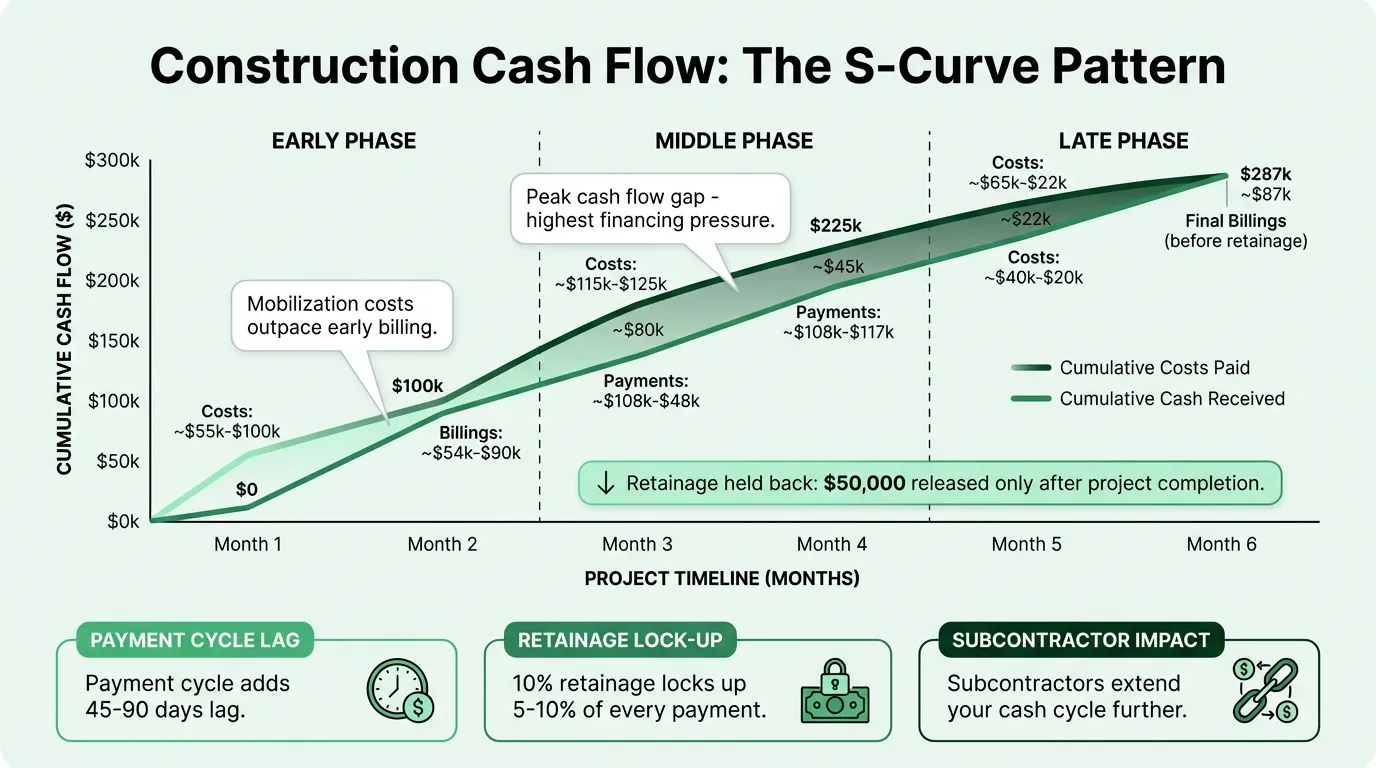
You are drafting the 'Financial Resilience Protocol' for your new electrical contracting company. Your goal is to architect a system that forces the business to build liquid reserves while protecting daily operations and ensuring you remain eligible for large-project surety bonds. Based on the volatile cash flow cycles illustrated in the infographic, which protocol design correctly synthesizes all the necessary components of reserve funding discipline?
Based on the cash flow volatility illustrated in the infographic, why is an electrical contractor practicing 'reserve funding' advised to treat an operating account floor balance as 'untouchable for routine spending'?
You are designing the 'Financial Integrity Framework' for your new electrical contracting business to withstand the extreme payment cycles shown in the infographic. To build a system that maximizes both your immediate survival and your long-term ability to win large project bonds, match each System Architecture Rule you are implementing to the Financial Vulnerability it is specifically engineered to neutralize.
Looking at the volatile payment cycles in the provided infographic, an electrical contractor decides to maintain their 5% reserve funding habit during a 'dry' period by drawing from their Line of Credit (LOC) to make the transfer. Evaluate the effectiveness of this decision for a contractor whose primary goal is to qualify for a large project surety bond.
Based on the cash flow volatility illustrated in the infographic, an electrical contractor must maintain both a 'fixed percentage' reserve habit and an 'untouchable' floor balance. Analyze why the 'fixed percentage' habit alone is structurally insufficient for protecting the business during the 'dry' periods of negative cash flow.
Learn After
When banks and surety companies evaluate an electrical contracting business, what does a current ratio below 1.0 indicate?
The construction-industry average current ratio, as benchmarked by CFMA and used by banks and surety companies to evaluate contractor financial health, is ____.
Match each current ratio concept with its correct meaning or practical implication for an electrical contracting business.
An electrical contractor with $60,000 in current assets and $75,000 in current liabilities has a current ratio that indicates strong working capital health, which will likely satisfy a surety company's requirements for bond approval.
Analyze the causal chain of financial deterioration for an electrical contractor. Arrange the following events in the logical sequence that illustrates how a shift in working capital leads to external operational restrictions.
An electrical contractor currently has $110,000 in current assets and $100,000 in current liabilities, giving a current ratio of 1.1—well below the construction-industry benchmark of 1.6. The contractor needs to strengthen this ratio before applying for a surety bond on a large commercial project next quarter. Which of the following actions should the contractor prioritize to most effectively improve the current ratio for bond approval?
As the owner of a new electrical contracting business, you are designing a 'Quarterly Financial Health Review' policy to satisfy banks and surety companies while maintaining your internal goals. Which of the following policy designs most effectively synthesizes industry standards with your internal operational tracking?
To calculate the 'current ratio' used by banks and surety companies to evaluate an electrical contractor’s working capital, which two financial categories must be divided?
In a professional financial management system for an electrical contractor, the current ratio is an 'external-facing' health check that is specifically intended to complement which internal measure?
Why would a surety company consider an electrical contractor with a current ratio of 1.1 to be a higher financial risk than a contractor with a ratio of 1.6, even if both businesses have the same amount of cash in their bank accounts?
According to industry benchmarks like the CFMA, which current ratio value is considered the construction-industry average for assessing an electrical contractor's working capital health?
Match each current ratio component or value with its specific significance for an electrical contractor's financial health.
Rank these three electrical contracting businesses from strongest to weakest financial health based on their current ratios (calculated as current assets divided by current liabilities), keeping in mind the industry benchmark of 1.6.
Suppose an electrical contractor has $$150,000 in current assets and $$100,000 in current liabilities. If the contractor uses $$60,000 of their cash to buy a new specialized service truck outright, their current ratio will fall below 1.0, likely leading surety companies to block bonding for future projects.
An electrical contractor with a current ratio of 1.4 claims their business meets the 'average' financial health standard for the construction industry. Based on the CFMA benchmark of ____, the contractor's self-evaluation is incorrect because their ratio is still below the industry average.
Which external entities primarily analyze an electrical contractor's current ratio to judge whether their working capital is adequate for bonding approval and borrowing costs?
How does tracking the current ratio quarterly complement an electrical contractor's internal cash-reserve goals?
Match each electrical contractor's financial scenario with the most likely assessment a surety company would make regarding their bonding health, based on the industry benchmark of 1.6.
An electrical contractor currently has $150,000 in current assets and $100,000 in current liabilities, resulting in a current ratio of 1.5. Rank the following independent business actions from the one that results in the highest (healthiest) current ratio to the one that results in the lowest (least healthy) current ratio.
An electrical contractor who only monitors their internal cash-reserve targets decides that calculating a quarterly current ratio is unnecessary for evaluating their business health. This reasoning is correct because internal reserve targets and the current ratio (CFMA benchmark of 1.6) are redundant metrics that provide the same evaluation to banks and surety companies.