
Learn Before
Electrical Contractor Job Costing
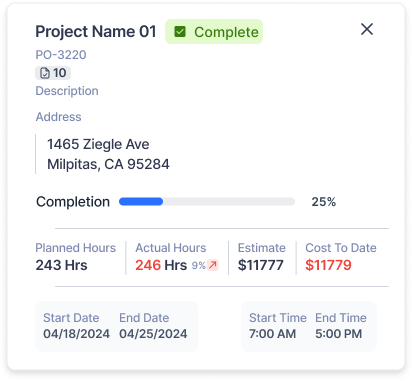
Electrical contractor job costing is the process of assigning the labor, materials, equipment, overhead allocation, purchases, time entries, and other direct expenses of a specific electrical job to that job, then comparing the actual cost with the estimate. Its purpose is to reveal whether the job is financially on track before profit erosion is hidden inside companywide bookkeeping.
0
1
Tags
Electrical Contracting Business Operations
Running an Electrical Contracting Business Course
Related
Electrical Contractor Job Costing
Gross Margin by Electrical Job Type
Overhead Percentage KPI for Electrical Contractors
Billable Utilization Rate for Electrical Crews
WIP Report for Contractor Project Performance
Job-Cost Dashboard Basics for Electrical Contractors
Match each key performance indicator (KPI) to the business question it helps an electrical contractor answer.
When an electrical contractor reviews their performance metrics, they notice that their gross profit margin is consistently high, but their utilization rate is low. What does this combination indicate about their business operations?
Arrange the steps an electrical contractor should take to apply job-cost data to correct a recurring profitability issue on commercial lighting projects.
An electrical contractor reviewing their job-cost dashboard notices that their gross margin remains stable on recent projects, but their crew utilization rate has steadily declined over the past quarter. Based on this evidence, the most appropriate operational change is to adjust material pricing on future estimates.
An electrical contracting owner evaluates their performance metrics and sees that the crew's utilization rate is excellent, meaning electricians are consistently working on billable tasks. However, the job-cost reports reveal that the gross margin on these jobs is consistently too low to cover overhead. Judging that the field execution and scheduling are not the problem, the owner must use this evidence to justify raising their ________.
An electrical contractor realizes that despite having accurate initial estimates, actual costs for commercial retrofits consistently exceed projections by the end of the project, leading to poor gross margins. Simultaneously, the utilization rate is low due to crews frequently waiting for specialized lifts that were not scheduled in advance. The owner needs to design a new operational feedback loop to prevent these specific issues. Which of the following proposed workflows best synthesizes estim
Review the 'Actual vs. Estimate' report provided in the image for a recently completed residential wiring project. You notice that while your material costs were close to the budget, your labor costs were nearly 40% higher than you had originally estimated. How should you apply this performance metric to your next similar project bid?
Your electrical business's monthly dashboard shows the following performance metrics:
- Gross Profit Margin: 42% (Target: 40%)
- Utilization Rate: 82% (Target: 75%)
- Overhead Percentage: 38% (Target: 25%)
Despite your crews working efficiently and your jobs being priced correctly for profit, your business is struggling to generate a net profit. Based on these metrics, which management action should you apply to fix this specific issue?
Review the 'Actual vs. Estimate' report provided in the image. Your Project Manager claims the job was a 'perfect success' because the final cost ($1,340) was lower than the total estimate ($1,475). As the business owner, how should you evaluate the validity of this claim to improve your operational accuracy?
What are the three essential Key Performance Indicators (KPIs) that an electrical contractor should track to gain business clarity and make decisions based on evidence rather than guessing?
Learn After
Job Number Discipline in Electrical Job Costing
Estimate Actual Result Loop for Electrical Jobs
Estimated Versus Actual Labor for Electrical Jobs
Estimated Versus Actual Materials for Electrical Jobs
Estimates Versus Actuals Report for Electrical Job Items
What is the primary purpose of job costing in an electrical contracting business?
An electrical contractor can accurately identify if a specific wiring project is experiencing profit erosion just by reviewing their companywide bookkeeping.
You are setting up the job costing for a new commercial wiring project. Match each specific expense incurred during the project to the correct job costing category it must be assigned to.
An electrical contractor suspects that a recent commercial wiring project is losing money, even though the company's overall bank balance appears stable. Analyze the job costing process and arrange the necessary steps the contractor must take to isolate and identify the financial performance of this specific project.
An electrical contractor evaluates the end-of-month financials. The companywide bookkeeping shows a healthy net profit overall. However, a detailed job costing review of a specific warehouse lighting project reveals that its assigned labor, materials, and equipment expenses were significantly higher than budgeted. The contractor evaluates this discrepancy and correctly identifies that the warehouse project is actually experiencing ________, a critical financial issue that the overall company pro
You are designing a custom 'Profit Protection' system for your new electrical company. To ensure you can see exactly where your money is going on every project, arrange the following steps in the correct order to construct a functional job-costing workflow from start to finish.
You are designing a 'Profit Integrity System' for your electrical company to prevent the type of labor overage shown in the provided image from going unnoticed on future projects. Which of the following system designs would most effectively integrate your field operations with your financial tracking to create an 'early warning' for profit erosion?
The provided image shows a significant labor overage on a commercial lighting job (3,400 estimated vs. 5,200 actual hours). To prevent this from ruining your company's overall profitability, you must construct a 'Project Recovery Strategy' for the remaining phases of the project. Arrange the following steps in the correct order to design and implement this financial intervention.
Review the provided chart comparing estimated versus actual labor hours for an electrical project. If your company's overall monthly bookkeeping shows that the business is profitable, what is the primary insight this specific job costing data provides to you as a business owner?
Review the provided labor report for an electrical project that has just completed the 'Underground' phase. Despite the 1,800-hour overage shown in the image, your company's overall bookkeeping indicates that the business is currently profitable. Analyze this discrepancy and identify the primary risk of relying solely on the company-wide financials instead of this project-specific job costing data.