
Learn Before
Example of a Factorial Design Table
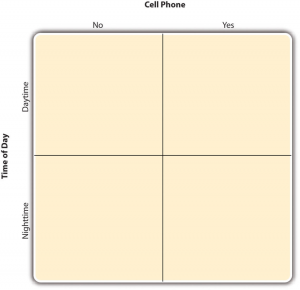
A factorial design table visually represents the different combinations of independent variables in an experiment, where the columns typically represent the levels of one variable and the rows represent the levels of another. For example, in a factorial design investigating the effects of cell phone use and time of day on driving ability, the table creates four distinct cells representing the four possible experimental conditions: using a cell phone during the day, not using a cell phone during the day, using a cell phone at night, and not using a cell phone at night.
0
1
Tags
KPU
Research Methods in Psychology - 4th American Edition @ KPU
Related
Factorial Design Notation
Main Effect
Example of a Factorial Design Table
Between-Subjects Factorial Design
Within-Subjects Factorial Design
Mixed Factorial Design
Non-Experimental Factorial Design
Graphing Factorial Experiments
Factorial ANOVA
Example of a Non-Manipulated Independent Variable: Private Body Consciousness
Interaction Effect
Example of a Factorial Design
Example of a Factorial Design
What is the defining characteristic of a factorial design?
In a factorial design, researchers evaluate multiple independent variables by testing each one in separate, isolated conditions rather than combining them.
A social psychologist is designing an experiment to study how room temperature (Cold or Warm) and group size (Alone, in a Pair, or in a Small Group) influence social anxiety. Match each component of the study to its correct description within this factorial design.
A methodology review board is critiquing several proposed study designs for their ability to evaluate the complex joint effects of factors: Room Temperature and Task Difficulty. Rank the following proposals from the least robust to the most robust strategy for achieving a complete evaluation of all possible factor combinations.
A researcher is formulating a factorial design to study how Social Support (Present vs. Absent) and Stress Level (High vs. Low) influence physical health. Arrange the following steps in the correct logical sequence to construct the complete experimental architecture for this factorial approach.
A cognitive psychologist is designing a study to investigate how Study Environment (Noisy vs. Quiet) and Study Method (Spacing vs. Cramming) influence exam performance. If the researcher decides to employ a factorial design, what does this imply about the structure of the experimental conditions?
A social psychologist is designing a study to test how Room Temperature (Cold, Room Temp, Hot) and Task Type (Mental, Physical) influence irritability. If the researcher uses a full factorial design to ensure every level of temperature is combined with every level of task type, the study will consist of _____ unique experimental conditions.
In a factorial design, every level of one independent variable is systematically combined with every level of the other independent variables, such that each unique combination of these levels forms a distinct _____ within the experiment.
In a study investigating the effects of participant major (psychology vs. nutrition) and food type (cookie vs. hamburger) using a factorial design, a researcher must structure the study with exactly distinct conditions because the design requires combining every level of the major factor with every level of the food type factor.
A researcher is planning a study with multiple independent variables. Match each design or analysis decision to the correct methodological evaluation or justification.
Define a factorial design as it is used in experimental research. In your definition, explain how independent variables (factors) and their levels are structured to form the conditions of the experiment.
Based on this scenario, explain how the researcher must combine these factors to structure the study as a factorial design. Identify the specific factors, their levels, and list all the resulting distinct conditions that must be created.
A cognitive psychologist is designing a memory experiment with two independent variables: Study Environment (Quiet vs. Noisy) and Study Method (Spacing vs. Cramming). Applying the principle of a factorial design, how many distinct experimental conditions must they create, and what are these conditions?
Learn After
In an experimental layout table like the one shown, what is represented by the individual cells formed where a row and a column meet?
Imagine you are designing a new psychological study using the factorial design table structure shown in the image. Your study explores the effects of Room Color (Red vs. Blue) and Music Presence (Music vs. Silence). You assign Room Color to the columns (Column 1: Red, Column 2: Blue) and Music Presence to the rows (Row 1: Music, Row 2: Silence). Match the logical cell coordinates in your table to the specific experimental conditions they would contain.
To add a third level to the 'Time of Day' variable (e.g., 'Dusk') in the factorial design table shown, a researcher would only need to add additional cell to the grid to represent the new experimental condition.
Suppose you are peer-reviewing a researcher's draft of a table representing a $2 \times 2$$ factorial study. To evaluate whether the table is internally consistent and correctly captures the research design, arrange the following evaluative steps in their correct logical sequence.
In the standard visual layout of a factorial design table, which components are used to represent the levels of the independent variables?
In psychological research, a factorial design table is a visual tool used to organize complex experiments. Using the provided example image, match each visual component of the grid to the conceptual element it represents in a research study.
In a 2 × 2 factorial design, the design table contains _____ distinct cells, each representing a unique combination of the levels of the two independent variables.
A researcher studying the effects of noise level (quiet vs. loud) and lighting condition (bright vs. dim) on reading comprehension creates a factorial design table with noise level represented by the columns and lighting condition represented by the rows. This table will contain exactly 4 cells, with each cell representing one unique experimental condition.
A researcher expands the original cell phone and driving study by adding a third independent variable — road type (highway vs. city street), also with 2 levels. To represent every unique combination of conditions in the new factorial design table, the researcher would need _____ total cells.
A classmate submits a factorial design table for a study on exercise frequency (low vs. high) and sleep duration (4 hours, 6 hours, or 8 hours) and asks you to evaluate whether the table is correctly constructed. Arrange the following evaluation steps in the most logical order, from first to last.
Describe the visual structure of a factorial design table. In your description, explain what the columns, rows, and individual cells represent conceptually, and illustrate this using the example of a factorial design investigating cell phone use and time of day.
Based on the provided case, explain how the researcher should construct their factorial design table. Detail what the columns, rows, and cells will represent, and specify the exact experimental conditions that will occupy the cells.
Suppose you are setting up a factorial design experiment with the independent variables cell phone use (using vs. not using) represented by columns and time of day (day vs. night) represented by rows. Apply this layout to list the four specific experimental conditions represented by the cells in the table.