
Late-Stage Collection and Legal Remedies for Electrical Receivables
At 60 days past due, send a written demand letter and evaluate whether mechanics-lien rights apply to the project. Lien filing deadlines and procedures differ by state, so a construction attorney in the project's state should be consulted before filing. At 90+ days, consider turning the account over to a collections agency or initiating legal action. Throughout late-stage efforts, the contractor must stay professional and lawful—threatening, harassing, or misrepresenting a debt violates fair-debt-collection standards and can damage the contractor's reputation.
0
1
Tags
Electrical Contracting Business Operations
Running an Electrical Contracting Business Course
Related
Late-Stage Collection and Legal Remedies for Electrical Receivables
When a customer's invoice reaches 45 days past due, who should you contact by phone to discuss payment?
As an electrical contractor, arrange the following mid-stage collection actions in the correct chronological order to progressively escalate an unpaid invoice.
As an electrical contractor managing overdue accounts, match each specific customer scenario with the most appropriate mid-stage collection action.
An electrical contractor is reviewing a commercial customer's account with an invoice that is 38 days past due. To effectively escalate the collection, the correct procedural step at this exact stage is to bypass further written correspondence and immediately call the customer's accounts payable department to demand full payment.
An electrical contractor is evaluating why their mid-stage collections are failing at the 45-day mark. They discover that their office staff is simply sending repeated emails to the clients' accounts payable departments. Judging this approach to be ineffective for securing overdue funds or negotiating structured payment plans, the contractor implements a new policy. To properly escalate the issue, the new policy requires staff to bypass accounts payable and place a phone call directly to the ___
You are formulating a 'Resolution Call Script' for your electrical contracting business to handle invoices that have reached the 45-day mark. Which of the following script drafts most effectively integrates all the required elements of mid-stage escalation to reach a constructive payment agreement?
An electrical contractor implements a policy to only send formal past-due letters for all overdue accounts until they reach 60 days, reasoning that 'avoiding phone calls prevents awkward confrontations and maintains a strictly professional paper trail.' How would you evaluate the effectiveness of this policy for an invoice that is currently 48 days past due?
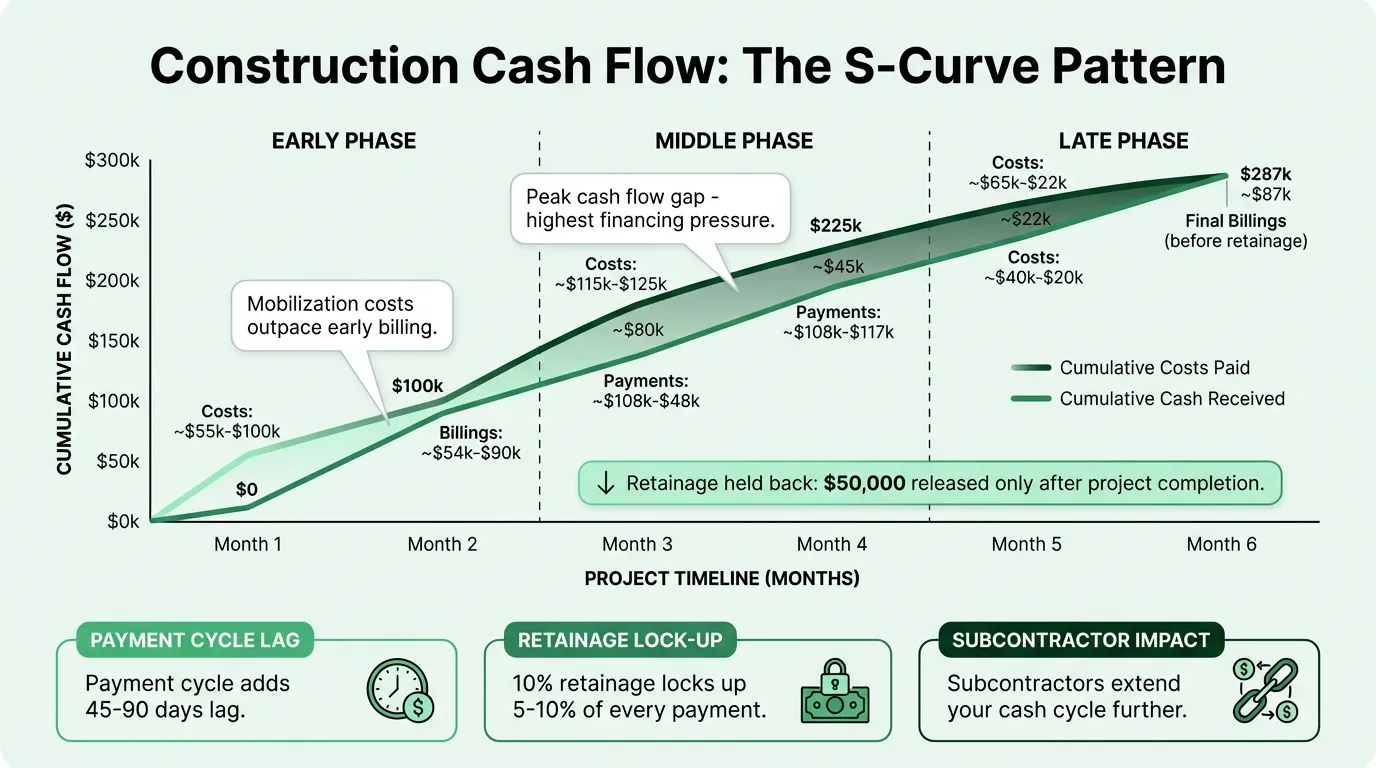
Review the provided cash flow infographic, which illustrates the 'Cash Flow Gap' between when an electrical contractor pays for labor and materials (outflow) and when they finally receive payment (inflow).
If a contractor has an invoice that reaches 45 days past due, how does the protocol's requirement to call a 'Decision-Maker'—rather than just 'Accounts Payable'—specifically analyze and address the financial risk depicted in the Month 3 gap?
An electrical contractor is reviewing their collection procedures. For a commercial invoice that is 45 days past due, an office assistant suggests calling the customer’s Accounts Payable department rather than the business owner (the decision-maker), arguing that 'it is better to stay in the clerk’s good graces since they are the ones who actually process the payments.'
How should the contractor evaluate the effectiveness of this assistant's reasoning?
In the mid-stage collection escalation process for an electrical contractor, at what point should the contractor send a formal past-due letter that references the original due date and the specific late-fee terms found in the contract?
Learn After
When a customer's invoice for electrical contracting work is 60 days past due, which action should the contractor take?
Match each late-stage collection timeframe or concept with the appropriate action or guideline an electrical contractor should follow.
An electrical contractor has a client who is 95 days past due on a large commercial project. Frustrated by the lack of communication, the contractor leaves a voicemail threatening to send a crew to uninstall the electrical fixtures if payment is not received by Friday. This is an acceptable late-stage collection escalation.
An electrical contractor finished a commercial wiring project two months ago, but the client has ignored all payment reminders. The invoice is now 60 days past due. Analyze this scenario and arrange the contractor's escalation steps in the most strategically and legally sound order.
An electrical contractor evaluates a commercial account that is 60 days past due. Determining that simple written demands are no longer sufficient, the contractor decides to escalate the matter by consulting a state-specific construction attorney to evaluate their rights to file a mechanics ____ against the project property.
When an electrical contractor's invoice reaches 90 days past due, the recommended first step is to send a written demand letter and evaluate whether a mechanics lien may apply.
An electrical contractor completed a commercial project, but the client's final invoice has now reached 65 days past due. Up to this point, the contractor has only sent standard email reminders. Frustrated by the delay, the contractor wants to take decisive action. According to best practices for late-stage collections, which of the following is the most appropriate next step?
Arrange the recommended actions for managing late-stage electrical receivables in the correct chronological order as an unpaid invoice ages from 60 days to over 90 days past due.
An electrical contractor is reviewing several delinquent accounts and needs to determine the appropriate next steps. Analyze each scenario and match it with the correct late-stage collection strategy or legal assessment.
An electrical contractor has a commercial invoice that is 97 days past due. Rather than referring the account to a collections agency or consulting an attorney about legal action, the contractor begins calling the client daily, implies the outstanding balance is larger than it actually is, and threatens consequences they have no real intention of pursuing. After evaluating this contractor's conduct, a construction attorney would most likely conclude that these actions — specifically the misrepre
You are establishing a formal 'Late-Stage Delinquency Policy' for your new electrical contracting business. Which of the following integrated plans correctly synthesizes the legal, procedural, and ethical requirements for handling accounts once they cross the 60-day mark?
An electrical contractor completed a residential wiring project, but the final payment of $4,500 is now 92 days past due. The contractor has already sent a formal demand letter and attempted several polite follow-ups without success. According to best practices for late-stage collections, which action is most appropriate for the contractor to take now?
An electrical contractor decides to skip the 60-day evaluation of mechanics lien rights, choosing instead to wait until the invoice is 95 days past due before hiring a collections agency. Which statement best evaluates the strategic risk of this decision?
Based on the provided cash flow infographic, an electrical contractor is currently in the deepest part of the 'cash gap' (negative territory) and needs to recover funds to keep the business running. They have two delinquent accounts:
- Project A: 62 days past due ($12,000). No action has been taken yet.
- Project B: 98 days past due ($4,000). A demand letter was sent 30 days ago.
The contractor decides to immediately hire a collections agency for Project A to maximize their potential cash re
When an electrical contractor reaches the 60-day mark for an unpaid invoice, they are advised to evaluate mechanics-lien rights and consult a construction attorney in the project's state. Which of the following best explains the reasoning behind this specific recommendation?