
Slow Payment Scale in the U.S. Construction Industry
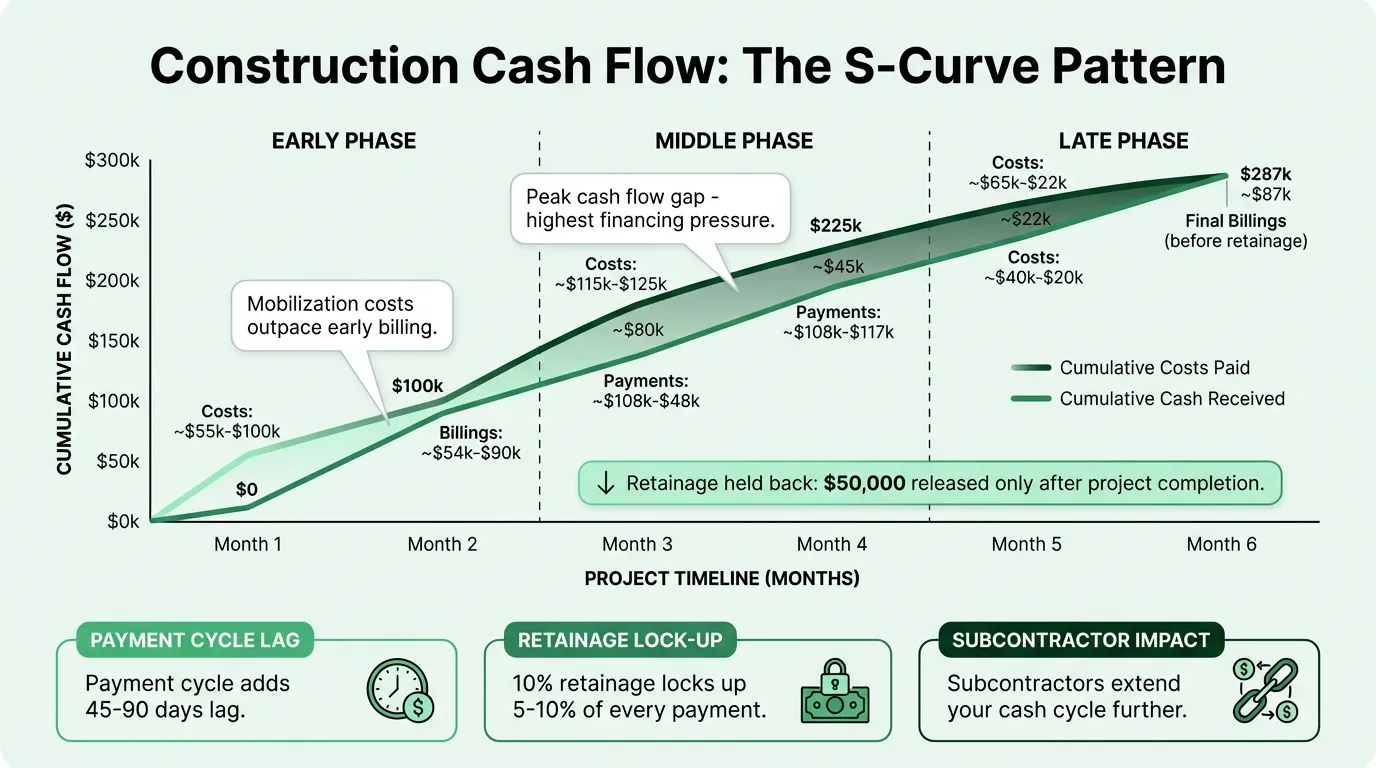
Slow payments cost the U.S. construction industry an estimated $280 billion in 2024, and 82% of general contractors report payment delays exceeding 30 days. Electrical subcontractors face these same delays because their invoices pass through a GC payment chain before reaching the owner's accounts-payable desk. The scale of the problem underscores why proactive cash-flow tools—deposits, progress billing, and a collections workflow—are operational necessities rather than optional best practices.
0
1
Tags
Electrical Contracting Business Operations
Running an Electrical Contracting Business Course
Related
Slow Payment Scale in the U.S. Construction Industry
In electrical contracting, costs such as materials, crew wages, and equipment rental are described as ____ because they must be paid before the contractor receives any payment from the customer or general contractor.
Which scenario best demonstrates the 'front-loaded' cost structure typical in an electrical contracting business?
You are managing a commercial lighting retrofit. To demonstrate how the structural cash-timing mismatch forces you to finance the job upfront, arrange the following financial events in the correct chronological order.
Analyze the structural cash-timing mismatch in electrical contracting by matching each operational scenario to its specific impact on the business's cash flow.
It is a financially sound decision for an electrical contractor to accept a highly profitable commercial project with net-60 payment terms and no upfront deposit, even without adequate cash reserves, because the project's high paper profit margin will inherently protect the business from financial distress during the material-intensive installation phase.
In electrical contracting, a contractor typically pays for materials, crew wages, and equipment costs before receiving payment from the customer or general contractor.
You recently won a commercial electrical project and are preparing to start work next week. According to the typical cost structure of electrical contracting, which of the following best describes your expected cash flow situation during the first few weeks of the project?
You have just won a bid for a commercial electrical project and need to plan your cash flow. Arrange the following events in the chronological order they will typically occur, illustrating the structural cash-timing mismatch you will experience.
Analyze the components of the structural cash-timing mismatch in electrical contracting by matching each business factor to its specific impact on the contractor's cash flow.
You are an electrical contractor evaluating two commercial bids. Project X offers an impressive 22% profit margin but requires you to complete 60 days of work before your first invoice will be processed. Project Y offers a modest 14% profit margin but includes a 25% upfront mobilization payment. To minimize the severe out-of-pocket financing risks caused by the industry's structural cash-timing mismatch, you determine that Project ____ is the safer business decision.
You must formulate a cash flow management plan for an upcoming commercial electrical project. To counteract the industry's structural cash-timing mismatch, you need to combine practices that address material purchases, equipment usage, and billing. Which combination of practices constructs the most effective strategy to avoid financing the project out of pocket?
Study the provided infographic showing the relationship between 'Cumulative Cost' and 'Cumulative Revenue' over a project's timeline. In electrical contracting, which of the following strategies identifies the most effective way to narrow the financial gap between these two lines by addressing the timing of the business's costs?
Study the provided infographic, which tracks 'Cumulative Cost' and 'Cumulative Revenue' over the course of a project. A peer contractor argues: 'The front-loaded cost structure is not a real risk for my business; I simply bid with a higher profit margin to ensure I never run out of money while the work is being performed.'
Based on the evidence in the infographic, which of the following is the most accurate evaluation of this argument?
Study the provided infographic, which tracks 'Cumulative Cost' (blue line) and 'Cumulative Revenue' (green line) over the course of a project. Analyze the red shaded area representing the 'Net Cash Flow' deficit. Why does this financial gap exist even in a project that is projected to be profitable (where final revenue exceeds total cost)?
Your electrical contracting business has just won a contract to install a backup generator at a local medical clinic for a total price of $15,000. According to your estimate, you must pay $7,500 for the generator unit upon delivery in week one, and you will owe $3,000 in total labor wages by the end of week two. If you submit your invoice immediately after finishing the work in week two, and the clinic's payment terms are 'Net 30', how much cash must you have available to cover these front-lo
Learn After
In 2024, how much did slow payments cost the U.S. construction industry overall?
In the U.S. construction industry, 82% of general contractors report experiencing payment delays that exceed 30 days.
Match each industry reality regarding slow payments with the business understanding an electrical contractor must have to manage them effectively.
Scenario: You are an electrical subcontractor taking on a commercial job. Knowing that your invoices will pass through a lengthy general contractor payment chain, arrange the following operational practices in the chronological order you should apply them to proactively protect your business's cash flow.
Scenario: An electrical subcontractor analyzes the root cause of their recurring cash-flow crises on commercial jobs. By mapping out the payment cycle, they realize their invoices are structurally delayed because they must pass through a general contractor's payment chain before ever reaching the property owner. Concluding that waiting until the end of the project to invoice is financially unviable, the subcontractor decides they must submit invoices for portions of the project as the work advan
Scenario: A new electrical subcontractor has completed three small residential side jobs without any payment problems. Based on this experience, the contractor tells a colleague: 'I don't need deposits, progress billing, or a collections process. I've never had a customer pay late, so those steps are just unnecessary overhead that slows down my business.' Which of the following is the strongest critique of this contractor's reasoning?
Which of the following are identified as proactive cash-flow tools that are operational necessities for electrical subcontractors dealing with industry-wide payment delays?
Based on the standard payment structure of the U.S. construction industry, arrange the typical path an electrical subcontractor's invoice takes, which illustrates why they frequently experience severe payment delays.
You have just won a large commercial wiring contract. To simplify your new company's bookkeeping, you decide to wait and submit one comprehensive invoice to the general contractor only after the project is 100% complete. In the context of the U.S. construction industry, this is a sustainable operational strategy.
Because electrical subcontractors are subject to the structural delays of the construction industry's payment chain, managing cash flow requires dissecting the project lifecycle and applying specific tools to different financial vulnerabilities. Match each proactive cash-flow tool to the specific operational vulnerability it is designed to neutralize.
Considering that 82% of general contractors report payment delays and slow payments cost the industry $280 billion annually, an electrical contractor who evaluates their business risk must judge that proactive tools like progress billing are an operational ____ for survival, rather than an optional best practice.
You are formulating a new Standard Operating Procedure (SOP) to defend your electrical contracting business against the structural payment delays endemic to the U.S. construction industry. Construct a proactive cash-flow management workflow by arranging the following operational policies into the logical sequence they must be executed throughout a project.
According to industry reports from 2024, what percentage of general contractors in the U.S. report experiencing payment delays that exceed 30 days?
Based on the cash-flow timeline and the 'Gaps' illustrated in the provided infographic, construct a proactive financial protection strategy to survive the $280 billion slow-payment problem endemic to the U.S. construction industry. Sequence these operational actions in the order they must be executed from the initial contract phase through project completion.
In the U.S. construction industry, the 'GC payment chain' means that an electrical subcontractor’s invoice must be approved and processed by the General Contractor (GC) before it reaches the owner for payment. Analyze this structure in the context of the cash flow 'Gap' shown in the infographic. Why does the industry-wide scale of slow payments—costing $280 billion annually—create a more severe financial threat for the subcontractor than for the party at the top of the chain?
You are preparing a bid for a $30,000 warehouse wiring project. Knowing that of general contractors in the U.S. report payment delays exceeding , which billing strategy should you implement to protect your business from the structural 'gap' shown in the infographic?