
The £40 Isocost Line (FG)
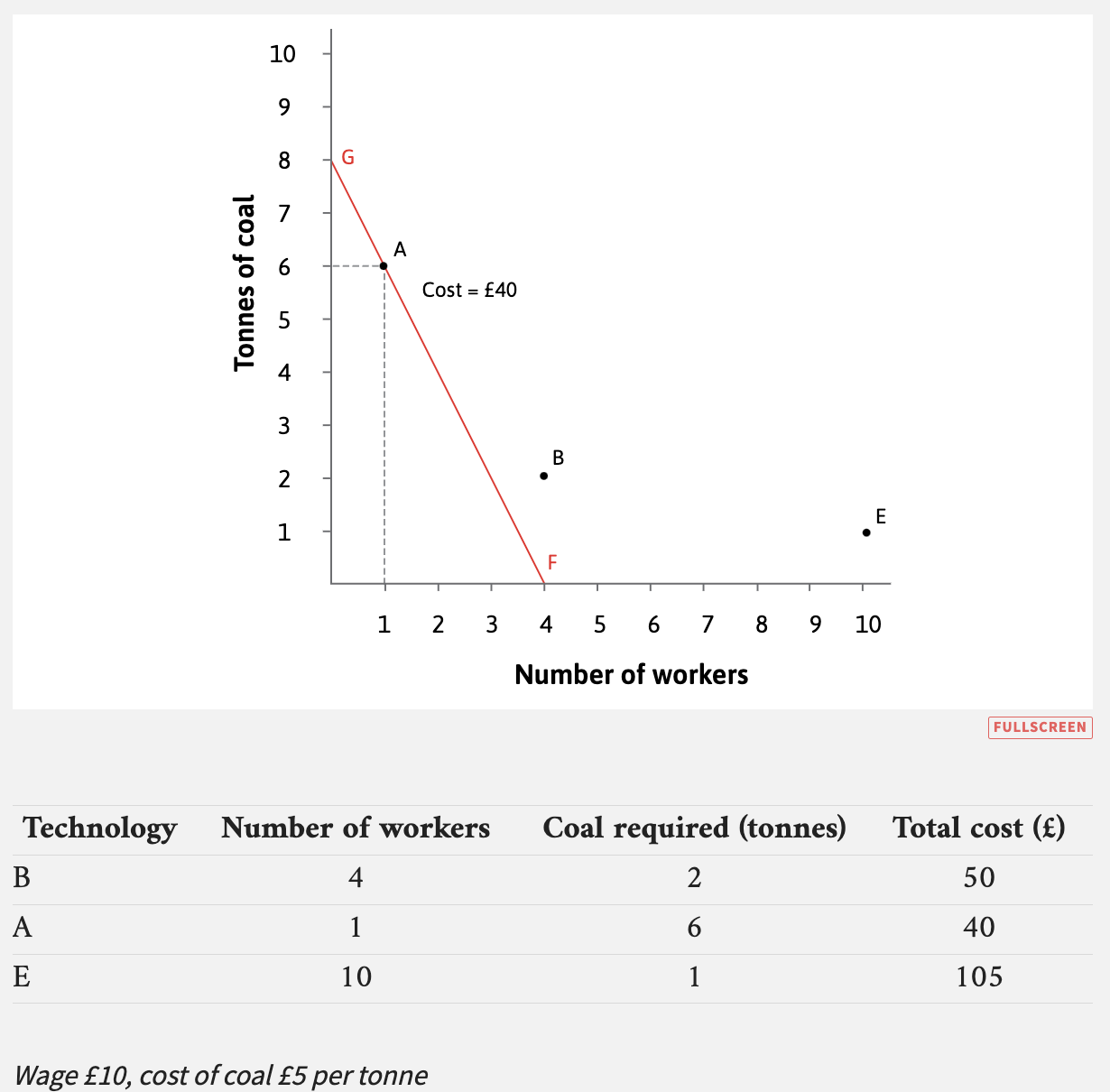
The isocost line labeled FG illustrates all input combinations of labor and coal that yield a total production cost of £40. In a diagram where the number of workers is on the horizontal axis and tons of coal are on the vertical axis, this line passes through point G (0 workers, 8 tons of coal), point A (1 worker, 6 tons of coal), and point F (4 workers, 0 tons of coal).
0
1
Contributors are:


Who are from:


Tags
Social Science
Empirical Science
Science
Economy
CORE Econ
Economics
Introduction to Microeconomics Course
The Economy 2.0 Microeconomics @ CORE Econ
Ch.2 Technology and incentives - The Economy 2.0 Microeconomics @ CORE Econ
Related
The £40 Isocost Line (FG)
Using Isocost Lines to Compare Production Technologies
Cost-Effective Production Choice
A firm needs to produce 100 metres of cloth and has five production methods available, each using a different combination of labor (workers) and energy (tonnes of coal). The input requirements for each method are shown in the table below.
Method Workers Tonnes of Coal A 1 10 B 2 5 C 4 6 D 5 3 E 10 1 A production method is considered inefficient if another available method can produce the same output using less of at least one input without using more of the other. Based on this principle, which method is clearly inefficient?
A firm can produce 100 metres of cloth using five different methods, each with a unique combination of labor and energy inputs as shown in the table. Match each description of a production strategy to the corresponding method.
Method Workers Tonnes of Coal A 1 10 B 2 5 C 4 6 D 5 3 E 10 1 A firm can produce 100 metres of cloth using five different methods, each with a unique combination of labor and energy inputs as shown in the table. Match each description of a production strategy to the corresponding method.
Method Workers Tonnes of Coal A 1 10 B 2 5 C 4 6 D 5 3 E 10 1 Evaluating Production Efficiency
A textile firm can produce 100 metres of cloth using any of the five methods shown in the table below, which specify the number of workers and tonnes of coal required.
Method Workers Tonnes of Coal A 1 10 B 2 5 C 4 6 D 5 3 E 10 1 Statement: A profit-maximizing firm would never choose Method D, regardless of the price of labor and the price of coal.
Optimal Production Technology Selection Process
A firm can produce 100 metres of cloth using any of the five methods shown in the table, which specifies the number of workers and tonnes of coal required.
Method Workers Tonnes of Coal A 1 10 B 2 7 C 4 4 D 7 2 E 10 1 Initially, the wage for a worker is £10 and the price of coal is £20 per tonne. Later, the wage increases to £40 per worker and the price of coal falls to £5 per tonne. How does the firm's most cost-effective choice of production method change in response to these new input prices?
A firm can produce a specific quantity of cloth using five different production methods. Each method uses a combination of two inputs: labor (number of workers) and energy (tonnes of coal). The input combinations for the methods are: Method A (2 workers, 8 tonnes), Method B (3 workers, 5 tonnes), Method C (5 workers, 6 tonnes), Method D (6 workers, 3 tonnes), and Method E (8 workers, 2 tonnes). A method is considered inefficient if another available method can produce the same output using less of at least one input without using more of the other. Based on this principle, which method would a cost-minimizing firm never select, regardless of the price of labor and energy?
Proposing a New Production Technology
Example Calculation of Isocost Slope (w=£10, p=£5)
Impact of Cheaper Coal on Relative Production Costs
The £40 Isocost Line (FG)
A firm can produce a specific quantity of output using different combinations of labor and coal. The wage for one worker is £10, and the price for one ton of coal is £5. Given the following production options, which one represents the lowest total cost for the firm?
Production Technology Choice with Changing Input Prices
Cost-Minimization Decision
A factory manager is considering different ways to produce a certain amount of goods. The wage for a worker is £10 per day, and the price of coal is £5 per ton. To keep the total daily production cost the same, if the manager decides to hire one fewer worker, they can instead use an additional ______ tons of coal.
A firm is choosing between several production methods, each using a different mix of labor and coal. If the daily wage for a worker is £10 and the price of a ton of coal drops to £5, the firm should always switch to the production method that uses the most tons of coal to minimize its costs.
Impact of Relative Input Price Changes on Technology Choice
A firm is evaluating different production technologies to produce a set amount of output. The daily wage for a worker is £10, and the price per ton of coal is £5. Match each technology, described by its required inputs, to its correct total daily cost.
A manufacturing firm is notified that the price of coal, a key input, has decreased, while the wage for labor has not changed. To ensure it is producing at the lowest possible cost, the firm must re-evaluate its production method. Arrange the following actions in the most logical sequence the firm should follow.
A company uses labor and coal as inputs for production. The daily wage for a worker is £10, and the price for a ton of coal is £5. To maintain the same level of total production cost, which statement accurately describes the relationship between these two inputs?
Evaluating a Production Strategy After a Price Change
Technology A as the Least-Cost Choice for w=£10 and p=£5
Under which condition does Technology A produce 100 metres of cloth at the lowest cost?
Why is Technology A more cost-effective when the price of coal is low?
Which factor makes Technology A the most cost-effective option when coal is relatively cheap?
When is Technology A the most cost-effective for producing 100 metres of cloth?
Britain's 18th Century Shift to Energy-Intensive Technology A
The £40 Isocost Line (FG)
Cost-Effective Technology Selection
Cost Minimization and Technology Choice
A manufacturing firm determines that an energy-intensive production method is its most cost-effective option given current input prices. If a new regulation causes the price of energy and the cost of labor to both increase by exactly 20%, the firm should switch to a less energy-intensive method to minimize its production costs.
A firm can produce a specific quantity of output using two different methods. Technology B is labor-intensive, requiring 4 workers and 2 tons of coal. Technology A is energy-intensive, requiring 1 worker and 6 tons of coal. Initially, the daily wage is $10 per worker and the price of coal is $15 per ton. Which of the following scenarios would make the energy-intensive Technology A the more cost-effective option for the firm?
Analyzing the Impact of Relative Price Changes on Technology Choice
Evaluating Policy Impacts on Technology Choice
The £40 Isocost Line (FG)
Combined Impact of Technology and Specialization on Labor Productivity
Production Technology Choice
A factory can produce a set amount of goods using two different methods. Method X requires 10 workers and 2 tons of coal. Method Y requires 4 workers and 5 tons of coal. Initially, the daily wage for a worker is £10 and the price of coal is £25 per ton. Later, due to economic changes, the daily wage increases to £20 per worker, while the price of coal falls to £10 per ton. Based on these input costs, how would a profit-maximizing firm most likely respond?
Critique of a Historical Argument
The Engine of Industrial Change
An 18th-century factory owner in Britain faces a significant increase in workers' wages, while the price of coal remains relatively low and stable. To maintain profitability, the owner needs to choose a new production technology. Which of the following choices represents the most economically rational response to this specific situation?
True or False: If 18th-century British firms had faced a scenario where wages fell significantly while the price of coal doubled, they would have had a strong economic incentive to invent and adopt even more energy-intensive production methods.
An 18th-century British firm's choice of production technology depends on the relative costs of inputs, specifically labor (wages) and energy (coal). Match each economic scenario below with the most likely technological response from a profit-maximizing firm.
The Incentive for Innovation
Technology Adoption in Different Economies
A manufacturing firm observes that most of its competitors have switched from a production method requiring 4 units of labor and 2 tons of coal to a new method requiring only 1 unit of labor but 6 tons of coal. Assuming all firms are acting to minimize costs, what is the most logical conclusion that can be drawn about the economic environment?
Steeper Isocost Line and £50 Cost for Technology B After Price Change
Learn After
Given the £40 isocost curve with w = 10 and p = 5, which of the following statements is true?
If the wage rate (w) is 10 and the price of the other input (p) is 5, which of the following combinations of inputs (labor and other input) lies on the £40 isocost line?
Which of the following statements correctly describes the relationship between the isocost line FG and technologies A, B, and E, given the £40 isocost curve with w = 10 and p = 5?
Which of the following combinations of labor (L) and other input (K) will be on the £40 isocost line if the wage rate (w) is 10 and the price of the other input (p) is 5?
Calculating Gains for the First Adopter of a New Technology
Vertical Intercept G(0,8) of the £40 Isocost Line (w=£10, p=£5)
Horizontal Intercept F(4,0) of the £40 Isocost Line (w=£10, p=£5)
Interpreting the Isocost Line's Slope
Evaluating a New Production Method
True or False: A firm has a total production budget of £40. If the wage rate is £10 per worker and the price of coal is £5 per ton, a production method using 2 workers and 5 tons of coal would lie on the firm's £40 isocost line.
Evaluating Production Efficiency Using an Isocost Line
Match each characteristic of the £40 isocost line (FG) with its correct description or value, given a wage (w) of £10 per worker and a coal price (p) of £5 per ton.
A firm's total budget for production inputs is £40. The wage for one worker is £10, and the price for one ton of coal is £5. To remain exactly on its budget line, if the firm decides to employ 3 workers, it can afford to purchase ____ tons of coal.
Technology A as the Least-Cost Choice for w=£10 and p=£5