
Learn Before
Workers Compensation Insurance for Electrical Contractor Employees
Workers compensation insurance is coverage for employee job-related injury or illness, with requirements and benefits that vary by state and by where the contractor hires or operates. An electrical contractor should identify employee locations and job activities, then confirm workers compensation and employers liability needs with a licensed insurance professional and the applicable state requirements.
0
1
Tags
Electrical Contracting Business Operations
Running an Electrical Contracting Business Course
Related
Contractor Liability Risk in Insurance
Workers Compensation Insurance for Electrical Contractor Employees
Commercial Auto Insurance for Electrical Contractor Vehicles
Coverage for Portable Tools and Jobsite Equipment
Professional Liability Coverage for Electrical Design or Advice Work
Umbrella Insurance for Larger Contractor Liability Limits
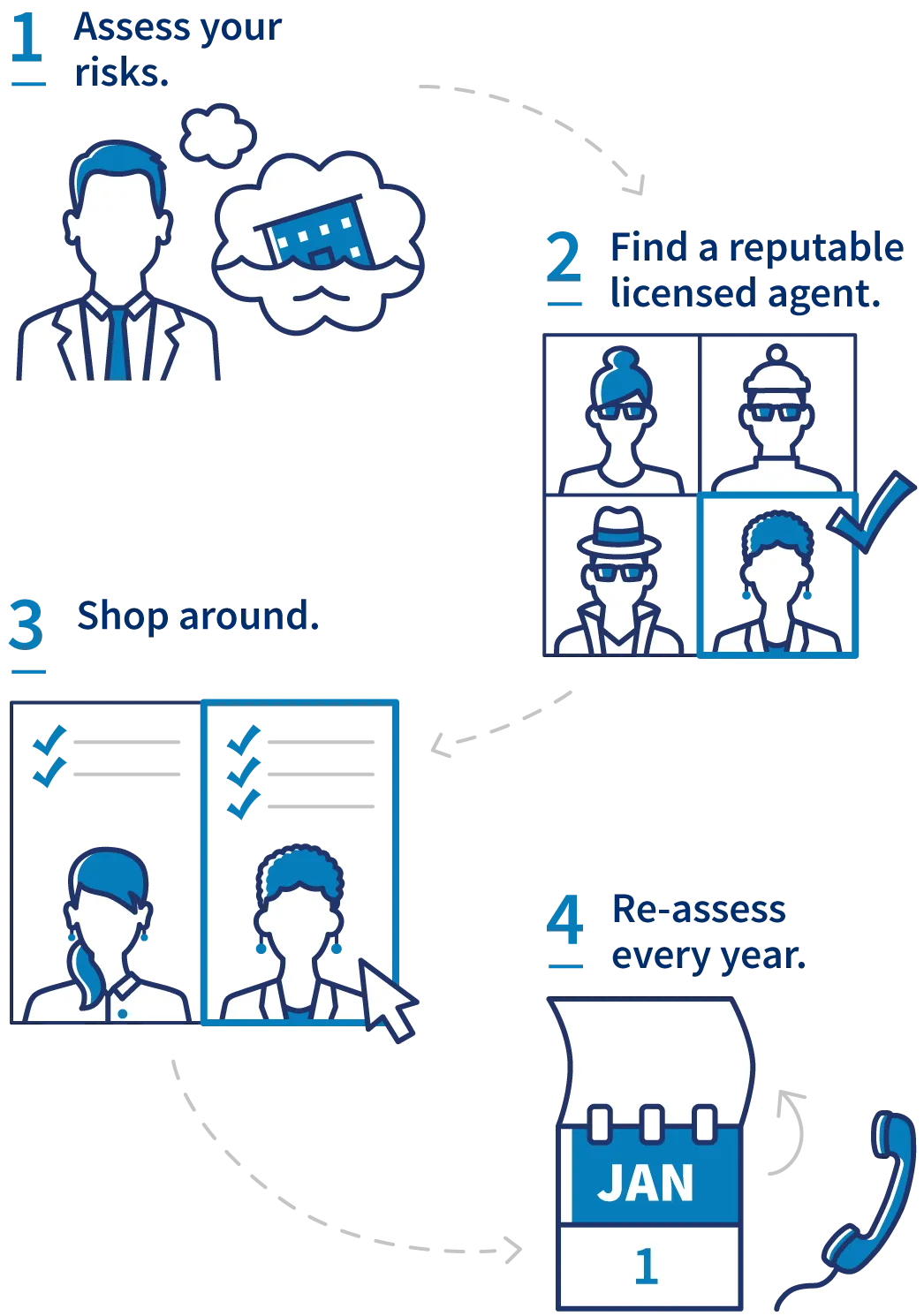
According to SBA guidance, what is the correct order of steps an electrical contractor should follow when obtaining business insurance?
An electrical contractor is preparing to start accepting larger commercial jobs and plans to hire two new apprentices. Why should the contractor schedule a business insurance review with a licensed agent rather than simply keeping their current, basic liability policy?
As your electrical contracting business grows, you must communicate specific changes to your licensed insurance agent to ensure your coverage matches your actual exposures. Match each business scenario to the specific category of information you must discuss during your business insurance review.
An electrical contractor has maintained the exact same annual revenue, vehicle fleet size, and number of employees over the past two years. However, they recently shifted their primary operations from standard residential wiring to complex commercial warehouse installations. Based on the principle of matching coverage to actual exposures, the contractor's decision to forgo a business insurance review is justified because their core quantifiable business metrics (revenue, vehicles, and headcount)
A contractor expanded their services from standard residential wiring to heavy commercial installations, but chose to keep their original insurance policy unchanged to save money. This decision is deeply flawed because the contractor failed to schedule a formal business insurance ____ with a licensed agent to properly match their coverage to their new, actual exposures.
You are expanding your electrical contracting business from residential service calls to industrial plant maintenance. To ensure your new risks are fully covered, you must construct a comprehensive risk profile to present during your insurance review. Arrange the steps below in the correct logical sequence to synthesize your business data into a finalized insurance plan.
According to the provided guidance, what is the primary goal of describing your job locations, employees, and vehicles to a licensed insurance agent during a review?
A new electrical contractor is comparing two different methods for their upcoming business insurance review with a licensed agent.
Method A: Providing a summary of total projected revenue and asking for the 'most affordable' policy that meets local licensing laws. Method B: Providing a comprehensive description of their specific job locations, employee driving records, and the specialized tools they will use on high-voltage sites.
Which of the following is the most valid evaluation of these me
The video states that there is no 'one-size-fits-all' insurance for contractors. Which of the following best explains why an electrical contractor should provide a detailed description of their specific work, locations, and customers during a review with a licensed agent?
Based on the recommendations for small businesses, which professional should an electrical contractor consult to find the right insurance coverage for the best price?
Learn After
What determines the specific requirements and benefits of workers' compensation insurance for your electrical contracting employees?
Workers' compensation insurance requirements and benefits are the same in every state, so an electrical contractor only needs to verify coverage rules once regardless of where the business operates or hires employees.
Arrange the steps an electrical contractor should take to secure the appropriate workers' compensation coverage for their employees.
As an electrical contractor, you must apply workers' compensation principles to various business situations. Match each operational scenario with its appropriate coverage implication or action.
When an electrical contracting business takes on projects in neighboring states, the owner must carefully audit both the hiring locations and the physical work sites of their team. This geographical analysis is critical to prevent uncovered liabilities, because the legal requirements and employee benefits for ____ are dictated by individual state laws.
An electrical contractor based in Texas recently won a large commercial project across the state line in Oklahoma. She plans to send her existing Texas-based crew to perform the work. Her current workers' compensation policy only covers Texas operations, and she reasons that since all her employees were hired in Texas, her existing policy is sufficient. Which of the following best explains why her reasoning is flawed and what she should do?
You are designing a 'Master Compliance Protocol' for your electrical contracting business to manage Workers' Compensation across multiple states. Arrange the following steps to construct a functional and comprehensive workflow that ensures every electrician is legally protected before work begins at a new out-of-state job site.
When setting up workers' compensation insurance, why must an electrical contractor identify every state where they hire or operate rather than simply following the insurance rules of their home state?
An electrical contractor operates out of a main office in State A. They have recently started taking on large-scale industrial projects in State B and have hired a specialized foreman who lives and signed his employment contract in State C. When analyzing this business structure for workers' compensation compliance, why is it critical for the contractor to evaluate each state's regulations separately?
Based on the provided video, which of the following best summarizes the scope of protection offered to employees by workers' compensation and employers' liability insurance?
Why must an electrical contractor identify all physical locations where they operate and hire when setting up workers compensation insurance?
To ensure your electrical contracting business is legally compliant and your employees are protected, arrange the following steps in the correct order for securing workers compensation insurance.
An electrical contractor is updating their business insurance to account for recent growth. Match each business scenario with the correct action required to maintain Workers Compensation compliance.
True or False: An electrical contractor who hires all technicians at a single central headquarters can assume their workers' compensation insurance obligations are uniform across all projects, provided the technicians perform identical job activities at every site.
When evaluating the legal sufficiency of a workers compensation policy for a multi-state electrical contracting business, the owner must judge the adequacy of their coverage based on the varying ____ of each state where they hire or operate.
You are designing a comprehensive workers' compensation strategy for your electrical contracting business as you expand from working solely in your home state to managing projects and hiring crews in multiple neighboring states. Which of the following integrated plans represents the most effective synthesis of the requirements for protecting your employees and maintaining multi-state compliance?
Along with workers compensation, an electrical contractor should identify their needs for ____ liability insurance to ensure their employees are fully protected from job-related injuries or illness.
True or False: Because workers compensation benefits and requirements are determined by state law rather than federal standards, an electrical contractor's insurance needs for their employees are primarily dictated by the specific locations where the work is performed and where the hiring occurs.
Sparky's Electrical Solutions is expanding from its home base in one state to take on a specialized wiring contract in a neighboring state. The owner plans to hire three technicians who live in that neighboring state to work exclusively on the new site. Arrange the following steps in the sequence the owner must follow to ensure these new employees are properly covered under workers compensation insurance.
To properly configure an insurance strategy that protects both the business and its employees, an electrical contractor must analyze several distinct operational factors. Match each factor with the specific analytical role it plays in determining the requirements for Workers Compensation and Employers Liability insurance.