
Working Capital Reserve for Electrical Job Cash Timing
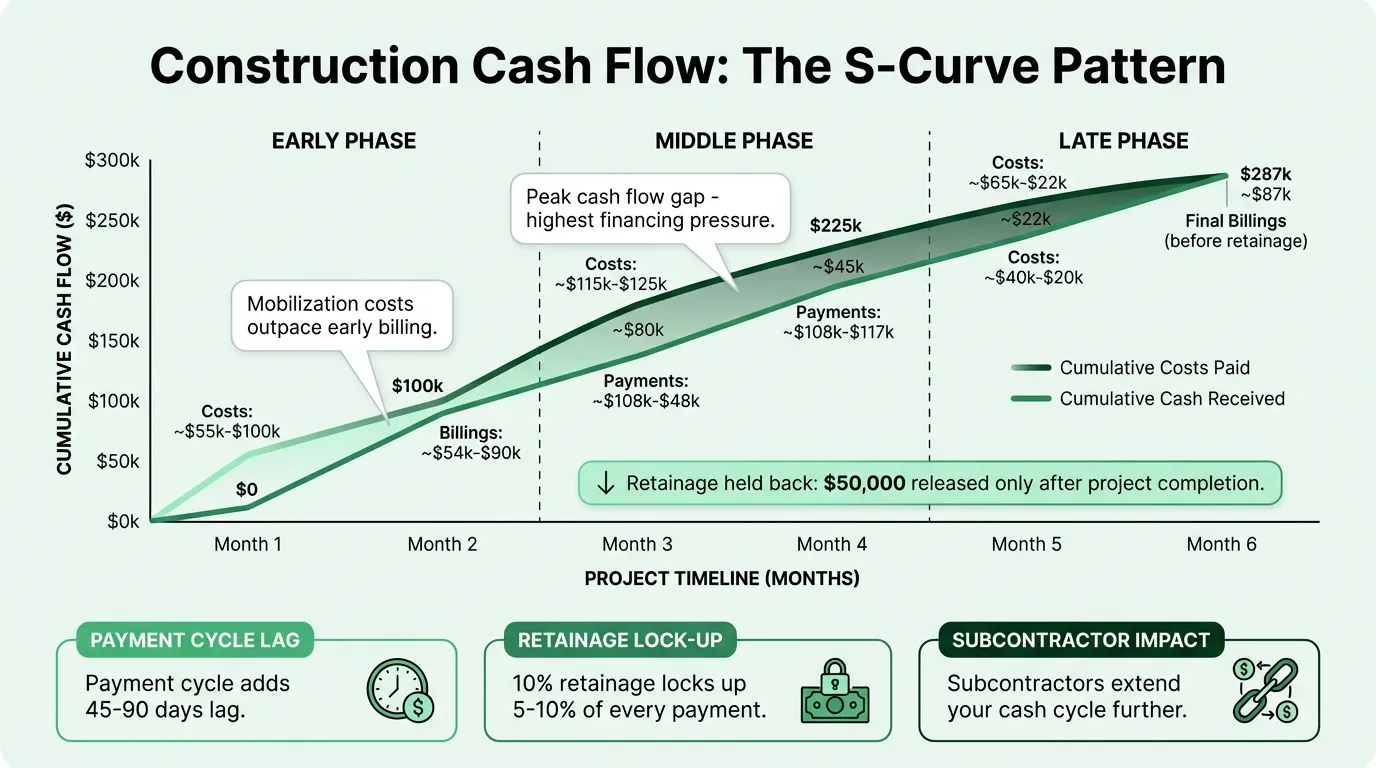
A working capital reserve is cash intentionally left available to pay job costs before the contractor is paid by the customer. In electrical contracting, the reserve protects the business when materials must be purchased for a rough-in, service upgrade, or other job before the invoice is collected. The reserve amount should fit the contractor's job size and cash cycle rather than being treated as spendable profit.
0
1
Tags
Electrical Contracting Business Operations
Running an Electrical Contracting Business Course
Related
Startup Cost List for an Electrical Contractor
Startup Cost Report for Funding Discussions
Working Capital Reserve for Electrical Job Cash Timing
Hiring Reserve Before Adding Field Employees
After your electrical contracting business officially opens, the cash you must keep available to pay for near-term materials, payroll, and operating bills before customer payments arrive is known as ____ capital.
In the video, the contractor describes keeping $10,000 in the business bank account and treating that amount as 'zero.' Which of the following best explains why this approach helps a new electrical contracting business?
You are a new electrical contractor who just secured a $20,000 project. The materials will cost $5,000 and labor will cost $3,000, both of which you must pay this week. However, the customer will not pay the $20,000 invoice until the work is completed in 30 days. Because this project guarantees a $12,000 profit, you do not need to utilize working capital to take on this job.
Arrange the following sequence of events to demonstrate how a new electrical contractor can experience a severe cash shortage despite winning a highly profitable project.
As a new electrical contractor, you must critically assess different financial strategies to ensure your business survives its crucial first year. Match each contractor's capital management decision with the most accurate evaluation of its viability and risk.
You are building a complete pre-launch funding plan for your new electrical contracting business. You have identified the following one-time costs that must be paid before you can begin operating: work van ($15,000), tools and equipment ($8,000), contractor's license and insurance ($4,000), and initial marketing materials ($3,000). You also know from researching your local market that you will typically need to purchase materials and pay a helper's wages on each job one to four weeks before
Which of the following expenses is categorized as startup capital for a new electrical contractor?
Two new electrical contractors, Sam and Alex, each start their businesses with $40,000 in total funding. Sam spends $35,000 on a brand-new service van and $5,000 on high-end testing tools. Alex spends $15,000 on a reliable used van and $5,000 on basic tools, keeping the remaining $20,000 in a business savings account. Both win a contract for a $25,000 warehouse lighting upgrade that requires $12,000 in upfront material costs. Based on their initial capital planning, examine the most like
You have adopted the financial strategy of treating $10,000 in your business bank account as 'zero' to maintain a safety reserve for your electrical contracting business. Your current bank balance is $13,000. You are offered a job that requires you to pay $4,000 for materials today. According to your 'zero' balance rule, how should you evaluate your ability to take this job?
Maria is starting an electrical contracting business with $15,000 in total savings. She spends $10,000 on a used van and a set of tools to get the business ready to open. She then lands her first big project, which requires $6,000 in upfront material costs. Maria realizes she cannot start the project because she only has $5,000 remaining in her account. Which statement best explains her planning mistake?
Learn After
Minimum Bank Balance as Unavailable Working Cash
What is the primary function of a working capital reserve for an electrical contractor?
A working capital reserve in an electrical contracting business should be treated as spendable profit once it reaches the target amount in the business bank account.
Arrange the steps of a typical job's cash cycle in the correct order to demonstrate how a working capital reserve protects an electrical contracting business.
Match each operational decision to how it affects or utilizes an electrical contractor's working capital reserve.
Consequences of Substituting Supply-House Credit for Cash Planning
An electrical contractor analyzes their upcoming job schedule and determines they will need to purchase $8,000 in materials for rough-ins before any customer invoices are collected. If their current business bank account balance is $12,000, they must recognize that only $________ of that balance can be evaluated as spendable profit, as the remainder must act as their working capital reserve to protect the cash cycle.
An electrical contractor keeps a $10,000 working capital reserve as a cash-flow safety net, treating that amount as 'zero' in the business bank account. The current balance is $$18,000. A supplier offers a one-time 20% discount on $7,000 worth of wire and panels the contractor will likely need over the next two months, but there are also three upcoming rough-in jobs that will require purchasing $5,000 in materials before any customer invoices are collected. Which course of action best protect
To move from reactive cash management to a proactive business model, you must design a custom 'Zero Balance' (Working Capital Reserve) policy. Arrange the following steps in the logical order required to build a reserve that scales with your electrical contracting business.
An electrical contractor maintains a $12,000 working capital reserve, treating this amount as 'zero' in their business bank account for financial safety. The current bank balance is $20,000. The contractor is about to start a new project that requires a $9,000 upfront material purchase before any customer invoices can be issued. Which statement best analyzes the contractor's financial position if they buy the materials today?
Using the cash flow infographic and the video discussion on bank balance management as your guide, design a custom 'Working Capital Reserve' policy for your electrical business by matching each design component to its specific role in your financial plan.
An electrical contractor treats $10,000 in their bank account as 'zero' (their working capital reserve). Using the cash flow infographic as a guide for how material costs impact liquidity, analyze the following scenarios. Match each bank balance and material cost pair to the correct analysis of the business's financial safety.