
Cash Flow Determines Contractor Survival While Profit Is Earned
Profit is measured after the fact; cash flow determines whether the business survives long enough to collect that profit. A contractor who runs out of cash cannot make payroll, buy materials, or keep insurance current — even if every signed contract is profitable. Both metrics matter, but cash flow keeps the lights on during the weeks and months while profit is still being earned. This is why cash-flow planning must run alongside job-cost accounting, not after it.
0
1
Tags
Electrical Contracting Business Operations
Running an Electrical Contracting Business Course
Related
Cash Flow Determines Contractor Survival While Profit Is Earned
During which phase of a contractor project is the repeating monthly cash-flow gap typically at its widest?
Because a contractor submits a progress billing at the end of the first month, their cash-flow gap is usually resolved immediately, providing sufficient incoming cash to cover the next month's labor and material expenses.
You are managing a commercial electrical project and need to forecast your working capital. Arrange the following events in chronological order to demonstrate how the repeating cash-flow lag compounds during the early and middle stages of the job.
Analyze the financial dynamics of an ongoing electrical project. Match each business factor to its specific structural role in compounding the monthly cash-flow gap.
An electrical contractor is evaluating the working capital required for a new 9-month commercial build. A junior partner suggests that the company only needs enough cash to survive the first 30 days before the first progress billing is submitted. The senior contractor rejects this financial plan as dangerously inadequate. Evaluating the reality that owner payments typically lag 45 to 90 days while weekly payroll hits immediately, the senior contractor knows the unfunded shortfall will compound r
You are designing a 'Cash-Flow Survival Plan' for your new electrical business to manage a 6-month commercial contract. To ensure your business can withstand the repeating monthly lag—where weekly payroll and material costs hit immediately while owner payments lag by 60 days—arrange these strategic steps in the correct order to construct a functional financial bridge for the project.
Your electrical contracting business is working on a commercial project with a 60-day payment lag from the time you submit your end-of-month invoice. Your project costs are $5,000 in Month 1, $8,000 in Month 2, and $12,000 in Month 3. Applying the logic of the repeating monthly cash-flow lag, what is the total amount of working capital your business must have spent out-of-pocket to cover these costs just before the first payment for Month 1 is received at the end of Month 3?
You are designing a Project Cash-Flow Simulator for your startup electrical business to model how the repeating monthly lag compounds during a large contract. To build this simulator correctly, arrange the following calculation steps in the order they must be processed to determine your business's total working capital requirement for the project.
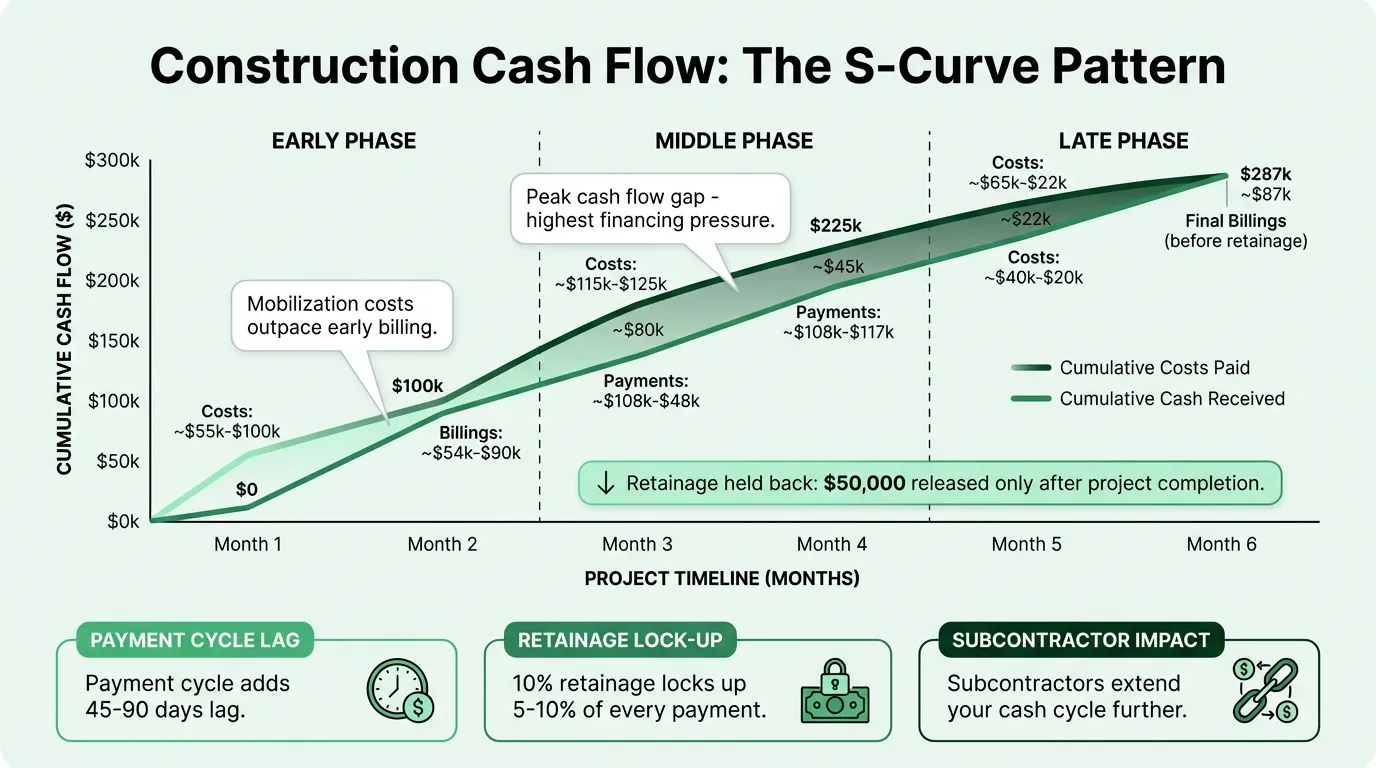
Referencing the provided cash-flow infographic, analyze why the contractor's total out-of-pocket 'cash hole' (the cumulative cash position) continues to get deeper during the middle months of the project, even after the owner has begun making regular monthly payments for the first few months of work.
You are designing a Monthly Cash-Flow Monitoring Protocol for your electrical business to ensure you don't run out of cash during a project's peak-activity middle months. To build a tool that successfully tracks how the monthly lag compounds, arrange the following logic steps in the correct order to create a functional financial roadmap for the project.
Learn After
An electrical contracting business can still fail even when every signed contract it holds is profitable.
Which statement best explains the relationship between cash flow and profit for an electrical contracting business?
Arrange the following events in the chronological order of a typical electrical project to illustrate why cash flow determines business survival while profit is measured after the fact.
Analyze the following business scenarios and match each to the financial reality it best illustrates regarding an electrical contractor's survival and success.
An electrical contractor evaluates a lucrative six-month commercial project that promises a 25% margin but delays all payments until completion. The contractor decides to reject the contract, correctly judging that the massive delayed profit is not worth the risk of bankruptcy. This decision justifies the critical business principle that while profit is measured after the fact, it is ________ that actually determines whether the business survives long enough to keep the lights on and make weekly
An electrical contractor has several signed contracts that are calculated to be highly profitable. However, the business is at risk of closing because it lacks the immediate funds to pay for this week's payroll and wire supplies. Which business principle does this illustrate?
A new electrical contractor secures a large, highly profitable commercial project. They can safely focus solely on job-cost accounting and delay cash-flow planning until the end of the project, because the high profit margin will automatically cover weekly payroll, materials, and insurance costs as they arise.
An electrical contractor wins a profitable 6-week commercial panel-upgrade project. Arrange the following events in the order they actually occur during a typical project, from first to last.
Analyze the following operational scenarios for an electrical contracting business. Match each scenario to the underlying financial principle or operational condition it best illustrates.
You are evaluating the operational health of an electrical contracting business for a potential buyout. The owner emphasizes that every signed contract has a high profit margin, yet they repeatedly rely on high-interest loans just to cover weekly payroll and material purchases. You determine that the business is actually in critical danger of failing, because while profit is the end goal, managing the day-to-day __________ is what dictates if the business can survive long enough to finish the pr
You are preparing to start a $40,000 electrical renovation project estimated to yield a $10,000 profit over eight weeks. However, you must pay $15,000 for materials immediately, and your weekly payroll and overhead are $2,500. You currently have $6,000 in your business account. Based on the provided infographic showing the 'valley' where cash flow goes negative before profit is realized, which of the following integrated business plans would you create to ensure your company survives the fi
You have just secured a $50,000 renovation project estimated to earn a $10,000 profit. To execute the job, you must pay $15,000 for materials on day one, and your weekly payroll/overhead is $2,500 for the 10-week duration. You currently have $5,000 in your business account. Based on the infographic showing the negative cash flow 'valley' during construction, which 'Integrated Project Plan' would you create to ensure your business survives long enough to collect the final profit?
You are managing an electrical project that follows the 'Construction Cash Flow' infographic (provided). You are currently in the negative 'Valley' where your bank account balance has dropped to $1,500, but you have a $2,500 supplier invoice for conduit that must be paid today to keep the job moving. Even if your accounting records show that you have already 'earned' $5,000 in profit on this job, what is the immediate reality for your business?
Examine the provided infographic, specifically the phase where the 'Cash Flow' line is in the negative 'Valley' while the 'Work Performed' (Profit) line continues to rise. What is the most critical analytical conclusion regarding business survival that can be drawn from this relationship?
To ensure an electrical contracting business survives long enough to collect its final profit, when should the owner perform cash-flow planning?