
Repeating Monthly Cash-Flow Lag Pattern on Contractor Projects
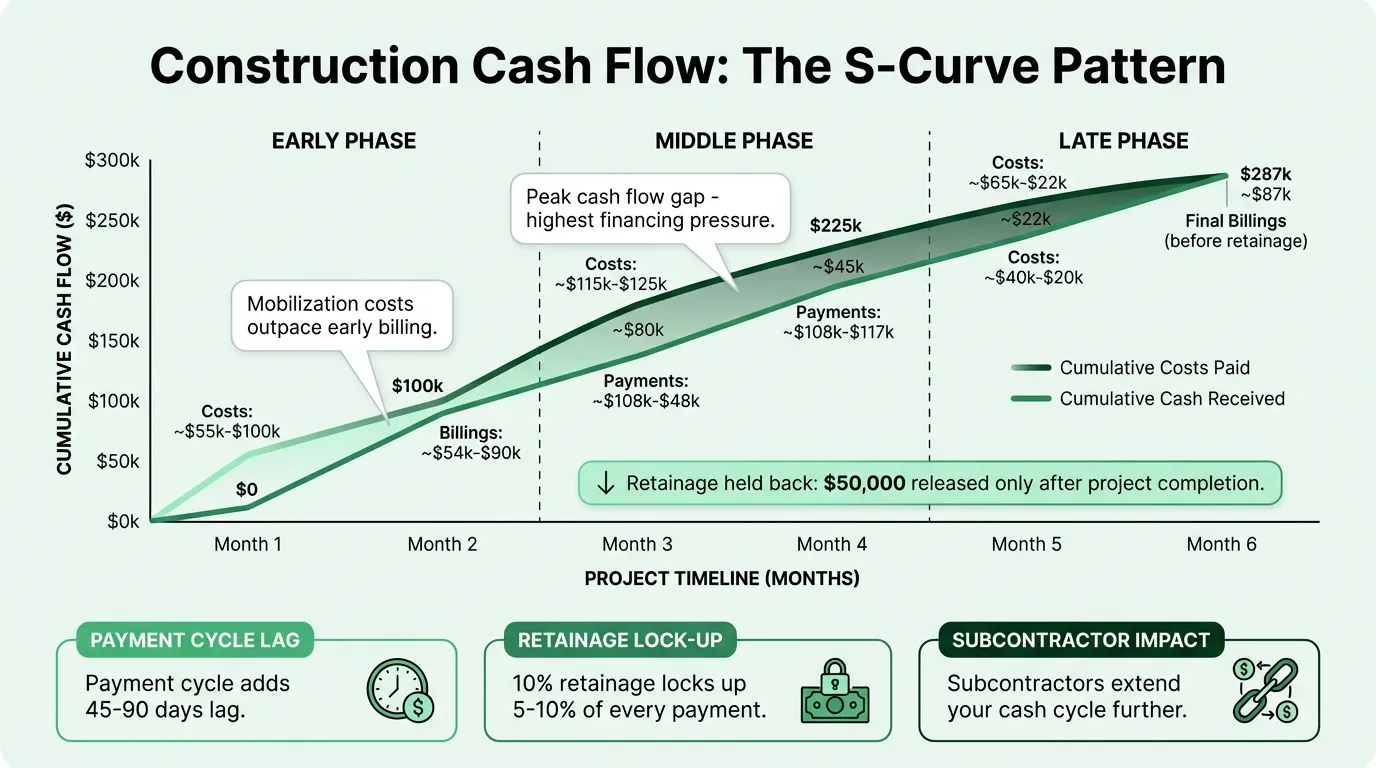
The timing gap from the first billing cycle repeats every month. Costs hit immediately — payroll is due weekly, suppliers bill on net-30, and subcontractors expect prompt payment — while owner payments lag 45–90 days behind the work performed. The cash-flow gap is widest during the peak-activity middle months of a project, when labor, material, and subcontractor invoices are at their highest volume. Each month compounds the prior shortfall until collections catch up.
0
1
Tags
Electrical Contracting Business Operations
Running an Electrical Contracting Business Course
Related
Repeating Monthly Cash-Flow Lag Pattern on Contractor Projects
On an electrical project using monthly progress billing with 30-day payment terms, a contractor who completes $60,000 of work and incurs $55,000 in costs during Month 1 will have received payment for that work before the end of Month 1.
An electrical contractor completes $60,000 of work in the first month of a project, incurring $55,000 in out-of-pocket costs. The contract stipulates a 10% retainage and 30-day payment terms. Which of the following best describes the contractor's cash flow reality while waiting for payment during the second month?
An electrical contractor completes $100,000 of billed work in the first month of a new project. To perform this work, the contractor incurred $85,000 in out-of-pocket payroll and material costs. The contract features standard 10% retainage and 30-day payment terms. Before the first net payment arrives late in the second month, the contractor experiences a cash flow gap and must float $____ out of their own reserves to cover the first month's expenses.
Analyze the financial components of a progress-billing cycle where an electrical contractor completes $60,000 of work, incurs $55,000 in costs, and faces a 10% retainage with 30-day terms. Match each operational event to its specific impact on the contractor's cash flow.
Evaluate the operational timeline of a $500,000 electrical project with 30-day payment terms and 10% retainage to determine how a liquidity gap forms despite profitable work. Arrange the following financial events in the correct chronological sequence that creates a one-month funding hole for the contractor.
An electrical contractor completes 60,000 of work in Month 1 on a project with 10% retainage and 30-day payment terms. The owner withholds____ as retainage before issuing the net payment.
An electrical contractor completes $60,000 of work in the first month of a project, incurring $55,000 in costs. The contract specifies monthly progress billing, 10% retainage, and 30-day payment terms. Why does the contractor experience a temporary cash flow deficit during this period despite the work being profitable?
You are managing a $500,000 electrical project. In Month 1, you complete $60,000 of work but spend $55,000 on labor and materials. Your contract specifies monthly billing with 10% retainage and 30-day payment terms. Match each of the following financial figures to its specific role in your company's cash flow during this initial cycle.
An electrical contractor begins a $500,000 commercial project with monthly progress billing, 10% retainage, and 30-day payment terms. In the first month, the contractor completes $60,000 of work and spends $55,000 on labor and materials. Analyze the sequence of financial events that creates the cash flow timing gap, and arrange the following steps in the correct chronological order.
After Month 1 of a new project, an electrical contractor completes $60,000 of work while incurring $55,000 in labor and material costs. The contract includes a 10% retainage and 30-day payment terms. The contractor determines that because the billed work is profitable, they will not need to rely on existing cash reserves to float the project expenses. This is a valid financial assessment.
You are designing a cash-management strategy for a new $500,000 electrical project. Your analysis shows that the $55,000 in Month 1 startup costs, combined with the standard 60-day lag in payment receipt, will create a significant 'funding hole' in your reserves. Which of the following contract and operational structures would you create to ensure the project remains cash-neutral from the start?
You are designing the Schedule of Values (the itemized list of task prices used for monthly billing) for a new $500,000 project. Your projections show that you will spend $55,000 in Month 1 on labor and materials, but the 10% retainage and 30-day payment delay will create a funding hole in your reserves. Which creative billing structure would you develop to ensure your first payment is large enough to cover these initial costs?
To prevent the $55,000 'funding hole' identified in a $500,000 project (where costs are incurred 60 days before the first check arrives), you must design a cash-positive project workflow. Arrange the following strategic actions in the chronological sequence you would implement them to ensure the project generates its own startup capital.
In the example of a $500,000 project where you complete $60,000 of work and incur $55,000 in labor and material costs, what does the $55,000 'funding hole' specifically represent?
In the example of the $500,000 electrical project, you complete $60,000 of work in Month 1 while incurring $55,000 in expenses. After receiving your first net payment of $54,000 in Month 2, which statement best explains your company's financial position regarding that specific month of work?
Learn After
Cash Flow Determines Contractor Survival While Profit Is Earned
During which phase of a contractor project is the repeating monthly cash-flow gap typically at its widest?
Because a contractor submits a progress billing at the end of the first month, their cash-flow gap is usually resolved immediately, providing sufficient incoming cash to cover the next month's labor and material expenses.
You are managing a commercial electrical project and need to forecast your working capital. Arrange the following events in chronological order to demonstrate how the repeating cash-flow lag compounds during the early and middle stages of the job.
Analyze the financial dynamics of an ongoing electrical project. Match each business factor to its specific structural role in compounding the monthly cash-flow gap.
An electrical contractor is evaluating the working capital required for a new 9-month commercial build. A junior partner suggests that the company only needs enough cash to survive the first 30 days before the first progress billing is submitted. The senior contractor rejects this financial plan as dangerously inadequate. Evaluating the reality that owner payments typically lag 45 to 90 days while weekly payroll hits immediately, the senior contractor knows the unfunded shortfall will compound r
You are designing a 'Cash-Flow Survival Plan' for your new electrical business to manage a 6-month commercial contract. To ensure your business can withstand the repeating monthly lag—where weekly payroll and material costs hit immediately while owner payments lag by 60 days—arrange these strategic steps in the correct order to construct a functional financial bridge for the project.
Your electrical contracting business is working on a commercial project with a 60-day payment lag from the time you submit your end-of-month invoice. Your project costs are $5,000 in Month 1, $8,000 in Month 2, and $12,000 in Month 3. Applying the logic of the repeating monthly cash-flow lag, what is the total amount of working capital your business must have spent out-of-pocket to cover these costs just before the first payment for Month 1 is received at the end of Month 3?
You are designing a Project Cash-Flow Simulator for your startup electrical business to model how the repeating monthly lag compounds during a large contract. To build this simulator correctly, arrange the following calculation steps in the order they must be processed to determine your business's total working capital requirement for the project.
Referencing the provided cash-flow infographic, analyze why the contractor's total out-of-pocket 'cash hole' (the cumulative cash position) continues to get deeper during the middle months of the project, even after the owner has begun making regular monthly payments for the first few months of work.
You are designing a Monthly Cash-Flow Monitoring Protocol for your electrical business to ensure you don't run out of cash during a project's peak-activity middle months. To build a tool that successfully tracks how the monthly lag compounds, arrange the following logic steps in the correct order to create a functional financial roadmap for the project.