
Example of an Interrupted Time-Series Design: Student Absences
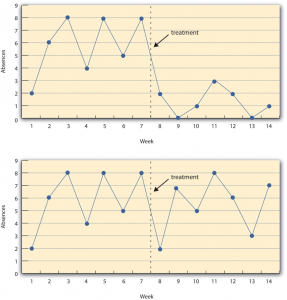
An interrupted time-series design can be illustrated by tracking the number of student absences per week in a course. In this scenario, the 'interruption' is the instructor beginning to publicly take daily attendance. If the multiple measurements show a consistently high number of absences before this treatment, followed by an immediate and sustained drop afterward, the treatment is deemed effective. However, if the long-term trend of absences remains virtually unchanged on average after the intervention, it suggests the treatment failed to produce a meaningful effect, even if minor weekly fluctuations exist.
0
1
Tags
KPU
Research Methods in Psychology - 4th American Edition @ KPU
Related
Example of an Interrupted Time-Series Design: Factory Shift Reduction
Example of an Interrupted Time-Series Design: Student Absences
Interrupted Time-Series Design with Nonequivalent Groups
AB Design
Advantage of Interrupted Time-Series Over Pretest-Posttest Designs
Which of the following procedures is the defining characteristic of an interrupted time-series design?
In an interrupted time-series design, researchers rely on a single measurement before and a single measurement after a treatment to distinguish the actual effect of an intervention from normal variation.
A clinical psychologist wants to evaluate the impact of a new mindfulness-based stress reduction (MBSR) program on patients' anxiety levels using an interrupted time-series design. Arrange the following steps of the study in the correct chronological order.
Researchers using an interrupted time-series design must analyze data patterns to determine the internal validity of an intervention. Match each hypothetical data pattern with the analytical conclusion it most strongly supports.
You are designing a quasi-experimental study to determine if a new 'Mandatory Recess' policy (implemented on October 1st) improves elementary students' focus. To create an interrupted time-series design that distinguishes the policy's effect from the natural 'mid-semester slump' in student engagement, which of the following data collection schedules should you propose?
In an interrupted time-series design, measurements of a dependent variable are taken at regular intervals both before and after the treatment is introduced.
A researcher critiquing a study that relies on a single 'before-and-after' measurement argues that this method is insufficient to judge an intervention's success. To accurately evaluate whether an observed change reflects a genuine intervention effect rather than _____, the researcher recommends using an interrupted time-series design with multiple measurements before and after the treatment.
A team of psychologists wants to choose the correct methodology for different studies. Match each research scenario or description with the most appropriate design term based on the interrupted time-series methodology.
An investigator is analyzing the source of fluctuations in a study on workplace productivity. They note that a simple pretest-posttest design makes it difficult to separate treatment effects from normal variation. To better distinguish the actual effect of the intervention from normal variation, the researcher should use an interrupted time-series design to incorporate _____ measurements of the dependent variable before and after the treatment.
A research methods class is evaluating the validity of a proposed study on student absences. Arrange the steps below in the correct chronological order to properly execute an interrupted time-series design.
Define the interrupted time-series design and explain its structure as a variant of the pretest-posttest design. In your explanation, highlight the specific operational difference between this design and a simple pretest-posttest design, and state the main advantage this difference provides to researchers.
Based on the case context, justify the choice of research design by explaining why the psychologist's decision to collect multiple weekly measurements over a sixteen-week period is superior to using a simple before-and-after measurement. How does this methodology help in understanding the intervention's true impact?
A clinical director wants to apply an interrupted time-series design to evaluate whether a new scheduling app reduces client missed appointments. Write a brief explanation (1-3 sentences) detailing how the director should schedule their measurements of missed appointments relative to the introduction of the app.
Example of an Interrupted Time-Series Design: Student Absences
What is a primary advantage of the interrupted time-series design over a simple one-group pretest-posttest design?
A researcher measures student anxiety once before introducing a new study-skills workshop and once after. She observes a decrease in anxiety and concludes the workshop was effective. However, if anxiety levels naturally rise and fall from week to week, her conclusion may be unwarranted because a single pre- and post-measurement cannot distinguish a genuine treatment effect from ordinary fluctuations in the outcome variable.
A clinical psychologist wants to evaluate whether a new mindfulness technique reduces insomnia. Rather than measuring a patient's sleep quality just once before the therapy and once after, she tracks the patient's sleep quality every night for two weeks prior to introducing the technique and two weeks after. By doing this, she can account for normal daily sleep fluctuations by establishing a baseline ______, which prevents her from falsely attributing typical night-to-night variations to the new
A clinical psychologist is evaluating a new mindfulness-based intervention for reducing patient anxiety. Match each methodological component to the analytical role it plays in distinguishing a genuine treatment effect from normal, ongoing fluctuations in anxiety levels.
A researcher is investigating whether a new workplace wellness initiative actually reduces employee stress levels or if a recorded decrease is simply part of a natural seasonal cycle. To evaluate the initiative's impact while effectively ruling out normal fluctuations as the cause, arrange the following steps of an interrupted time-series design in the correct logical sequence.
A school psychologist is tasked with generating a research protocol to evaluate if a new 'Mindful Minutes' exercise reduces student stress, which is known to fluctuate significantly based on the day of the week and upcoming exams. Which of the following measurement frameworks should the psychologist synthesize to ensure the design effectively accounts for these natural fluctuations and establishes a reliable baseline trend before the exercise is introduced?
A single pretest and posttest measurement is sufficient for researchers to establish a baseline trend and rule out normal, ongoing fluctuations in a dependent variable.
Match each research design or component with the description of how it addresses (or fails to address) normal, ongoing fluctuations in a dependent variable.
A health researcher wants to determine whether a hospital's new hand-hygiene protocol genuinely reduced patient infection rates, or whether an observed drop simply reflects the unit's normal weekly fluctuation. She records infection counts for 12 consecutive weeks before the protocol and 12 weeks after. By examining the full set of pre-intervention data points together, she establishes a _____ that she can then use to judge whether the change observed at the moment the protocol was introduced ex
A university counseling director collected 14 weekly measurements of students' self-reported anxiety—7 weeks before a new stress-management workshop and 7 weeks after—using an interrupted time-series design. She must now evaluate whether the post-workshop drop in anxiety is a genuine treatment effect or merely normal semester variation. Rank the following analytical steps in the order that best supports a valid, evidence-based conclusion.
Explain the primary advantage of utilizing an interrupted time-series design over a simple one-group pretest-posttest design when evaluating a psychological intervention. In your response, specifically address the role of measurement frequency and how it affects a researcher's ability to draw conclusions about the intervention's effectiveness.
A researcher is studying the impact of a new workplace ergonomics program on weekly employee back pain ratings, which naturally fluctuate. Instead of using a simple pretest-posttest design, how should the researcher structure their measurement schedule using an interrupted time-series design to ensure they do not falsely attribute normal variation to the program?
Identify the major limitation of the psychologist's research design in terms of measurement frequency. Then, explain how transitioning to an interrupted time-series design would address this limitation and why it would lead to a more valid conclusion.
Learn After
Example of an Interrupted Time-Series Design with Nonequivalent Groups: Student Absences
In the example of an interrupted time-series design tracking student absences, what specific event serves as the 'interruption'?
In the context of the student absence example using an interrupted time-series design, match each data pattern or event with the specific role it plays in evaluating the study's outcome.
A professor tracks student absences for five weeks, finding an average of 12 absences per week. She then begins publicly taking attendance every day. Over the next five weeks, the number of absences recorded per week are 11, 13, 12, 11, and 13. Based on the logic of an interrupted time-series design, the professor should conclude that the attendance-taking intervention was effective.
In an interrupted time-series design tracking student absences, arrange the following analytical steps in the logical order a researcher must take to determine if a new attendance-taking policy caused a meaningful reduction in absences.
Suppose you are tasked with constructing a new research protocol to determine if a 'guided-meditation' session before exams reduces student test anxiety. To ensure the study follows the same structural logic as the student absence example, which methodology would you formulate?
In the student absences study, if the average number of absences remains virtually unchanged after the instructor begins taking daily attendance, the intervention is concluded to have failed to produce a meaningful effect.
A professor concludes that taking daily attendance was effective because absences were lower in the first week, despite returning to their original average for the rest of the term. This professor's evaluation of the intervention is incorrect because they failed to demonstrate that the reduction in absences was _____.
A researcher conducts an interrupted time-series study on student absences. Match each researcher action or observation to the reason that action is necessary for drawing a valid conclusion from this design.
A researcher reviews the student absence data and finds that absences dropped sharply in the first week after the attendance policy began but gradually climbed back to pre-intervention levels by week five. Applying interrupted time-series reasoning, the researcher should classify this outcome as evidence of a _____ effect—not the sustained reduction required to conclude the treatment was meaningfully effective.
A peer reviewer is evaluating whether a student researcher's interrupted time-series study on absences provides sufficient evidence to support the causal claim that publicly taking attendance reduced absences. Arrange the following evaluative judgments in the order they should be made, from the most foundational prerequisite to the final overall verdict.
Based on the student absences example, identify the specific event that serves as the 'interruption' in the interrupted time-series design. Then, describe the two different post-interruption outcomes (effective vs. ineffective treatment) in terms of the pattern and trend of student absences.
Explain whether this pattern indicates an effective intervention according to the criteria of an interrupted time-series design, and justify your conclusion based on the observed short-term versus long-term trends of student absences.
A researcher is using an interrupted time-series design to study student absences in a psychology class. Before the treatment (introducing public attendance taking), they collect only a single measurement of absences from the week immediately prior. Apply your knowledge of this design's structure to explain why collecting only one pre-treatment measurement, instead of multiple measurements, compromises the validity of their conclusions.