
Fixed-Cost Coverage Target for Electrical Contractor Reserves
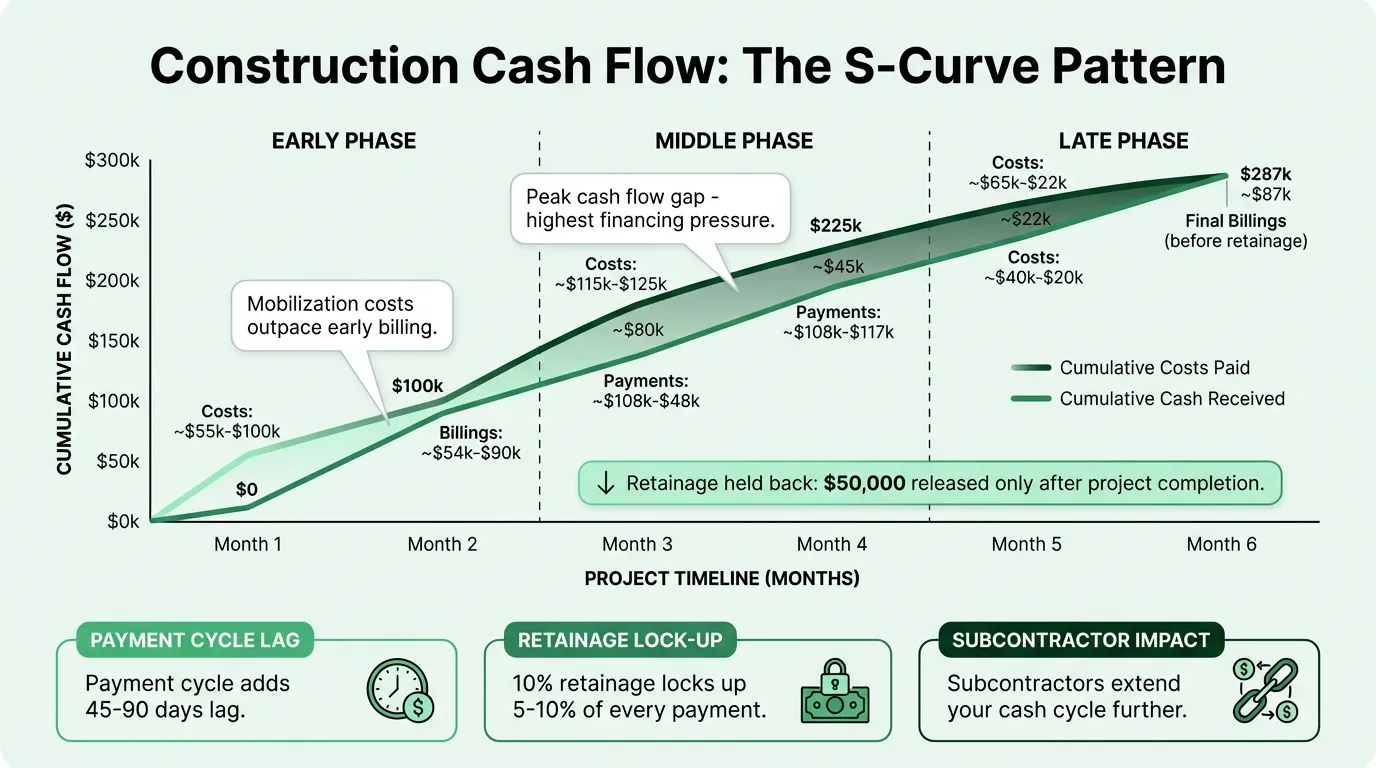
To size a cash reserve, first total every fixed weekly outflow: payroll, rent, insurance premiums, vehicle payments, and any obligation that cannot be deferred. Then multiply that figure by a coverage target of 6–13 weeks of fixed costs. A 13-week target aligns with the rolling cash-flow projection horizon recommended for construction companies, giving the contractor enough runway to survive a full billing-and-collection cycle without borrowing.
0
1
Tags
Electrical Contracting Business Operations
Running an Electrical Contracting Business Course
Related
Two-Week Cash Flow Look-Ahead for Electrical Contractors
Fixed-Cost Coverage Target for Electrical Contractor Reserves
Single Slow-Pay Cascade Risk Without a Cash Reserve
When determining the appropriate size for an electrical contractor's cash reserve, what are the primary factors used in the calculation?
For an electrical contracting business, maintaining a cash reserve is considered optional because most construction customers pay promptly within a few days of invoicing.
Arrange the steps for sizing an electrical contractor's necessary cash reserve in the correct order.
Match each specific financial scenario for an electrical contracting business to the corresponding concept used in sizing and utilizing a cash reserve.
An electrical contractor is analyzing their cash reserve sizing model. They determine that multiplying fixed weekly outflows by a targeted number of coverage weeks effectively neutralizes the risk of standard 45-90 day payment delays. However, evaluating their commercial contracts reveals a secondary risk: clients routinely withhold 10% of every invoice until final project sign-off. To structurally protect the business against this specific cash flow gap, the contractor concludes they must layer
A new electrical contracting company has fixed weekly outflows of $12,000 (payroll, vehicle leases, insurance, and rent). The owner calculates a cash reserve by multiplying $12,000 by 10 weeks of coverage, arriving at $120,000. She considers this sufficient and moves on to other planning tasks. However, roughly 40% of her projected revenue will come from commercial contracts where clients withhold 10% of every invoice until final project completion, which can take 4–6 months. Which of the fol
What are the primary components used to determine the proper size of a cash reserve for an electrical contracting business?
If an electrical contractor successfully signs a contract for a large project that will generate enough revenue to cover all business expenses for the next six months, they no longer need to maintain a liquid cash reserve.
As a new electrical contractor preparing for the reality of construction payment cycles, you must apply cash reserve principles to your financial planning. Match each component of a cash reserve strategy to the practical action you would take to implement it.
An electrical contractor is analyzing their business operations to determine the appropriate size for a cash reserve, recognizing that construction payment cycles typically lag 45–90 days. Arrange the following steps in the correct logical sequence to properly size this emergency fund.
You are evaluating the financial health of an electrical contracting business that frequently bids on commercial projects with 45–90 day payment cycles. The owner presents a cash reserve sized strictly by multiplying their fixed weekly outflows by a 12-week coverage target. You determine this reserve is inadequate because it fails to account for the standard industry practice of clients withholding a portion of the payment until project completion. To correct this critical vulnerability, you adv
You are launching a new electrical contracting business and must build your cash reserve plan from scratch before accepting your first job. Your fixed weekly outflows total $4,200 (wages, insurance, fuel, and loan payments). Industry guidance recommends a 12-week coverage target. You also know that commercial clients typically withhold 10% of each invoice as retainage until project close-out, and your first contract will bill $60,000 over its duration. Which cash reserve plan correctly synthes
Match each financial term with the description that best explains its role in managing the cash flow of an electrical contracting business.
An electrical contractor maintains a cash reserve that successfully covers 12 weeks of fixed operating expenses (wages, rent, and insurance). However, as they near the completion of a large six-month commercial project, they find they are unable to pay their final material invoices, despite the project being profitable and all previous invoices being paid by the client. Analyze the following factors to determine which structural flaw in their reserve sizing is the most likely cause of this speci
When calculating the necessary size of a cash reserve, what is the typical range of days an electrical contractor should expect for construction payment cycles to lag?
Referencing the typical construction payment lag shown in the provided infographic, why is an electrical contractor's 'fixed weekly outflows' used as the starting point for sizing a cash reserve?
Learn After
Retainage Buffer Addition to Cash Reserve Target
When building a cash reserve for your electrical contracting business, the recommended coverage target is how many weeks of fixed costs such as payroll, rent, insurance premiums, and vehicle payments?
When determining the size of a cash reserve, an electrical contractor should apply the 6- to 13-week coverage target to all anticipated business expenses, including deferrable material purchases.
An electrical contractor calculates that their non-deferrable weekly obligations—including payroll, rent, insurance premiums, and vehicle payments—total $4,500. To align with the recommended construction industry rolling cash-flow projection horizon and ensure enough runway to survive a full billing-and-collection cycle without borrowing, the contractor should build a cash reserve of $____.
An electrical contractor is planning to size their business cash reserve to ensure enough runway to survive a full billing-and-collection cycle without the need for borrowing. Analyze the financial sizing process and arrange the necessary steps in the correct logical order.
Evaluate the following cash reserve sizing strategies and calculation methods for an electrical contracting business by matching each approach to its correct critique.
As the owner of a new electrical contracting firm, you are designing a formal 'Cash Reserve Policy' to ensure your company remains solvent during the long gaps between performing work and receiving payment. Based on the typical cash-flow cycles in the construction industry, which of the following policy formulations most effectively synthesizes the required coverage duration with the correct business cost variables?
An electrical contractor is transitioning from residential service work (where customers pay on-site) to large commercial subcontracts where payments are typically received 90 days after billing. Their fixed weekly costs—including payroll, rent, insurance, and vehicle payments—total $7,500. They currently have a cash reserve of $70,000. Evaluate the adequacy of this reserve for the contractor's new business model.
An electrical contractor's weekly ledger shows $4,000 in fixed outflows (payroll, rent, and insurance premiums) and $7,000 in variable project costs (job-specific materials and permits). Analyze these costs against the recommended 13-week coverage target to determine which statement correctly identifies the required reserve size and its underlying business logic.
Match each term related to sizing an electrical contractor's cash reserve with its correct industry definition or strategic rationale.
The 13-week upper coverage target for an electrical contractor's cash reserve is specifically recommended because it provides enough runway to survive which of the following without borrowing?