
Retainage Buffer Addition to Cash Reserve Target
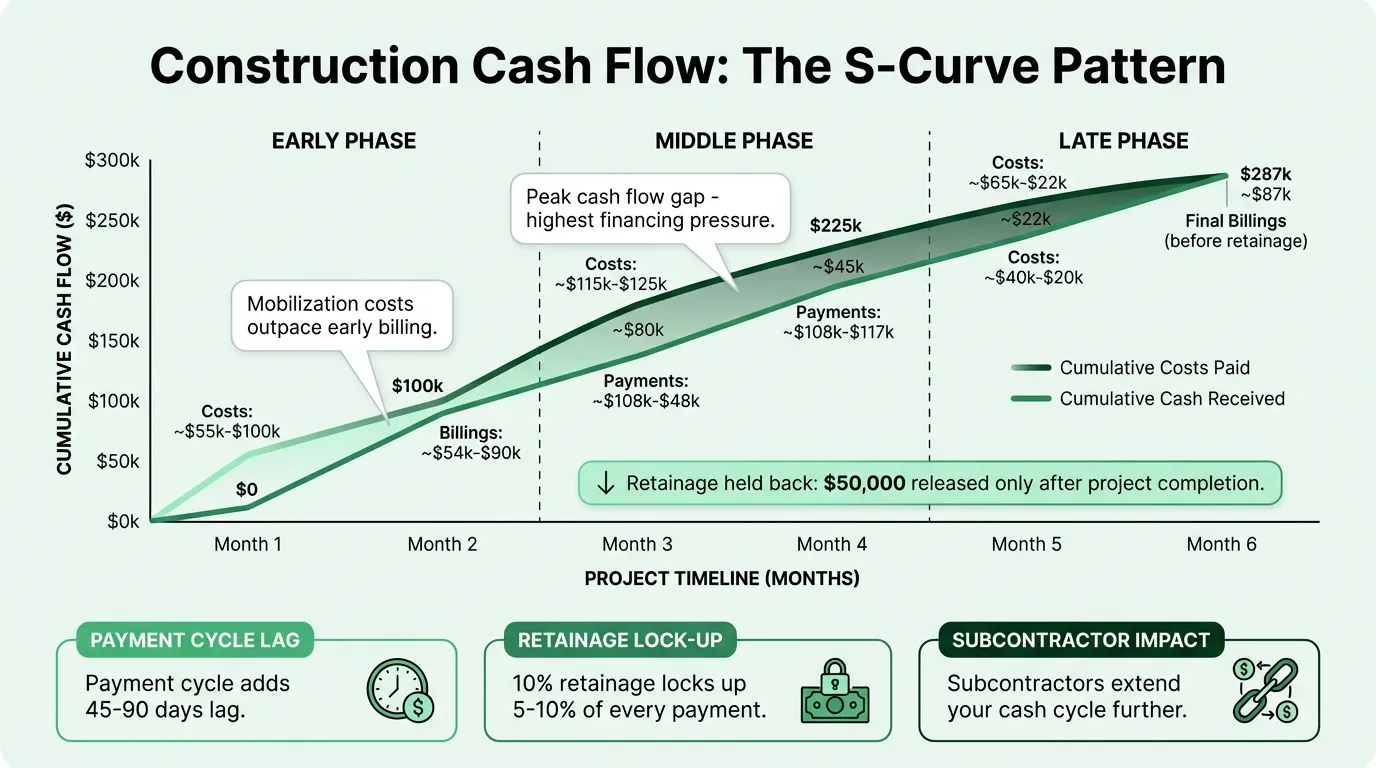
After calculating the fixed-cost coverage target, add a retainage buffer. If 5–10 % of billings are held back as retainage until project completion, that money is unavailable for operations even though it appears on the books as an asset. Model the typical retainage balance as cash the contractor cannot touch, and add it to the reserve target. Revisit this adjustment quarterly as project sizes and retainage percentages change.
0
1
Tags
Electrical Contracting Business Operations
Running an Electrical Contracting Business Course
Related
Retainage Buffer Addition to Cash Reserve Target
When building a cash reserve for your electrical contracting business, the recommended coverage target is how many weeks of fixed costs such as payroll, rent, insurance premiums, and vehicle payments?
When determining the size of a cash reserve, an electrical contractor should apply the 6- to 13-week coverage target to all anticipated business expenses, including deferrable material purchases.
An electrical contractor calculates that their non-deferrable weekly obligations—including payroll, rent, insurance premiums, and vehicle payments—total $4,500. To align with the recommended construction industry rolling cash-flow projection horizon and ensure enough runway to survive a full billing-and-collection cycle without borrowing, the contractor should build a cash reserve of $____.
An electrical contractor is planning to size their business cash reserve to ensure enough runway to survive a full billing-and-collection cycle without the need for borrowing. Analyze the financial sizing process and arrange the necessary steps in the correct logical order.
Evaluate the following cash reserve sizing strategies and calculation methods for an electrical contracting business by matching each approach to its correct critique.
As the owner of a new electrical contracting firm, you are designing a formal 'Cash Reserve Policy' to ensure your company remains solvent during the long gaps between performing work and receiving payment. Based on the typical cash-flow cycles in the construction industry, which of the following policy formulations most effectively synthesizes the required coverage duration with the correct business cost variables?
An electrical contractor is transitioning from residential service work (where customers pay on-site) to large commercial subcontracts where payments are typically received 90 days after billing. Their fixed weekly costs—including payroll, rent, insurance, and vehicle payments—total $7,500. They currently have a cash reserve of $70,000. Evaluate the adequacy of this reserve for the contractor's new business model.
An electrical contractor's weekly ledger shows $4,000 in fixed outflows (payroll, rent, and insurance premiums) and $7,000 in variable project costs (job-specific materials and permits). Analyze these costs against the recommended 13-week coverage target to determine which statement correctly identifies the required reserve size and its underlying business logic.
Match each term related to sizing an electrical contractor's cash reserve with its correct industry definition or strategic rationale.
The 13-week upper coverage target for an electrical contractor's cash reserve is specifically recommended because it provides enough runway to survive which of the following without borrowing?
Learn After
Reserve Funding Discipline for Electrical Contractors
When setting a cash reserve target for an electrical contracting business, why must a retainage buffer be added?
Retainage held back on your electrical contracting projects can be counted as available operating cash because it appears as an asset on your books.
Arrange the steps in the correct order to properly integrate a retainage buffer into your contracting business's cash reserves.
You are calculating the cash reserves for your electrical contracting business. Your baseline fixed-cost coverage target is $45,000. Across your active jobs, clients are holding back a typical balance of $15,000 in retainage. To ensure you have enough available cash for operations, your adjusted total cash reserve target must be $____.
As an electrical contractor reviewing your quarterly financials, you must analyze various financial components to accurately determine your cash liquidity. Match each financial scenario with its correct role or impact regarding your adjusted cash reserve target.
An electrical contractor currently covers $40,000 per month in fixed costs and keeps a cash reserve target of $80,000 (two months of fixed costs) plus a $20,000 retainage buffer based on the typical retainage held across active jobs. The contractor just signed a large commercial project that will increase the total retainage balance from $20,000 to approximately $48,000 over the next two months. The contractor decides to leave the reserve target unchanged until the next annual financial rev
You are tasked with creating a comprehensive 'Cash Reserve Policy' to protect your new electrical business from the liquidity gaps illustrated in the provided infographic. To ensure you always have enough available cash to cover operations despite the 5–10% of billings held back by clients as retainage, which specific model should you design and implement?
An electrical contractor maintains a baseline cash reserve of $40,000 to cover two months of fixed costs. They are evaluating the liquidity needs of two different project portfolios:
Portfolio A: Multiple small residential jobs where 0% is held as retainage. Portfolio B: One large industrial project where $15,000 is currently held back as retainage.
Which statement best analyzes the impact of these portfolios on the contractor's total cash reserve target?
How frequently should an electrical contractor revisit and adjust their retainage buffer to ensure their cash reserve target reflects changes in project sizes and typical retainage percentages?
An electrical contractor is reviewing their business's liquidity. Their current fixed-cost coverage target is $60,000. They have $100,000 in their operating bank account. Their latest quarterly report shows that general contractors are currently holding a total of $50,000 in retainage across all active projects.
The contractor concludes: 'I have $40,000 in surplus cash above my reserve target, so I am in a strong position to start a new high-cost project.'
Using the provided infographic as