
Quote Reference Attachment to Electrical Estimate Line Items
After selecting a supplier quote, the estimator attaches the quote reference — typically a quote number and date — to the corresponding estimate line item. This linkage ensures the purchasing team orders the same specification at the quoted price rather than re-sourcing at current market rates. It also creates a paper trail that connects the bid assumption to the eventual purchase order, supporting job-cost tracking and any post-project variance analysis between estimated and actual material costs.
0
1
Tags
Electrical Contracting Business Operations
Running an Electrical Contracting Business Course
Related
Quote Reference Attachment to Electrical Estimate Line Items
When comparing quotes from multiple electrical supply distributors, the supplier offering the lowest unit price on materials always represents the best overall value for your project.
An electrical estimator is comparing quotes from two distributors for a large lighting package. Supplier A offers a lower unit price on the fixtures, but Supplier B has them in stock locally, whereas Supplier A has a three-week delivery time. Why is it important to document and evaluate these differences rather than immediately choosing the lowest unit price?
Match each multi-distributor quoting scenario with the most appropriate evaluation action the estimator should take.
You receive bids from multiple electrical distributors for a large material package. Arrange the analytical steps you should take to compare these quotes and make a risk-adjusted, auditable purchasing decision.
As an electrical contractor evaluating material bids, you reject a quote from Supplier A despite them offering the lowest unit price. You determine that their extended lead time forces the project to carry unacceptable schedule risk. To ensure your decision to award the contract to a more expensive, reliable local vendor is ____ and can be justified to the business owner, you document both suppliers' terms side-by-side.
You are designing the standardized 'Vendor Selection Matrix' for your new electrical contracting business to evaluate material bids for projects with strict deadlines. To create a decision-making framework that is both auditable and minimizes financial risk, which combination of data fields and evaluation logic should you implement to compare multiple distributor quotes?
You are comparing two distributor quotes for an emergency electrical repair that must be completed within 3 days.
- Distributor A: $1,200 for materials, $100 overnight shipping, 1-day lead time.
- Distributor B: $1,050 for materials, Free shipping, 7-day lead time.
If you miss the 3-day deadline, you will lose a $500 'on-time' completion bonus from the customer. Based on the documented lead times and total costs, which distributor is the best choice for this project?
You are managing a project for a retail store that has a fixed 'Grand Opening' date. The client is still undecided on the final fixture styles but wants you to order the main material package immediately to avoid missing the deadline. You are evaluating two distributor quotes:
- Supplier A: $8,000 total; 4-week lead time; 'Final Sale' policy (no returns or exchanges).
- Supplier B: $9,200 total; 1-week lead time; 100% refund on returns within 30 days.
Which of the following rationales demons
An electrical contractor is performing a side-by-side comparison of two distributor quotes for an emergency industrial repair. The project contract includes a penalty of $500 for every day the facility remains without power.
- Distributor A: $4,000 total; materials are in-stock locally (available today); 25% restocking fee on all returns.
- Distributor B: $3,200 total; 10-day shipping lead time; 0% restocking fee on all returns.
After analyzing the components of both quotes, the contractor
You are designing a 'Multi-Distributor Decision Matrix' to help your electrical business compare material quotes. To construct a tool that effectively balances financial data with operational risk and auditability, match each 'Logic Module' you are building with its primary 'System Function'.
Learn After
After choosing a supplier quote for electrical materials, what is the primary reason an estimator attaches the quote number and date to the corresponding estimate line item?
Attaching a supplier's quote reference to an estimate line item legally binds the supplier to hold those material prices for the entire duration of the electrical project.
To ensure that the material prices and specifications used to win a bid are actually realized during construction, arrange the following steps in the correct operational sequence to demonstrate how a quote reference maintains control from the estimating phase to final job-cost tracking.
Match each operational scenario to the specific way that attaching a supplier's quote reference to an estimate line item resolves or supports it.
An electrical business owner is evaluating a recent job that suffered a severe margin fade due to elevated material costs. Her post-project variance analysis reveals that while the estimating team had secured excellent pricing from a supplier, the purchasing team later ordered the materials at higher current market rates because they were unaware of the specific bid assumptions. Concluding that this workflow disconnect requires a structural fix, she mandates that all estimators must explicitly a
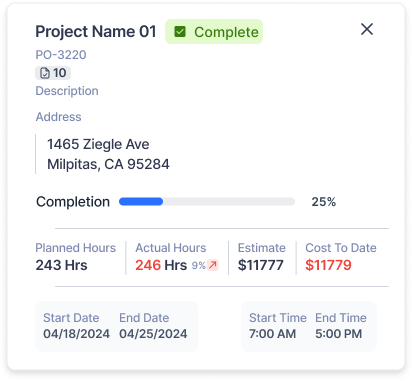
The provided image illustrates a post-project variance between estimated and actual costs. What specific information should an estimator attach to estimate line items during the bidding phase to create the paper trail needed to investigate these differences?
When finalizing a bid, simply providing the purchasing team with the total estimated material cost is sufficient, as they will naturally seek out the best current market rates when it is time to order.
Imagine you are drafting a Standard Operating Procedure (SOP) for your new electrical contracting business to prevent material cost overruns. Arrange the following procedural steps in the correct chronological order to establish a secure operational link between your estimating and purchasing phases.
An electrical contractor is reviewing a project's 'Actual vs. Estimate' report (as shown in the image) and notices that the cost for copper wire was significantly higher than what was bid, even though the quantities used were correct. Match the following business operational challenges with the specific way that 'attaching a supplier's quote reference to the estimate line item' addresses them.
You are evaluating two different estimating-to-purchasing handover workflows for your electrical contracting business. Workflow A provides the purchasing team with a simple total material list. Workflow B requires the estimator to explicitly attach the supplier's ____ to each estimate line item. You determine Workflow B is the superior operational choice because it creates a clear paper trail, ensuring the purchasing team orders the exact specification at the locked-in bid price rather than re-s
You are designing a 'Cost-Protection Protocol' for your new electrical business to ensure that the material prices you use in your bids are the same prices you pay during construction. Based on the need to avoid the 'Actual vs. Estimate' cost overruns shown in the image, which set of requirements should you mandate for every major material line item in your estimating system?
Looking at the 'Actual vs. Estimate' report in the provided image, you notice that material costs were significantly higher than what was bid. As a business owner, evaluate which of the following operational policies is the MOST effective for ensuring your profit margin is protected by holding suppliers to their original bid-day pricing.
You are reviewing the 'Actual vs. Estimate' report (shown in the image) for a completed commercial project and notice that the actual cost for specialized conduit was 20% higher than your estimate. Upon investigation, you find that the estimator successfully attached a specific supplier quote reference (Number: Q-492, Date: June 15) to that line item.
By comparing this quote reference against the actual purchase order and invoice, which analytical insight can you gain regarding the source of th
After a project finishes with the significant material cost overruns shown in the provided image, you discover that your estimator has been saving all supplier quotes as PDFs in a digital project folder, but has NOT been attaching the specific quote reference numbers directly to the line items in the estimate.
Evaluate the impact of this 'folder-only' strategy on your business's ability to control costs.
To prevent the significant material cost overruns shown in the 'Actual vs. Estimate' report (see image), how should you apply a supplier's quote (Ref: #CB-2026, Price: $1,450) to your internal estimate?