
Steering Customers Toward Lower-Cost Payment Methods
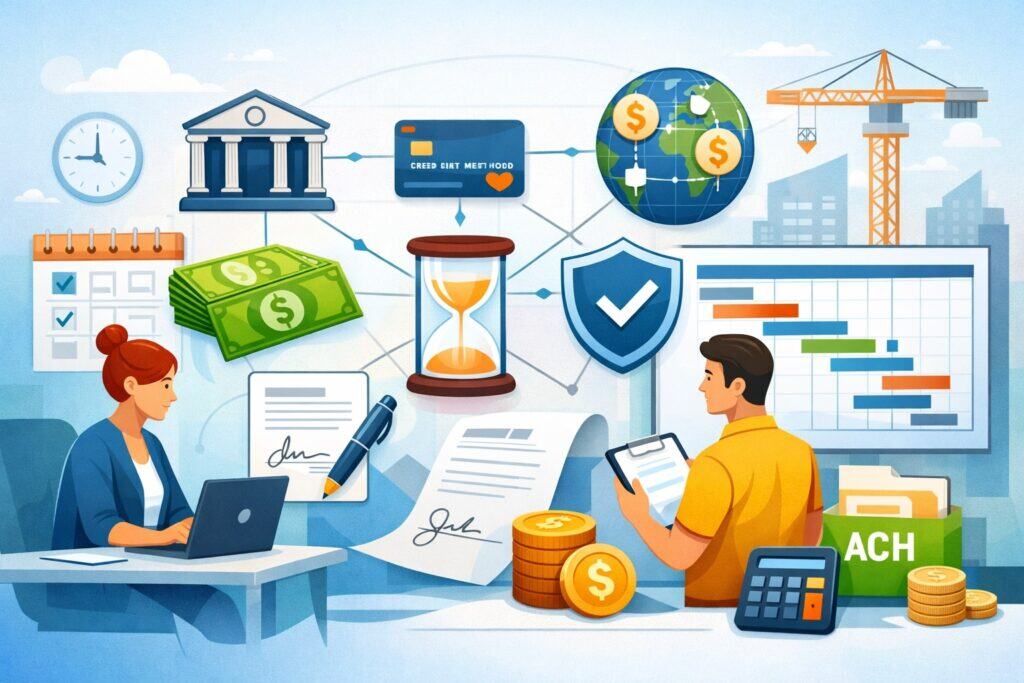
A strong payment strategy offers every method a customer might prefer while actively steering toward lower-cost rails like ACH. Contractors can encourage ACH by making it the default option on invoices, providing a secure online payment portal, and noting the fee differential in contract terms. Surcharge clauses for card payments, where permitted by state law, give customers a financial incentive to choose ACH or check. The goal is to reduce processing costs without creating friction that delays collections.
0
1
Tags
Electrical Contracting Business Operations
Running an Electrical Contracting Business Course
Related
Steering Customers Toward Lower-Cost Payment Methods
If your electrical contracting contract does not include a surcharge clause, the customer is automatically responsible for paying any credit card processing fees charged on the invoice.
You just completed a $30,000 commercial wiring upgrade. The client's Accounts Payable department contacts you to pay the invoice using a virtual credit card. Your contract with them does not include a credit card surcharge clause. Which of the following best describes the financial impact of accepting this payment?
Match each electrical contracting scenario with the most appropriate business action or financial outcome regarding credit card fees.
A commercial client intends to pay a $60,000 invoice using an Accounts Payable virtual credit card. To analyze the financial risk and properly mitigate the processing fees, arrange the steps you should take in the correct operational sequence.
An electrical contractor realizes that accepting virtual credit cards on large commercial invoices is severely eroding their profit margins due to 3% processing fees. They determine the best financial strategy is to pass this cost to the client via a new contract clause. Before finalizing and implementing this strategy, the contractor must critically evaluate their local state ____ to confirm that adding a card-fee line item is legally permissible.
You are designing a new standard operating procedure (SOP) to protect your electrical contracting business from the severe margin erosion caused by credit card fees on large commercial invoices. To successfully synthesize financial protection with operational and legal compliance, which of the following policy drafts should you finalize and implement?
You are constructing a new 'Fee Recovery and Margin Protection Workflow' for your electrical business to address the financial impact of credit card fees on large commercial projects. Arrange the following development steps in the correct sequence to build and launch this operational strategy.
As part of building your new electrical business's 'Financial Operations Handbook,' you are designing a strategy to protect your profit margins from processing fees. Match each strategic tool you have developed with the specific business scenario it is created to address.
An electrical contractor accepts credit cards for both residential repairs and large commercial installations, with both departments paying a 3% processing fee. While the residential department's budget is unaffected, the commercial department is experiencing a 'margin crisis' due to these fees. Which analysis best explains why the same 3% fee is significantly more damaging to the commercial department?
You are designing the 'Automated Margin-Protection Logic' for your electrical contracting firm's new billing software. To ensure the system successfully identifies and recovers the $1,500 fee on a $50,000 commercial invoice while adhering to all legal and contractual requirements, arrange the following development modules in the correct operational sequence.
Learn After
Remittance Instructions for Electrical Contractor Payments
To steer customers toward lower-cost payment methods like ACH, contractors should make ACH the ____ option on their invoices.
An electrical contractor wants to reduce the money lost to credit card processing fees without causing customers to delay their payments. Which of the following approaches best demonstrates a successful strategy for achieving this?
After completing a large electrical service upgrade, you want to minimize the processing fees on the final invoice. To successfully execute a lower-cost payment strategy, you should configure your invoicing software to completely disable the credit card option and only allow the customer to pay via ACH or check.
An electrical contractor is analyzing their payment strategy to steer customers toward lower-cost methods without delaying collections. Match each specific strategic action with its underlying operational mechanism.
An electrical contractor is revamping their payment strategy to reduce processing costs without creating friction that delays collections. Evaluate the following strategic actions and arrange them in the optimal sequence to smoothly transition customers toward lower-cost methods.
You are designing a comprehensive 'Payment Workflow' for your new electrical company to minimize processing fees without losing customers. Which of the following policy designs most effectively integrates the 'steering' components into a functional system?
Which of the following is a specific tactic recommended for steering customers toward lower-cost payment methods like ACH in an electrical contracting business?
You have just completed a $7,500 commercial sub-panel installation. Your goal is to encourage the customer to use a lower-cost payment method while still providing a convenient online experience. Which configuration of your digital invoice best applies the 'steering' strategy?
When an electrical contractor is designing their payment strategy, what is the primary risk of completely removing higher-cost options like credit cards instead of simply 'steering' customers toward lower-cost methods?
An electrical contractor reviews their financial data and discovers that while their overall processing fees have dropped, the average time it takes to receive payment for small service calls ($200 and under) has remained low, while large project payments ($5,000 and up) have shifted almost entirely to ACH. Which of the following best analyzes how the 'steering' strategy achieved this specific balance?
To reduce processing costs without delaying collections, which approach should an electrical contractor take to steer customers toward lower-cost payment methods like ACH?
To minimize high credit card processing fees on an invoice like a $8,500 home rewiring project, an electrical contractor should completely stop accepting credit card payments and only accept ACH.
As an electrical contractor, you want to optimize your payment collections by steering customers toward lower-cost methods like ACH (bank transfer) while minimizing transaction fees and keeping collections smooth. Match each business scenario with the most effective, low-friction implementation strategy to achieve this goal.
An electrical contractor is analyzing their billing workflow for a high-value commercial lighting upgrade with a final invoice of $15,000. To minimize expensive card processing fees while keeping collection friction low, the contractor wants to implement a payment steering strategy. Arrange the tactical steps of this strategy in the correct chronological order of the customer's billing and payment journey.
An electrical contractor is evaluating three different billing strategies to handle a high-value $12,000 residential electrical upgrade invoice:
Strategy A: Accept only physical checks, which completely eliminates online processing fees but introduces significant administrative and mailing delays, increasing collections friction. Strategy B: Offer credit card payments as the default option on the digital invoice, which ensures fast collection but forces the business to absorb a 3% processing f
To minimize credit card processing fees, a strong payment strategy for an electrical contracting business should completely eliminate credit card payment options and only accept low-cost methods like ACH or physical checks.
Based on the principles of a strong payment strategy, how should an electrical contractor balance the goal of reducing processing costs with the need to collect payments quickly?
An electrical contracting company wants to apply different tactics of a strong payment strategy to steer customers toward lower-cost bank transfers (ACH). Match each real-world business scenario with the most appropriate tactical action to achieve this goal.
An electrical contractor is analyzing their monthly payment processing expenses for high-value projects. Last month, they collected five invoices of $10,000 each. Because they left credit cards as the default online payment option, all five clients paid via credit card, costing the business 3 percent in processing fees, or a total of $1,500.
To reduce this expense in the future without adding collection friction, the contractor decides to modify their digital invoicing platform settings. By m
An electrical contractor is evaluating four different payment collection strategies for a high-value $15,000 home rewiring project. The contractor's goal is to optimize their payment strategy by balancing two key criteria: minimizing transaction fee expenses and minimizing collection friction (payment delays).
Evaluate and arrange these strategies in order from the MOST optimal (best balance of low cost and low friction) to the LEAST optimal (worst balance/highest friction or highest cost).