
Learn Before
ABAB Reversal Design Example
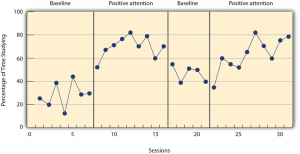
An ABAB reversal design can be illustrated by a study aimed at improving a student's studying behavior. The percentage of time spent studying is measured and found to be low during the initial baseline phase. A treatment is then introduced, causing studying time to increase until it stabilizes. When the treatment is removed during the second baseline phase, the studying behavior decreases. Finally, the treatment is reintroduced in a second treatment phase, which leads to studying behavior increasing once again.
0
1
Tags
KPU
Research Methods in Psychology - 4th American Edition @ KPU
Related
Baseline Phase
Treatment Phase
Internal Validity of Reversal Designs
Multiple-Treatment Reversal Design
Alternating Treatments Design
ABAB Design
Internal Validity in Reversal Designs
ABAB Reversal Design Example
Limitations of Reversal Design
Arrange the phases of a fundamental reversal design (ABA design) in the correct chronological order.
In a research study using a reversal design (ABA), what is the primary scientific purpose of withdrawing the treatment and returning to the baseline condition in the final phase?
A researcher is investigating the effectiveness of a 'gold star' reward system on a student's on-task behavior using a reversal design. Match each specific step of the study to its corresponding phase label in the ABA model.
In a single-subject reversal design (ABA), if a researcher observes that the target behavior does not return to baseline levels after the treatment is withdrawn, they can still definitively conclude that the treatment was the primary cause of the initial change.
When evaluating the appropriateness of a reversal (ABA) design for a specific study, a researcher must ensure that the target behavior is ______; if the behavior will not return to baseline levels once the treatment is removed, the design cannot effectively demonstrate experimental control.
Which of the following alternative names is commonly used to refer to the reversal design, the most fundamental single-subject research design?
In a single-subject reversal (ABA) design, the 'reversal' in the final phase is achieved by introducing an opposite treatment to actively force the behavior back to its baseline state.
A clinical psychologist is evaluating a new deep-breathing exercise to reduce a patient's daily anxiety attacks. Match each proposed action in the study to its corresponding phase within a standard ABA reversal design.
In a research study utilizing a single-subject ABA design, the researcher withdraws the treatment in the third phase specifically to return the participant to the _____, thereby analyzing whether the treatment was the actual cause of any behavioral change.
An educational researcher is evaluating the causal impact of a peer-tutoring program on a student's spelling accuracy using a reversal design. Arrange the steps of the study in the correct chronological order to assess the treatment's effectiveness.
Disadvantages of ABAB Design
Arrange the phases of an ABAB design in the correct chronological order.
ABAB Reversal Design Example
Arrange the phases of an ABAB research design in their correct chronological order.
A researcher uses an ABAB design to test whether a relaxation technique reduces anxiety in a client. During the first treatment phase, the client's anxiety decreases. When the treatment is temporarily removed, anxiety increases again. The treatment is then reintroduced and anxiety decreases once more. What is the primary reason the researcher includes the final treatment phase rather than ending the study after the return-to-baseline phase?
A school psychologist wants to study whether verbal praise increases a student's homework completion rate. She records the student's baseline completion rate for two weeks (Phase A), then provides daily verbal praise for three weeks (Phase B), then withdraws the praise for two weeks and observes that completion rates drop back toward baseline (Phase A). She concludes that her study is now complete because she has successfully demonstrated that the behavior changed with treatment and reversed wit
A researcher uses the single-subject design shown in the image to study a student's off-task behavior. Match each phase of this study with its specific analytical role in establishing a cause-and-effect relationship between the praise and the behavior change.
Based on the structural phases illustrated in the image, imagine you are tasked with creating a new research protocol to test the impact of 'verbal reminders' on 'safety belt usage' in a single driver. Which of the following experimental plans would you construct to properly implement an ABAB design and demonstrate a functional relationship?
In an design, the letter represents the treatment phase, and the letter represents the baseline phase.
In a single-subject research design, match each phase of an design with its primary conceptual role in demonstrating a functional relationship.
A clinical researcher is deciding whether to use an ABAB design to evaluate the effectiveness of a behavioral intervention for a child who engages in dangerous self-injurious behavior. While the design would provide strong causal evidence—because the behavior should change predictably each time the treatment is introduced or removed across all four phases—the researcher must weigh this scientific benefit against a serious _____ concern raised by requiring the temporary withdrawal of a potentiall
In an ABAB design, the final reintroduction of the treatment phase is considered critical for evaluating internal validity because it provides _____ of the initial treatment effect, allowing the researcher to conclude that the behavior change was caused by the intervention rather than a coincidental extraneous variable.
Describe the structure of an design, detailing each phase in chronological order and explaining what each phase represents in this single-subject design.
Based on the structural design of an study, explain how the student's studying behavior is expected to change during each phase when positive attention is introduced, removed, and then reintroduced. Explain what these changes indicate about the effect of positive attention.
If you are applying an design to evaluate a new behavior intervention, what specific action must you take during the transition from the second phase to the third phase, and why is this transition necessary according to the design's reversal structure?
A school psychologist is using an ABAB design to evaluate whether providing specific praise increases a student's on-task behavior during independent reading. Arrange the psychologist's actions in the correct chronological sequence to successfully implement this research design.
Learn After
Arrange the sequential phases of an ABAB reversal design study, using the example of improving a student's studying behavior, in the correct chronological order.
In an ABAB reversal design study focused on improving a student's study behavior, what is the primary scientific reason for removing the treatment during the second 'A' phase?
A researcher is using an ABAB reversal design to increase a student's study time, as illustrated in the provided graph. Match each phase label with the specific behavioral outcome observed during that period in the study.
In the ABAB reversal design example shown in the image, if the student's study behavior had remained at the high level even after the treatment was removed during the second 'A' phase, the researcher could no longer definitively conclude that the treatment was the specific cause of the improvement.
When evaluating the internal validity of the ABAB reversal design example shown in the image, the phase that is most critical for ruling out alternative explanations (such as maturation or history) by demonstrating that the behavior returns to its original state without the intervention is the second ______ phase.
Imagine you are developing a research protocol to test if a 'deep-breathing' technique reduces the heart rate of a student during mock exams. Based on the logic of the ABAB reversal design shown in the image, which of the following plans correctly organizes the phases to demonstrate a functional relationship between the technique and the student's heart rate?
In the ABAB reversal design example involving a student's studying habits, the percentage of time spent studying is measured and found to be high during the initial baseline phase.
An instructor asks students to apply their knowledge of the ABAB reversal design to the studying-behavior example. Match each research design term to the correct description of how it appears in that specific study.
When analyzing data from the ABAB reversal design example, a researcher breaks the evidence for causation into two complementary parts: (1) the increase in studying time during each treatment phase, and (2) the _____ of studying time during the second baseline phase once the treatment is removed. Without this second element, the design cannot distinguish the treatment's effect from a confound such as maturation.
A student is writing a critique evaluating whether the ABAB reversal design example involving studying behavior successfully demonstrated a causal relationship between the treatment and studying time. To build a sound evaluative argument, the student must examine each piece of evidence in a logical order. Arrange the following evaluative steps in the correct sequence.
Based on the provided example of an ABAB reversal design aimed at improving a student's studying behavior, describe the sequence of the four phases. For each phase, specify what action is taken regarding the treatment and how the student's studying behavior changes as a result.
Based on the logic of the ABAB reversal design example, justify why the researcher must include the second baseline (A) and second treatment (B) phases instead of stopping after the first treatment phase. What does the reversal (decrease and subsequent increase in behavior) demonstrate about the causal relationship between the treatment and the studying behavior?
In the provided ABAB reversal design example, the dependent variable is operationalized as the percentage of time spent studying. Suggest an alternative, objective operational definition for this dependent variable that a researcher could use to measure the student's study behavior, and explain how it would be measured across the baseline and treatment phases.