
Retainage Impact on Electrical Contractor Cash Flow
Retainage (retention) is the percentage of each progress payment a project owner withholds until substantial completion or punch-list sign-off — typically 5–10 %. Because the contractor has already paid labor, materials, and subs in full, retainage creates a timing gap between earned revenue and collected cash that must be modeled, negotiated, and tracked to protect working capital.
0
1
Tags
Electrical Contracting Business Operations
Running an Electrical Contracting Business Course
Related
Retainage Impact on Electrical Contractor Cash Flow
Application for Payment Line-Item Structure
Progress billing means an electrical contractor waits until the entire project is finished before sending the customer an invoice.
You are managing a six-month electrical installation for a new office building. To maintain positive cash flow, you plan to use progress billing. At the end of month one, how should you determine the amount to invoice the general contractor?
Match each progress billing term with its correct role in managing cash flow on an electrical project.
Analyze the operational workflow of progress billing. Arrange the logical sequence of actions an electrical contractor must take to set up and execute a progress billing cycle to maintain steady cash flow on a long-term project.
You are evaluating a dispute between an electrical contractor and a general contractor over a progress billing invoice. The general contractor refuses to pay the monthly draw request, arguing that the amount billed for the rough-in wiring seems arbitrary. You determine the electrical contractor's invoicing process is flawed because it lacks verifiable proof of progress. To correct this structural failure and guarantee that every billed amount is fully auditable, you dictate that their Applicatio
Which billing method allows an electrical contractor to invoice for work completed at regular intervals during a project, rather than waiting until the entire job is finished to receive payment?
An electrical contractor is two months into a six-month commercial build. Under a progress billing agreement, they must wait until the final inspection is passed before submitting an Application for Payment to cover their labor and materials.
You recently won a contract for a six-month commercial wiring project and want to avoid funding the entire job out of pocket. Arrange the practical steps of implementing progress billing in the correct order to successfully manage your cash flow.
Analyze the components of progress billing in an electrical contracting business. Match each project scenario or administrative task with its corresponding outcome or action.
An electrical contractor is offered a six-month commercial wiring contract worth $180,000. After reviewing the contract terms, she discovers it requires a single lump-sum payment only upon final project completion. She evaluates the financial risk and concludes that — before signing — she must negotiate ____ into the contract, which will allow her to invoice monthly against a Schedule of Values and avoid funding six months of labor and materials entirely out of pocket.
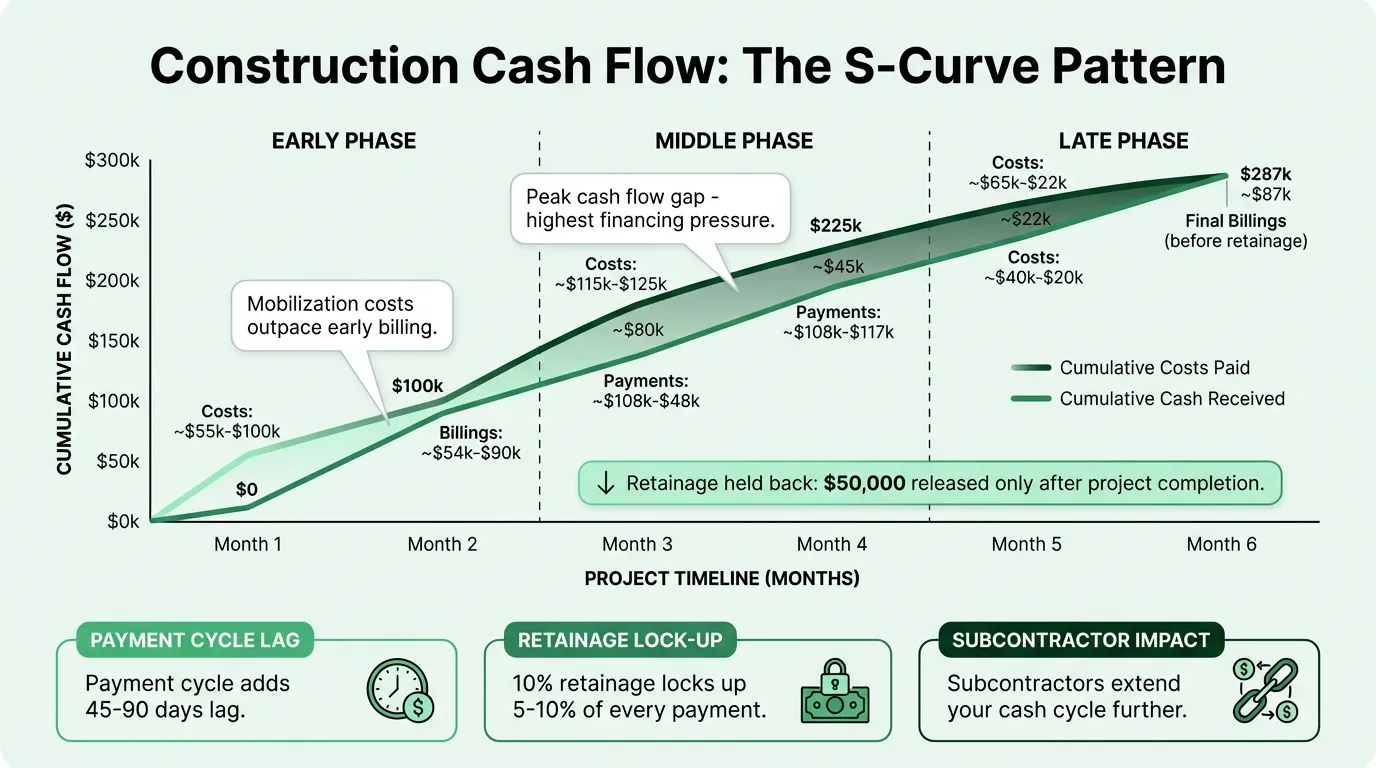
Review the 'Construction Cash Flow' infographic, which highlights the 'Cash Gap' (the red shaded area) where a contractor’s expenses exceed their income. To solve this problem for your business, you need to design a billing strategy for a new $90,000 commercial project. Which structure for your 'Schedule of Values' (the list of items you bill against) would you create to most effectively minimize this cash gap?
An electrical contractor is three months into a large commercial project. Their internal records show they have spent $20,000 on materials and $15,000 on labor. They submit a progress bill for $35,000. The project owner rejects the invoice because it does not align with the 'Schedule of Values,' which shows the 'Rough-in' stage (100% complete) is valued at only $25,000. Analyze the relationship between the contractor's request and the progress billing system to determine the root cause of th
An electrical contractor is preparing a monthly invoice for a commercial project. To ensure the billing is auditable and tied to the contract price, they must link each line item on their invoice to which specific document?
Review the 'Construction Cash Flow' infographic, which illustrates the 'Cash Gap'—the period where a contractor's expenses for labor and materials exceed their incoming payments. To create a professional billing system for your electrical business that eliminates this gap, in what order should you design and implement these administrative steps?
Evaluate the following scenario: A new electrical contractor chooses a $55,000 commercial project with a lump-sum payment at the end because the total payout is $2,000 higher than the progress-billing alternative. The contractor has $5,000 in cash reserves but must spend $15,000 on materials in the first month.
Based on the concept of the 'Cash Gap' shown in the provided infographic, what is the most accurate evaluation of this decision?
Learn After
Retainage as a Delayed Receivable
The portion of each progress payment that a project owner holds back until a project is substantially complete — typically 5–10 % — is called ____.
Arrange the following steps in order to show how a 10% retainage clause creates a timing gap between an electrical contractor's business expenses and their collected cash.
You just completed month one of a new commercial wiring project and are submitting a progress billing for $50,000 of completed work. To complete this work, you have already paid out $45,000 in direct labor and material costs. The project contract includes a standard 10% retainage clause. What is the direct impact of this retainage on your business's cash flow for this specific billing cycle?
You are awarded a $100,000 electrical contract that includes a standard 10% retainage clause. Your total expected project costs (materials, labor, and overhead) are $93,000. Because your total contract value is $7,000 higher than your total costs, this project will maintain a positive cash flow during the construction phase.
You are reviewing four different commercial electrical contracts before deciding which to bid on. Each contract contains a different retainage clause. Evaluate the cash-flow risk each clause poses to your business and match it to the correct risk assessment.
In the context of an electrical contracting business, what does the term 'retainage' refer to?
An electrical contractor completes work on a commercial project that includes a 10% retainage clause. Arrange the following events in the order they typically occur from the contractor's perspective:
As an electrical contractor, you must actively manage the cash flow impacts of retainage. Match each overarching strategy to the practical business action that best applies it.
An electrical contractor is analyzing their cash flow for a commercial project where the owner withholds 10% of every progress payment. Assuming the contractor's progress billing exactly matches their completed work, if their projected net profit margin on this project is 8%, their cash flow for this specific project will remain negative throughout the construction phase until the retainage is finally released.
After evaluating a proposed commercial contract that withholds 10% of all progress payments until final punch-list sign-off, you calculate that your electrical contracting business will run out of cash by month three. To protect your working capital and close the timing gap between earned revenue and collected cash, you determine that you must negotiate a reduction in this ________ percentage before signing the agreement.
You are designing a retainage management protocol for your electrical contracting business before signing a $480,000 commercial contract that withholds 10% of every progress payment until final punch-list sign-off. Your protocol must address three things simultaneously: (1) reduce the cash tied up in retainage during construction, (2) ensure you can track exactly how much is being withheld at any point in time, and (3) protect your working capital if retainage release is delayed beyond the expe
An electrical contractor is analyzing the financial status of an ongoing $300,000 commercial project at the halfway mark. They have completed and submitted progress billings for exactly $150,000 worth of work. The project owner has approved and paid these billings, withholding a standard 10% retainage. Meanwhile, the contractor's total out-of-pocket expenses for labor, materials, and subcontractors to complete this work amount to $140,000.
When analyzing the impact of retainage on the busine
You are evaluating two different contract offers for a $100,000 industrial project. Your analysis focuses on which job will put less strain on your business's bank account (cash flow) during the first few months.
- Contract A: 10% Retainage, but allows you to bill for 'Stored Materials' as soon as they are delivered to the job site.
- Contract B: 5% Retainage, but only allows you to bill for 'Work in Place' (materials after they are fully installed and inspected).
If the project requires a $
You submit an invoice for $50,000 for work completed on a commercial project. The contract terms include a 10% retainage. To complete the work for this billing period, you have already paid $47,000 out-of-pocket for labor, materials, and permits. Based on these numbers, how will your business's bank account balance be impacted once the owner pays this specific invoice?
You are a prime electrical contractor on a commercial project where the owner withholds a retainage from every progress payment. You hire a specialized fire alarm company to complete a segment of the work for a flat fee of $8,000. Your agreement with them does not allow you to withhold retainage from their payment. After you bill the owner for their completed work and receive the payment (minus the owner's retainage), what is the immediate impact on your business's cash flow once you pa