
Retainage as a Delayed Receivable
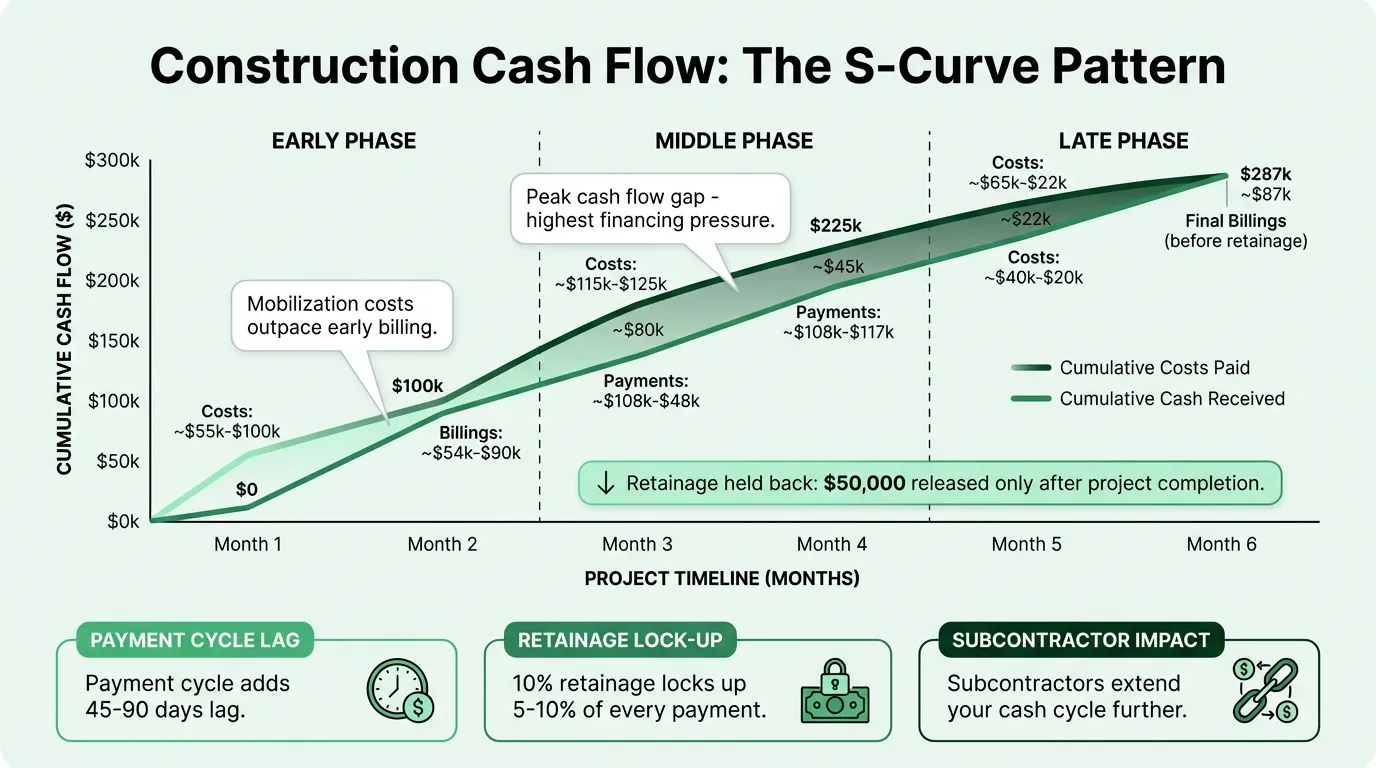
Retainage is earned revenue that sits outside the contractor's bank account for the full project duration. On a $500,000 project billed at 10 % retainage, $50,000 is earned but uncollectable until the owner releases it — often weeks or months after the last billable work. Many contractors fail not from poor margins but from this timing gap. Cash-flow models should show retainage as a separate delayed-receivable line so the shortfall is visible in every forecast period.
0
1
Tags
Electrical Contracting Business Operations
Running an Electrical Contracting Business Course
Related
Retainage as a Delayed Receivable
The portion of each progress payment that a project owner holds back until a project is substantially complete — typically 5–10 % — is called ____.
Arrange the following steps in order to show how a 10% retainage clause creates a timing gap between an electrical contractor's business expenses and their collected cash.
You just completed month one of a new commercial wiring project and are submitting a progress billing for $50,000 of completed work. To complete this work, you have already paid out $45,000 in direct labor and material costs. The project contract includes a standard 10% retainage clause. What is the direct impact of this retainage on your business's cash flow for this specific billing cycle?
You are awarded a $100,000 electrical contract that includes a standard 10% retainage clause. Your total expected project costs (materials, labor, and overhead) are $93,000. Because your total contract value is $7,000 higher than your total costs, this project will maintain a positive cash flow during the construction phase.
You are reviewing four different commercial electrical contracts before deciding which to bid on. Each contract contains a different retainage clause. Evaluate the cash-flow risk each clause poses to your business and match it to the correct risk assessment.
In the context of an electrical contracting business, what does the term 'retainage' refer to?
An electrical contractor completes work on a commercial project that includes a 10% retainage clause. Arrange the following events in the order they typically occur from the contractor's perspective:
As an electrical contractor, you must actively manage the cash flow impacts of retainage. Match each overarching strategy to the practical business action that best applies it.
An electrical contractor is analyzing their cash flow for a commercial project where the owner withholds 10% of every progress payment. Assuming the contractor's progress billing exactly matches their completed work, if their projected net profit margin on this project is 8%, their cash flow for this specific project will remain negative throughout the construction phase until the retainage is finally released.
After evaluating a proposed commercial contract that withholds 10% of all progress payments until final punch-list sign-off, you calculate that your electrical contracting business will run out of cash by month three. To protect your working capital and close the timing gap between earned revenue and collected cash, you determine that you must negotiate a reduction in this ________ percentage before signing the agreement.
You are designing a retainage management protocol for your electrical contracting business before signing a $480,000 commercial contract that withholds 10% of every progress payment until final punch-list sign-off. Your protocol must address three things simultaneously: (1) reduce the cash tied up in retainage during construction, (2) ensure you can track exactly how much is being withheld at any point in time, and (3) protect your working capital if retainage release is delayed beyond the expe
An electrical contractor is analyzing the financial status of an ongoing $300,000 commercial project at the halfway mark. They have completed and submitted progress billings for exactly $150,000 worth of work. The project owner has approved and paid these billings, withholding a standard 10% retainage. Meanwhile, the contractor's total out-of-pocket expenses for labor, materials, and subcontractors to complete this work amount to $140,000.
When analyzing the impact of retainage on the busine
You are evaluating two different contract offers for a $100,000 industrial project. Your analysis focuses on which job will put less strain on your business's bank account (cash flow) during the first few months.
- Contract A: 10% Retainage, but allows you to bill for 'Stored Materials' as soon as they are delivered to the job site.
- Contract B: 5% Retainage, but only allows you to bill for 'Work in Place' (materials after they are fully installed and inspected).
If the project requires a $
You submit an invoice for $50,000 for work completed on a commercial project. The contract terms include a 10% retainage. To complete the work for this billing period, you have already paid $47,000 out-of-pocket for labor, materials, and permits. Based on these numbers, how will your business's bank account balance be impacted once the owner pays this specific invoice?
You are a prime electrical contractor on a commercial project where the owner withholds a retainage from every progress payment. You hire a specialized fire alarm company to complete a segment of the work for a flat fee of $8,000. Your agreement with them does not allow you to withhold retainage from their payment. After you bill the owner for their completed work and receive the payment (minus the owner's retainage), what is the immediate impact on your business's cash flow once you pa
Learn After
Negotiating Retainage Release Conditions
Retainage Flow-Down to Electrical Subcontractors
In an electrical contractor's cash-flow models, what is the primary reason for showing retainage as a separate delayed-receivable line?
Many electrical contractors who go out of business do so because of poor profit margins rather than cash-flow timing gaps caused by earned revenue being withheld until project completion.
Arrange the following events in the correct sequence to demonstrate how retainage functions as a delayed receivable during an electrical contracting project.
You are building a cash-flow model for a $1,000,000 commercial electrical project with a 5% retainage clause. Match each project element to how it should be understood or categorized in your financial planning.
An electrical contractor realizes that despite high profit margins on paper, they are struggling to meet monthly payroll. Upon analyzing their payment applications, they notice that 10% of their earned revenue is consistently withheld by the project owner until the job is fully completed. To accurately reflect this timing gap and ensure the shortfall is visible in every forecast period, the contractor must restructure their cash-flow model by explicitly isolating these withheld funds as a ____.
A fellow electrical contractor shows you the cash-flow forecast for their upcoming $600,000 commercial rewiring project with 10% retainage. In the model, each month's full billed amount is listed as expected collectible income for that period. At the very bottom of the spreadsheet, a single note reads: 'Reminder — $60,000 retainage will be collected after final completion.' The contractor feels confident this model will keep them financially prepared. Which of the following best evaluates the
You are building a custom cash-flow forecasting spreadsheet for your new electrical contracting firm. You are starting a $500,000 project that includes a 10% retainage clause ($50,000), which will be withheld until months after the project ends. To create a system that ensures you can see and manage the resulting 'timing gap' (shown in the attached infographic) before it causes a bank account crisis, which of the following architectural designs for your model would be most effective?
An electrical contractor is reviewing a mid-project financial report for a commercial installation. The report shows the following figures:
- Total Value of Work Completed (Earned Revenue): $150,000
- Total Project Expenses (Labor, Material, and Overhead): $140,000
- Retainage (10% withheld by the owner per contract): $15,000
- Actual Cash Received from the Owner to date: $135,000
When analyzing these figures to determine why the company's bank account shows a $5,000 deficit for this proj
Analyze the following project scenarios based on the relationship between your profit margin and the retainage clause in each contract. Arrange the projects in order from the one that creates the most severe monthly cash-flow deficit (the largest timing gap) to the one that provides the most immediate cash surplus during the construction phase.
A general contractor offers you an electrical subcontract for $100,000. They give you two options for the contract terms:
- Option 1: The full $100,000 price, but with a 10% retainage clause ($10,000 withheld until 90 days after final project completion).
- Option 2: A reduced $96,000 price, but with 0% retainage (you are paid the full amount of every monthly invoice immediately).
If your business has very little cash in the bank to cover your weekly payroll and material costs, which evalu