
Learn Before
Retainage Flow-Down to Electrical Subcontractors
Electrical contractors who subcontract portions of work typically hold the same retainage percentage from their subs that the owner holds from them. A subcontractor completing $200,000 of work in months 1–3 may not see its retainage released until month 8 or 9 when the overall project closes out. This flow-down extends the timing gap down the payment chain and can strain sub relationships. Contractors should communicate the expected release timeline to subs at contract signing and release sub-retainage promptly once the owner releases theirs.
0
1
Tags
Electrical Contracting Business Operations
Running an Electrical Contracting Business Course
Related
Negotiating Retainage Release Conditions
Retainage Flow-Down to Electrical Subcontractors
In an electrical contractor's cash-flow models, what is the primary reason for showing retainage as a separate delayed-receivable line?
Many electrical contractors who go out of business do so because of poor profit margins rather than cash-flow timing gaps caused by earned revenue being withheld until project completion.
Arrange the following events in the correct sequence to demonstrate how retainage functions as a delayed receivable during an electrical contracting project.
You are building a cash-flow model for a $1,000,000 commercial electrical project with a 5% retainage clause. Match each project element to how it should be understood or categorized in your financial planning.
An electrical contractor realizes that despite high profit margins on paper, they are struggling to meet monthly payroll. Upon analyzing their payment applications, they notice that 10% of their earned revenue is consistently withheld by the project owner until the job is fully completed. To accurately reflect this timing gap and ensure the shortfall is visible in every forecast period, the contractor must restructure their cash-flow model by explicitly isolating these withheld funds as a ____.
A fellow electrical contractor shows you the cash-flow forecast for their upcoming $600,000 commercial rewiring project with 10% retainage. In the model, each month's full billed amount is listed as expected collectible income for that period. At the very bottom of the spreadsheet, a single note reads: 'Reminder — $60,000 retainage will be collected after final completion.' The contractor feels confident this model will keep them financially prepared. Which of the following best evaluates the
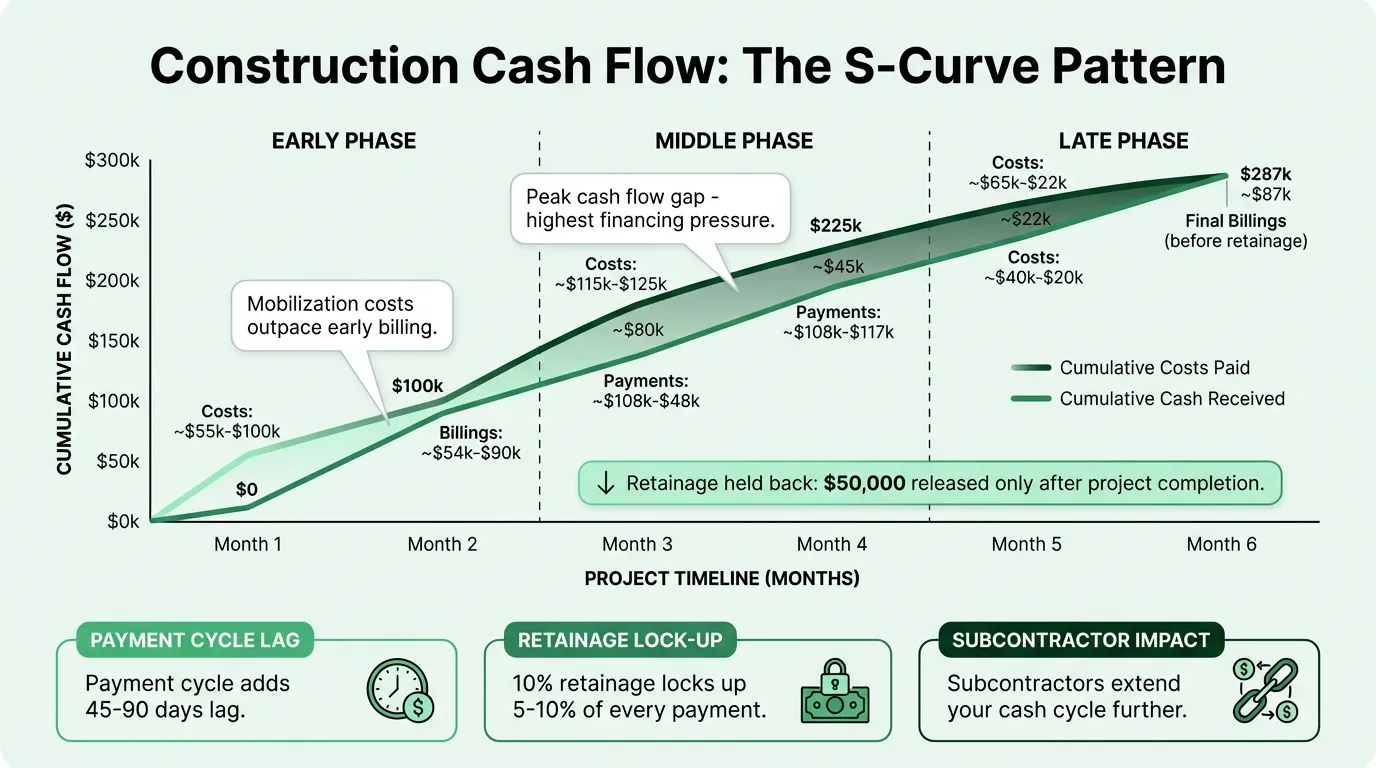
You are building a custom cash-flow forecasting spreadsheet for your new electrical contracting firm. You are starting a $500,000 project that includes a 10% retainage clause ($50,000), which will be withheld until months after the project ends. To create a system that ensures you can see and manage the resulting 'timing gap' (shown in the attached infographic) before it causes a bank account crisis, which of the following architectural designs for your model would be most effective?
An electrical contractor is reviewing a mid-project financial report for a commercial installation. The report shows the following figures:
- Total Value of Work Completed (Earned Revenue): $150,000
- Total Project Expenses (Labor, Material, and Overhead): $140,000
- Retainage (10% withheld by the owner per contract): $15,000
- Actual Cash Received from the Owner to date: $135,000
When analyzing these figures to determine why the company's bank account shows a $5,000 deficit for this proj
Analyze the following project scenarios based on the relationship between your profit margin and the retainage clause in each contract. Arrange the projects in order from the one that creates the most severe monthly cash-flow deficit (the largest timing gap) to the one that provides the most immediate cash surplus during the construction phase.
A general contractor offers you an electrical subcontract for $100,000. They give you two options for the contract terms:
- Option 1: The full $100,000 price, but with a 10% retainage clause ($10,000 withheld until 90 days after final project completion).
- Option 2: A reduced $96,000 price, but with 0% retainage (you are paid the full amount of every monthly invoice immediately).
If your business has very little cash in the bank to cover your weekly payroll and material costs, which evalu
Learn After
Planning Cash Flow Around Retainage Absence
When an electrical contractor subcontracts portions of a project, they typically hold the same retainage percentage from their subcontractors that the project owner holds from them.
Why can the standard practice of "flowing down" retainage create financial friction with electrical subcontractors, and what is the best way for a primary contractor to manage this expectation?
You are the primary electrical contractor on a large commercial build. The project owner is holding a 5% retainage on your contract until the building is completely finished in month 9. You hire a specialized trenching subcontractor who will complete all their underground work by month 2. To properly apply the 'flow-down' practice while maintaining a good relationship, arrange your management actions in the correct chronological order.
Analyze the mechanics and consequences of the retainage flow-down process by matching each scenario or management practice with its underlying strategic impact or root cause.
An electrical contractor holds 10% retainage from a subcontractor whose $200,000 scope of underground work was fully completed by month 3. However, the overall project does not close out until month 9. The subcontractor is now refusing future work because they had no idea their withheld funds would be tied up for an additional six months. When judging where this business relationship broke down, the contractor's most critical mistake was failing to communicate the expected retainage release ___
Which of the following best describes the standard practice of 'retainage flow-down' between an electrical contractor and their subcontractors?
Under standard retainage flow-down practices, an electrical subcontractor who completes their specific installation during the first few months of a year-long project will typically receive their retainage payment as soon as their portion of the work is inspected and approved.
As an electrical contractor managing a large project, arrange the following steps in the correct order to properly handle retainage flow-down with a subcontractor whose installation work is completed early in the schedule.
As an electrical contractor managing a large project, analyze the following management actions regarding subcontractor retainage and match them with their most likely operational consequence.
When evaluating the financial risk of paying a specialty subcontractor in full for work completed early in a year-long project, an electrical contractor must weigh the potential for unrecoverable costs against maintaining good relations. To prioritize their own cash flow protection and justify withholding the final payment until the project closes, the contractor enforces a ________ ________, a standard practice ensuring the subcontractor shares the burden of the owner's withheld funds.
You are establishing the standard operating procedures for your new electrical contracting firm. You need to design a 'Retainage Flow-Down' protocol that protects your company's cash flow during a long-term commercial project while ensuring your specialized subcontractors (like fire alarm or low-voltage installers) remain motivated and informed. Which of the following comprehensive designs represents the most professional and effective protocol?
Your electrical contracting firm is the prime contractor for a new retail build-out scheduled to take 8 months. The client is withholding 10% retainage from your monthly payments. You hire a subcontractor to handle the low-voltage wiring for a total of $20,000, and they complete their entire scope of work by the end of Month 2. Following the practice of 'retainage flow-down,' which of the following actions represents the correct way to handle their final invoice?
Match each standard business practice for subcontractor retainage flow-down with its correct description or timing requirement.
You are the prime contractor on an electrical project where the client is withholding 10% retainage from your payments. Match each project milestone with the correct action required to properly apply the practice of retainage flow-down.
Examine the typical timing gaps in construction payments shown in the provided cash flow example. Suppose you are an electrical contractor managing a 10-month project where the owner holds 10% retainage. Your subcontractor completes their specific installation in Month 2, but per the practice of 'retainage flow-down,' you do not expect to receive their portion of the funds from the owner until Month 10.
Evaluate the following management strategies and select the one that most effectively minim