
Learn Before
Planning Cash Flow Around Retainage Absence
Because retainage is earned money on a delayed schedule, the contractor's cash-flow plan must fund operations without it. Practical steps include sizing working-capital reserves to cover the retainage gap, aligning material purchases and sub payments to collected (not billed) revenue, and reviewing retainage exposure across all active projects — not just one job. Negotiating release terms before signing the contract is the single highest-leverage action, because it converts an uncertain holdback into a scheduled receivable.
0
1
Tags
Electrical Contracting Business Operations
Running an Electrical Contracting Business Course
Related
Planning Cash Flow Around Retainage Absence
When an electrical contractor subcontracts portions of a project, they typically hold the same retainage percentage from their subcontractors that the project owner holds from them.
Why can the standard practice of "flowing down" retainage create financial friction with electrical subcontractors, and what is the best way for a primary contractor to manage this expectation?
You are the primary electrical contractor on a large commercial build. The project owner is holding a 5% retainage on your contract until the building is completely finished in month 9. You hire a specialized trenching subcontractor who will complete all their underground work by month 2. To properly apply the 'flow-down' practice while maintaining a good relationship, arrange your management actions in the correct chronological order.
Analyze the mechanics and consequences of the retainage flow-down process by matching each scenario or management practice with its underlying strategic impact or root cause.
An electrical contractor holds 10% retainage from a subcontractor whose $200,000 scope of underground work was fully completed by month 3. However, the overall project does not close out until month 9. The subcontractor is now refusing future work because they had no idea their withheld funds would be tied up for an additional six months. When judging where this business relationship broke down, the contractor's most critical mistake was failing to communicate the expected retainage release ___
Which of the following best describes the standard practice of 'retainage flow-down' between an electrical contractor and their subcontractors?
Under standard retainage flow-down practices, an electrical subcontractor who completes their specific installation during the first few months of a year-long project will typically receive their retainage payment as soon as their portion of the work is inspected and approved.
As an electrical contractor managing a large project, arrange the following steps in the correct order to properly handle retainage flow-down with a subcontractor whose installation work is completed early in the schedule.
As an electrical contractor managing a large project, analyze the following management actions regarding subcontractor retainage and match them with their most likely operational consequence.
When evaluating the financial risk of paying a specialty subcontractor in full for work completed early in a year-long project, an electrical contractor must weigh the potential for unrecoverable costs against maintaining good relations. To prioritize their own cash flow protection and justify withholding the final payment until the project closes, the contractor enforces a ________ ________, a standard practice ensuring the subcontractor shares the burden of the owner's withheld funds.
You are establishing the standard operating procedures for your new electrical contracting firm. You need to design a 'Retainage Flow-Down' protocol that protects your company's cash flow during a long-term commercial project while ensuring your specialized subcontractors (like fire alarm or low-voltage installers) remain motivated and informed. Which of the following comprehensive designs represents the most professional and effective protocol?
Your electrical contracting firm is the prime contractor for a new retail build-out scheduled to take 8 months. The client is withholding 10% retainage from your monthly payments. You hire a subcontractor to handle the low-voltage wiring for a total of $20,000, and they complete their entire scope of work by the end of Month 2. Following the practice of 'retainage flow-down,' which of the following actions represents the correct way to handle their final invoice?
Match each standard business practice for subcontractor retainage flow-down with its correct description or timing requirement.
You are the prime contractor on an electrical project where the client is withholding 10% retainage from your payments. Match each project milestone with the correct action required to properly apply the practice of retainage flow-down.
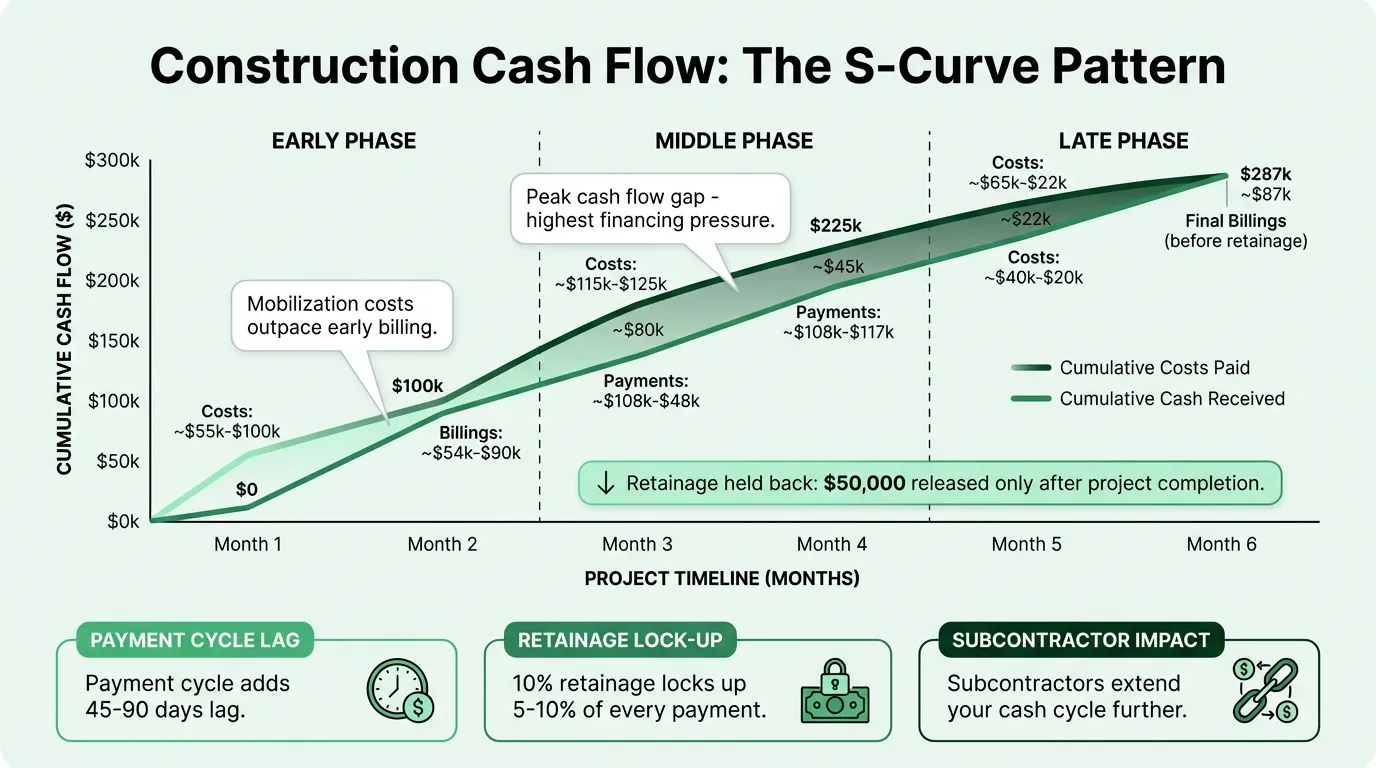
Examine the typical timing gaps in construction payments shown in the provided cash flow example. Suppose you are an electrical contractor managing a 10-month project where the owner holds 10% retainage. Your subcontractor completes their specific installation in Month 2, but per the practice of 'retainage flow-down,' you do not expect to receive their portion of the funds from the owner until Month 10.
Evaluate the following management strategies and select the one that most effectively minim
Learn After
When planning your electrical contracting business's cash flow, what is considered the single highest-leverage action for managing retainage — the portion of your earned payments that a client withholds until project milestones or completion?
To maintain healthy cash flow despite delayed retainage payments, an electrical contractor should base their material purchases and subcontractor payments on their total billed revenue.
Match each practical cash-flow strategy to the real-world scenario that best demonstrates its application for managing retainage in an electrical contracting business.
Arrange the following practical steps in the logical sequence an electrical contractor should take to manage the financial impact of retainage, progressing from the initial pre-project phase through to ongoing operational monitoring.
An electrical contractor is evaluating their company's severe cash-flow crisis despite having highly profitable jobs. Upon auditing their financial procedures, they identify a critical flaw: the business has been consistently aligning material purchases and subcontractor payments with the total amounts invoiced to clients. To correct this operational vulnerability and survive the absence of retainage, the contractor determines they must overhaul their policy to strictly align all outgoing paymen
Match each practical step for managing cash flow around retainage with its corresponding description or rationale.
When an electrical contractor creates a cash-flow plan to accommodate project retainage, which of the following approaches best ensures that daily operations remain funded?
As an electrical contractor preparing to take on a new commercial job with a 10% retainage requirement, arrange the following actions in the most effective chronological sequence to proactively manage and protect your company's cash flow.
When analyzing cash flow strategies for a commercial project with a 10% retainage, an electrical contractor concludes that negotiating retainage release milestones prior to contract signing is a higher-leverage financial strategy than simply increasing working-capital reserves, because negotiation transforms an uncertain payment delay into a predictable collection schedule.
When evaluating the effectiveness of different cash-flow management tactics, an electrical contractor determines that simply increasing working-capital reserves is a passive approach to handling delayed payments. To proactively protect the company's financial health, the contractor concludes that the single highest-leverage action is to ________ retainage release terms before signing the contract, thereby converting an unpredictable holdback into a scheduled receivable.
As the founder of a new electrical contracting business, you are designing a 'Cash Flow Protection Framework' to manage the financial gap caused by standard 10% retainage holdbacks across your portfolio. Which of the following integrated strategy sets represents the most robust and functional 'design' to ensure your company's operations remain fully funded throughout various project lifecycles?
Review the provided cash-flow infographic, which illustrates the 'valley' of negative cash flow that contractors typically face before a project becomes cash-positive.
Analysis: If an electrical contractor successfully negotiates a 'milestone retainage release' (where half of the withheld money is paid out once the project reaches 50% completion), which of the following statements best describes the resulting structural change to the company's cash-flow plan?
To effectively manage cash flow on projects with retainage, an electrical contractor should align their material purchases and subcontractor payments with which type of revenue?
To protect your new electrical business from insolvency, you are designing a 'Financial Resilience Protocol' to manage the gap between earning money and physically receiving it due to project retainage holdbacks.
Review the provided infographic showing the 'Cash Flow Valley,' then arrange the following strategic phases in the correct order to form a functional, self-sustaining financial framework.
Review the provided infographic illustrating the 'Cash Flow Valley.' If an electrical contractor is working on a project with a standard 10% retainage holdback, how does this holdback specifically impact the company's financial position during the 'valley' phase?