
Learn Before
Negotiating Retainage Release Conditions
Before the project starts, the contractor should negotiate specific, measurable conditions that trigger retainage release. Common triggers include passing final inspection, delivering as-built documents, submitting all lien waivers, and completing punch list items. Putting these conditions in writing at contract signing prevents disputes at closeout. Some contracts allow partial retainage release at substantial completion, with the remainder released after final completion. Tracking each trigger in a checklist helps the contractor request release promptly once all conditions are met. Retainage rules and allowable percentages vary by state and contract type.
0
1
Tags
Electrical Contracting Business Operations
Running an Electrical Contracting Business Course
Related
Negotiating Retainage Release Conditions
Retainage Flow-Down to Electrical Subcontractors
In an electrical contractor's cash-flow models, what is the primary reason for showing retainage as a separate delayed-receivable line?
Many electrical contractors who go out of business do so because of poor profit margins rather than cash-flow timing gaps caused by earned revenue being withheld until project completion.
Arrange the following events in the correct sequence to demonstrate how retainage functions as a delayed receivable during an electrical contracting project.
You are building a cash-flow model for a $1,000,000 commercial electrical project with a 5% retainage clause. Match each project element to how it should be understood or categorized in your financial planning.
An electrical contractor realizes that despite high profit margins on paper, they are struggling to meet monthly payroll. Upon analyzing their payment applications, they notice that 10% of their earned revenue is consistently withheld by the project owner until the job is fully completed. To accurately reflect this timing gap and ensure the shortfall is visible in every forecast period, the contractor must restructure their cash-flow model by explicitly isolating these withheld funds as a ____.
A fellow electrical contractor shows you the cash-flow forecast for their upcoming $600,000 commercial rewiring project with 10% retainage. In the model, each month's full billed amount is listed as expected collectible income for that period. At the very bottom of the spreadsheet, a single note reads: 'Reminder — $60,000 retainage will be collected after final completion.' The contractor feels confident this model will keep them financially prepared. Which of the following best evaluates the
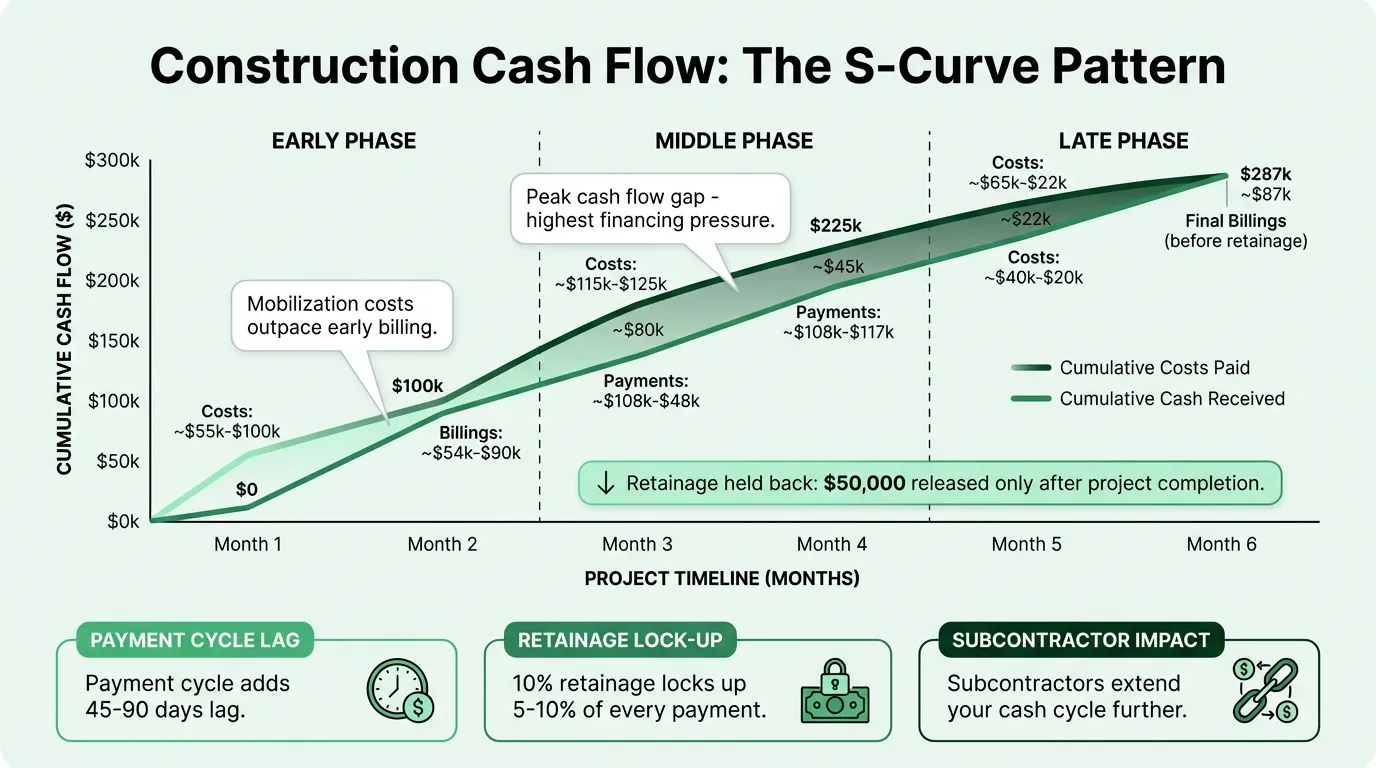
You are building a custom cash-flow forecasting spreadsheet for your new electrical contracting firm. You are starting a $500,000 project that includes a 10% retainage clause ($50,000), which will be withheld until months after the project ends. To create a system that ensures you can see and manage the resulting 'timing gap' (shown in the attached infographic) before it causes a bank account crisis, which of the following architectural designs for your model would be most effective?
An electrical contractor is reviewing a mid-project financial report for a commercial installation. The report shows the following figures:
- Total Value of Work Completed (Earned Revenue): $150,000
- Total Project Expenses (Labor, Material, and Overhead): $140,000
- Retainage (10% withheld by the owner per contract): $15,000
- Actual Cash Received from the Owner to date: $135,000
When analyzing these figures to determine why the company's bank account shows a $5,000 deficit for this proj
Analyze the following project scenarios based on the relationship between your profit margin and the retainage clause in each contract. Arrange the projects in order from the one that creates the most severe monthly cash-flow deficit (the largest timing gap) to the one that provides the most immediate cash surplus during the construction phase.
A general contractor offers you an electrical subcontract for $100,000. They give you two options for the contract terms:
- Option 1: The full $100,000 price, but with a 10% retainage clause ($10,000 withheld until 90 days after final project completion).
- Option 2: A reduced $96,000 price, but with 0% retainage (you are paid the full amount of every monthly invoice immediately).
If your business has very little cash in the bank to cover your weekly payroll and material costs, which evalu
Learn After
Reduced-Retainage Trigger Tracking
Final Billing and Closeout Payment Process
When should an electrical contractor negotiate the specific conditions that will trigger retainage release on a project?
Arrange the following steps in the correct chronological order for successfully managing and securing the release of retainage funds on a project.
You are preparing to sign a subcontract for a commercial wiring project. The general contractor verbally promises to release your withheld funds as soon as your crew finishes the electrical work. Because of this verbal assurance, you can safely proceed without adding specific retainage release triggers to the written contract.
Analyze the strategic impact of different retainage management practices. Match each action with its primary business benefit or risk mitigation.
An electrical contractor evaluates a contract and rejects a clause stating retainage will be released 'when the owner is satisfied.' To protect the business from arbitrary payment delays, the contractor negotiates to replace this subjective clause with objective, measurable ______ (such as passing final electrical inspection) that are put in writing before signing.
After analyzing the cash flow risks associated with project closeout (as illustrated in the infographic), you decide to design a 'Two-Tiered Retainage Release Protocol' for your electrical contracting business. Your goal is to assemble a functional set of triggers that recovers a portion of your funds as soon as your physical work is verified, while providing a clear path for the remaining balance. Which of the following structures best synthesizes these elements into an effective payment plan?
An electrical contractor is analyzing a contract that states: 'Retainage shall be released within 30 days of the completion of the project punch list.' To minimize the risk of payment delays, the contractor wants to negotiate this clause. Which of the following statements correctly analyzes why this specific trigger is problematic for a subcontractor?
In the context of an electrical subcontract, which of the following is a common, objective 'trigger' that should be negotiated into the contract to specify when retainage will be released?
As an electrical contractor, meeting closeout requirements is essential for getting your final payment (retainage) released. Match each common retainage release trigger with the specific action or document that proves the condition has been met.
In many electrical contracting agreements, which project milestone typically allows for a partial release of retainage funds before the project is fully completed?