
Learn Before
Reduced-Retainage Trigger Tracking
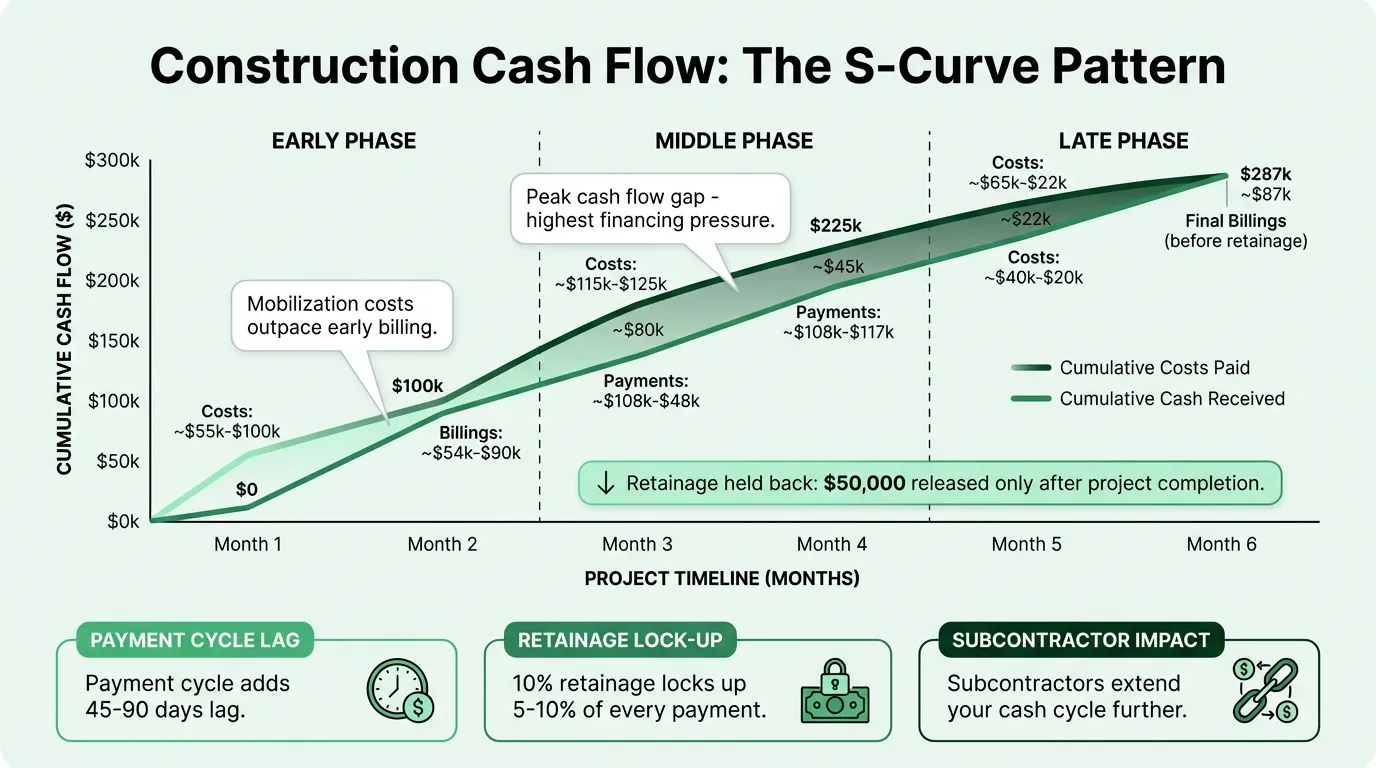
Some contracts allow the retainage rate to drop — for example, from 10 % to 5 % — after the project reaches a defined completion threshold such as 50 %. Missing that trigger means cash stays locked up unnecessarily. The project manager or billing coordinator should calendar the milestone, confirm completion percentage on the next pay application, and formally request the rate reduction in writing so the owner adjusts future withholdings.
0
1
Tags
Electrical Contracting Business Operations
Running an Electrical Contracting Business Course
Related
Reduced-Retainage Trigger Tracking
Final Billing and Closeout Payment Process
When should an electrical contractor negotiate the specific conditions that will trigger retainage release on a project?
Arrange the following steps in the correct chronological order for successfully managing and securing the release of retainage funds on a project.
You are preparing to sign a subcontract for a commercial wiring project. The general contractor verbally promises to release your withheld funds as soon as your crew finishes the electrical work. Because of this verbal assurance, you can safely proceed without adding specific retainage release triggers to the written contract.
Analyze the strategic impact of different retainage management practices. Match each action with its primary business benefit or risk mitigation.
An electrical contractor evaluates a contract and rejects a clause stating retainage will be released 'when the owner is satisfied.' To protect the business from arbitrary payment delays, the contractor negotiates to replace this subjective clause with objective, measurable ______ (such as passing final electrical inspection) that are put in writing before signing.
After analyzing the cash flow risks associated with project closeout (as illustrated in the infographic), you decide to design a 'Two-Tiered Retainage Release Protocol' for your electrical contracting business. Your goal is to assemble a functional set of triggers that recovers a portion of your funds as soon as your physical work is verified, while providing a clear path for the remaining balance. Which of the following structures best synthesizes these elements into an effective payment plan?
An electrical contractor is analyzing a contract that states: 'Retainage shall be released within 30 days of the completion of the project punch list.' To minimize the risk of payment delays, the contractor wants to negotiate this clause. Which of the following statements correctly analyzes why this specific trigger is problematic for a subcontractor?
In the context of an electrical subcontract, which of the following is a common, objective 'trigger' that should be negotiated into the contract to specify when retainage will be released?
As an electrical contractor, meeting closeout requirements is essential for getting your final payment (retainage) released. Match each common retainage release trigger with the specific action or document that proves the condition has been met.
In many electrical contracting agreements, which project milestone typically allows for a partial release of retainage funds before the project is fully completed?
Learn After
When a contract allows the retainage rate to decrease after a project reaches a certain completion percentage, the reduction is applied automatically without the contractor needing to take any action.
If an electrical contractor fails to actively track a project's reduced-retainage trigger, what is the most likely outcome regarding their cash flow?
You are managing a commercial electrical project where the contract allows retainage to drop from 10% to 5% once the work reaches 50% completion. Arrange the proactive steps your team should take to successfully execute this reduction and free up your cash flow.
Successfully executing a reduced-retainage trigger requires an electrical contractor to manage several distinct administrative steps. Analyze the following potential failures in this process and match each failure to its direct operational or financial consequence.
As an electrical contractor, you are evaluating why your company's cash flow is unnecessarily tight. You review a project that is 70% complete and notice the owner is still withholding 10% retainage, even though the contract allows it to drop to 5% after the halfway mark. You determine that your billing coordinator made a critical error by relying on the owner to automatically adjust the rate. To fix this process, you mandate that your team must proactively track this milestone and formally requ
Referring to the cash flow challenges illustrated in the infographic, you are designing a new 'Revenue Recovery Protocol' for your electrical business. To create a functional internal system that specifically addresses the mid-project cash 'lock-up' caused by retainage, which combination of administrative controls should you implement?
Which document is used to verify the project's completion percentage before submitting a formal request for a retainage rate reduction?
To effectively manage cash flow, an electrical contractor must proactively track triggers that allow for lower withholding rates. Match each step of the tracking process to its primary purpose.
You are managing an electrical project where the contract allows your retainage to drop from 10% to 5% once you reach 50% completion. Your billing coordinator suggests skipping the formal request for this reduction, stating: 'The project is moving fast, and it’s better not to bother the General Contractor with extra paperwork for a small percentage change.' Based on the cash flow principles shown in the 'Construction Cash Flow' infographic, evaluate the validity of this suggestion.
Your electrical firm is currently at 65% completion on a commercial project. You discover that your team never requested the retainage reduction (from 10% down to 5%) that was contractually available once the project passed 50% completion. Your Project Manager suggests skipping the request now, claiming: 'We already missed the 50% trigger window, so we might as well just wait for the final payout at the end of the job.' Referring to the cash flow challenges shown in the infographic, evaluate thi