
Progress Billing as a Cash Flow Tool for Electrical Contractors
Progress billing (periodic billing / draw requests) means invoicing for work completed to date at regular intervals — typically monthly — rather than waiting until the project is finished. Each invoice is called an Application for Payment and is tied to the contract's Schedule of Values so every line item is auditable.
0
1
Tags
Electrical Contracting Business Operations
Running an Electrical Contracting Business Course
Related
Cash Flow Versus Profit Distinction for Contractors
Customer Deposits and Mobilization Payments for Electrical Projects
Progress Billing as a Cash Flow Tool for Electrical Contractors
Collections Workflow for Electrical Contractor Receivables
Payment Methods and Processing Fees for Electrical Contractors
Cash Reserves and Emergency Fund Sizing for Electrical Contractors
Front-Loaded Cost Structure in Electrical Contracting
Why can an electrical contracting business experience a cash shortage even when a job is ultimately profitable?
Put the following steps of a typical billing-and-collections cycle for an electrical contracting job in the correct order, from first to last.
Match each cash flow management strategy to its practical role in helping an electrical contracting business meet its financial obligations.
You have just secured a large residential rewiring contract that guarantees a 25% profit margin. The homeowner will pay the full balance 30 days after the project is completed. In the meantime, you need to purchase wire and panels next week, and pay your electricians every Friday. True or False: Because the contract guarantees a high profit margin, your business will naturally have the necessary funds to cover the upcoming material and labor costs without relying on cash reserves or alternative
You are auditing an electrical contracting business that is struggling to make weekly payroll despite securing contracts with a 25% net profit margin. By breaking down their project timelines, you find they are paying for wire, conduit, and labor immediately, while allowing their commercial clients Net-60 payment terms. This analysis reveals that the fundamental cause of their financial distress is a severe disruption in ____, demonstrating that profitable jobs can still lead to insolvency if th
You are reviewing the billing and collections practices of two electrical contracting businesses that are similar in size, job volume, and profit margins.
Business A invoices commercial clients immediately upon completing each project phase, requires a 50% deposit before ordering materials, offers a 2% discount for payment within 10 days, and maintains a cash reserve equal to six weeks of operating expenses.
Business B invoices clients only after the entire project is finished, does not requir
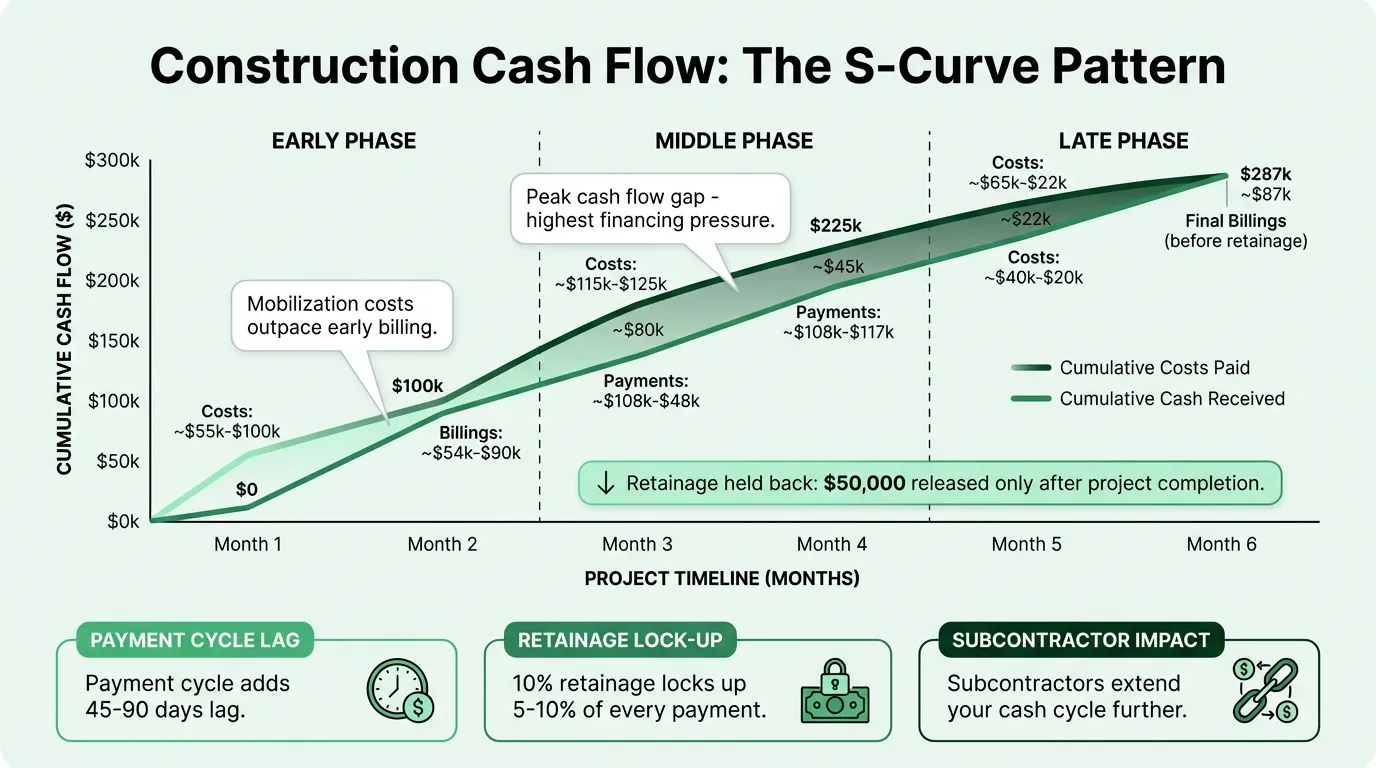
Using the provided infographic as a guide for the financial 'valleys' to avoid during a project, you must design a Standard Operating Procedure (SOP) that ensures your electrical contracting business maintains a positive cash balance from start to finish. Arrange the following components in the correct logical order to construct a Proactive Cash Flow System for a high-cost commercial job.
Based on the provided infographic, which illustrates the 'Cumulative Cash Position' (the running cash balance) during a project, how would the graph most likely change if an electrical contractor switched from billing only at the end of a project to using 'milestone billing' at regular intervals throughout the work?
Analyze the common financial struggles of a new electrical contracting business. Match each 'Cash Flow Symptom' to the underlying structural cause related to the timing of money in the business cycle.
You are starting a new residential rewiring project with the following financial details:
• Total Contract Value: $10,000 • Immediate Material Costs (Wire/Panels): $4,000 • Crew Labor Costs (Due this Friday): $1,500 • Current Business Bank Balance: $2,000
Which billing term should you apply to this contract to ensure you can meet your financial obligations by the end of the first week?
Learn After
Retainage Impact on Electrical Contractor Cash Flow
Application for Payment Line-Item Structure
Progress billing means an electrical contractor waits until the entire project is finished before sending the customer an invoice.
You are managing a six-month electrical installation for a new office building. To maintain positive cash flow, you plan to use progress billing. At the end of month one, how should you determine the amount to invoice the general contractor?
Match each progress billing term with its correct role in managing cash flow on an electrical project.
Analyze the operational workflow of progress billing. Arrange the logical sequence of actions an electrical contractor must take to set up and execute a progress billing cycle to maintain steady cash flow on a long-term project.
You are evaluating a dispute between an electrical contractor and a general contractor over a progress billing invoice. The general contractor refuses to pay the monthly draw request, arguing that the amount billed for the rough-in wiring seems arbitrary. You determine the electrical contractor's invoicing process is flawed because it lacks verifiable proof of progress. To correct this structural failure and guarantee that every billed amount is fully auditable, you dictate that their Applicatio
Which billing method allows an electrical contractor to invoice for work completed at regular intervals during a project, rather than waiting until the entire job is finished to receive payment?
An electrical contractor is two months into a six-month commercial build. Under a progress billing agreement, they must wait until the final inspection is passed before submitting an Application for Payment to cover their labor and materials.
You recently won a contract for a six-month commercial wiring project and want to avoid funding the entire job out of pocket. Arrange the practical steps of implementing progress billing in the correct order to successfully manage your cash flow.
Analyze the components of progress billing in an electrical contracting business. Match each project scenario or administrative task with its corresponding outcome or action.
An electrical contractor is offered a six-month commercial wiring contract worth $180,000. After reviewing the contract terms, she discovers it requires a single lump-sum payment only upon final project completion. She evaluates the financial risk and concludes that — before signing — she must negotiate ____ into the contract, which will allow her to invoice monthly against a Schedule of Values and avoid funding six months of labor and materials entirely out of pocket.
Review the 'Construction Cash Flow' infographic, which highlights the 'Cash Gap' (the red shaded area) where a contractor’s expenses exceed their income. To solve this problem for your business, you need to design a billing strategy for a new $90,000 commercial project. Which structure for your 'Schedule of Values' (the list of items you bill against) would you create to most effectively minimize this cash gap?
An electrical contractor is three months into a large commercial project. Their internal records show they have spent $20,000 on materials and $15,000 on labor. They submit a progress bill for $35,000. The project owner rejects the invoice because it does not align with the 'Schedule of Values,' which shows the 'Rough-in' stage (100% complete) is valued at only $25,000. Analyze the relationship between the contractor's request and the progress billing system to determine the root cause of th
An electrical contractor is preparing a monthly invoice for a commercial project. To ensure the billing is auditable and tied to the contract price, they must link each line item on their invoice to which specific document?
Review the 'Construction Cash Flow' infographic, which illustrates the 'Cash Gap'—the period where a contractor's expenses for labor and materials exceed their incoming payments. To create a professional billing system for your electrical business that eliminates this gap, in what order should you design and implement these administrative steps?
Evaluate the following scenario: A new electrical contractor chooses a $55,000 commercial project with a lump-sum payment at the end because the total payout is $2,000 higher than the progress-billing alternative. The contractor has $5,000 in cash reserves but must spend $15,000 on materials in the first month.
Based on the concept of the 'Cash Gap' shown in the provided infographic, what is the most accurate evaluation of this decision?