
Decline in Living Standards in China and India During Europe's Industrialization
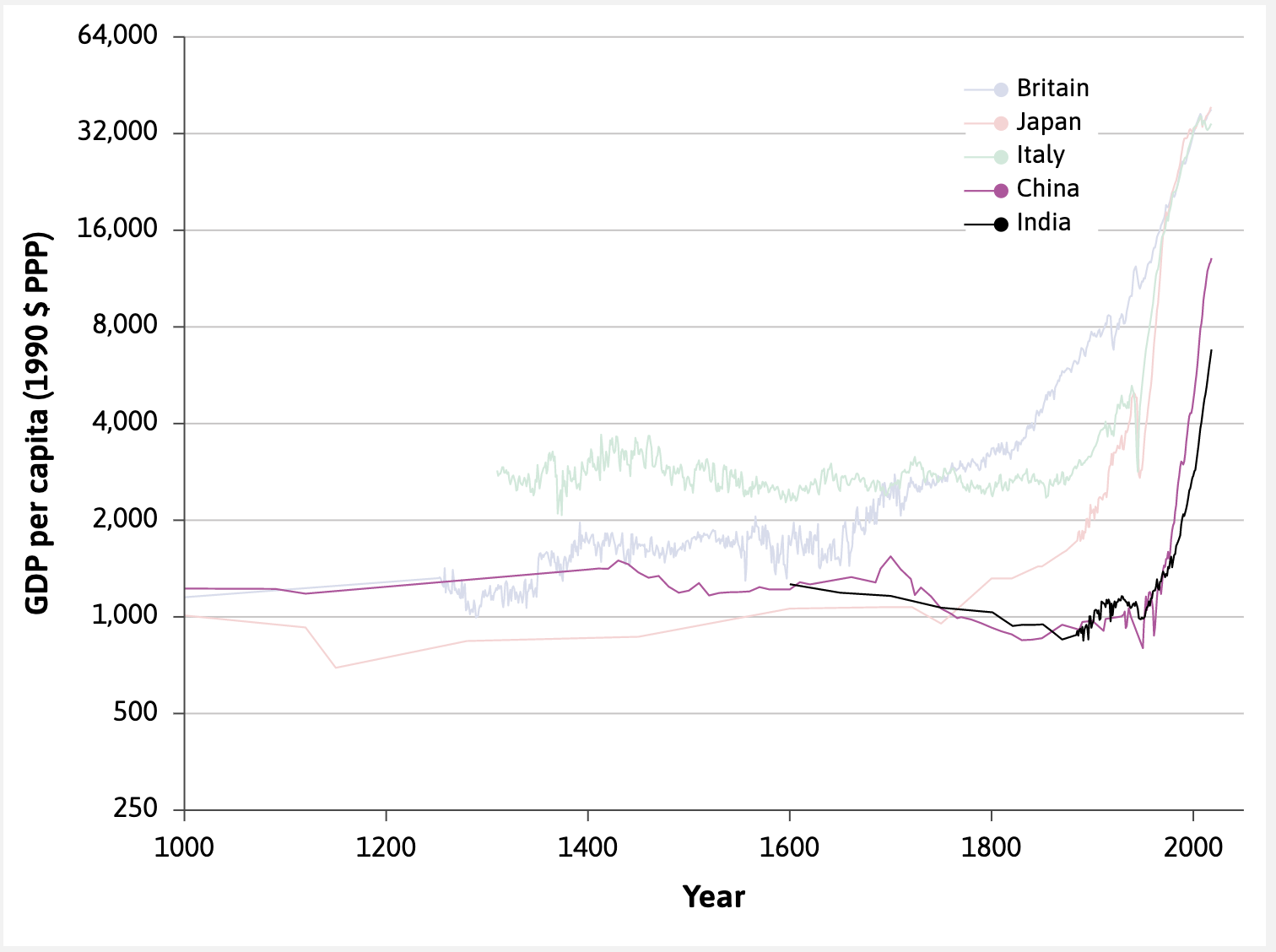
In stark contrast to the early industrializers, China and India experienced a period where their average living standards actually declined. This decline occurred precisely during the era when Western European nations were beginning their 'hockey stick' growth takeoff.
0
1
Contributors are:


Who are from:


Tags
Social Science
Empirical Science
Science
Economy
CORE Econ
The Economy 1.0 @ CORE Econ
Ch.1 The Capitalist Revolution - The Economy 1.0 @ CORE Econ
Economics
Introduction to Microeconomics Course
Ch.1 Prosperity, inequality, and planetary limits - The Economy 2.0 Microeconomics @ CORE Econ
The Economy 2.0 Microeconomics @ CORE Econ
Related
Decline in Living Standards in China and India During Europe's Industrialization
Delayed Economic Growth in China and India Until Post-Colonial Independence
From the early 19th to the mid-20th century, China's per capita income fell dramatically relative to Britain's. Given that China was not formally colonized during this period, which of the following best analyzes the primary mechanism behind this economic decline?
Foreign Influence and Economic Sovereignty
China's economic decline from the early 19th to the mid-20th century was a direct result of its formal colonization by multiple European powers.
Arrange the following historical events, which describe the economic trajectory of a major Asian nation from the early 19th to the mid-20th century, into the correct chronological order.
Evaluating Economic Decline Without Formal Colonization
Match each historical economic concept related to a major Asian nation's downturn between the early 19th and mid-20th centuries with its correct description.
Analyzing Economic Decline Under Foreign Influence
During a period of significant economic decline from the early 19th to the mid-20th century, a major Asian nation's economic decision-making was heavily restricted by foreign powers who, despite not formally colonizing the country, controlled its most important ____.
A historian argues that the primary reason for a major Asian nation's economic decline from the 19th to mid-20th century was internal political instability alone. Based on the understanding that this nation was not formally colonized but had its key ports controlled by foreign powers, which statement best evaluates the historian's argument?
An economic historian observes that a nation's per capita income stagnated for over a century while its global trading partners experienced rapid growth. The historian also notes that during this period, the nation was not officially part of any empire, but its major coastal cities and trade policies were heavily influenced by foreign governments. Which of the following conclusions is most strongly supported by these observations?
Global Population Distribution by Income Relative to India
Analyzing India's Economic Development Over Centuries
An economic historian observes that, compared to the 14th century, modern India has substantially higher life expectancy and better access to food. However, a separate development report concludes that a large portion of India's population is impoverished by today's global standards. Which statement best explains this apparent contradiction?
Consider the following two statements about India's economic situation:
Statement A: An average person in India today has a significantly longer life expectancy and better access to food and sanitation than an average person living in the same region in the 14th century.
Statement B: When measured against the average incomes of all countries in the world today, a large part of India's population is classified as poor.
Which of the following best explains how both of these statements can be factually correct?
Interpreting Economic Progress in India
A commentator argues: 'Given that a majority of India's population is still considered poor when compared to wealthy nations today, it is clear that there has been no meaningful improvement in the material wellbeing of the average Indian since the 14th century.' Which of the following provides the most accurate critique of this argument?
The fact that a large portion of India's population is considered impoverished when measured against contemporary global benchmarks is sufficient evidence to conclude that there has been no significant improvement in the average Indian's life expectancy or access to sanitation since the 14th century.
Reconciling Historical Progress and Modern Poverty in India
An economic researcher is presented with two reports on a specific region in India:
- Report A (Historical Analysis): This report compares data from the 14th century to the present day. It finds that average life expectancy has more than doubled, access to basic sanitation has gone from non-existent to widespread, and famines are far less common. The report concludes that living standards have improved dramatically.
- Report B (Global Snapshot): This report compares the region's current average income to that of high-income countries and the current global average. It finds the region's income is significantly lower than both benchmarks. The report concludes that the population experiences widespread poverty.
Which statement best reconciles the findings of these two reports?
Critiquing an Economic Argument
Evaluating Arguments on Economic Development
Examples of Improved Living Standards in India Since the 14th Century
Life Expectancy at Birth
Decline in Living Standards in China and India During Europe's Industrialization
Delayed Economic Growth in China and India Until Post-Colonial Independence
Britain's Early and Gradual 'Hockey Stick' Kink
Japan's Sharp 'Hockey Stick' Kink around 1870
Delayed or Absent 'Hockey Stick' Growth in Some Countries
Hans Rosling's Video on Divergent National Progress in Health and Wealth
Impact of Resisting Foreign Intervention on Economic Growth: Japan vs. Britain (1600-1975)
Variability of Success in Capitalist Economies
Insufficiency of a Single Model for Explaining 'Hockey Stick' Growth
Germany's Industrialization Strategy: Role of Government and Banks
Japan's Industrial Revolution
Decline in Living Standards in China and India During Europe's Industrialization
Delayed Economic Growth in China and India Until Post-Colonial Independence
An economic historian compares two countries. Country A began a period of rapid, sustained improvement in average living standards around 1870. Country B experienced a similar pattern of rapid growth, but its takeoff did not begin until 1990. Based on these different starting points for sustained growth, what is the most direct and significant consequence for the world today?
Match each country or region to the historical period that best describes when its economy began a sustained, rapid increase in living standards (its economic 'takeoff').
Interpreting Historical Growth Trajectories
Evaluating the 'Great Divergence'
Explaining the Great Divergence
The historical pattern of a long period of economic stagnation followed by rapid, sustained growth in living standards occurred at approximately the same time for all countries.
The graph below shows three stylized long-run economic growth paths for three different countries, labeled A, B, and C. Each path shows a long period of stagnation followed by a sharp upturn in living standards.
[Image of a graph with 'Time' on the x-axis and 'Living Standards' on the y-axis.
- Path A shows a slow, gradual upturn starting relatively early.
- Path B shows a sharp upturn starting later than A.
- Path C shows a very sharp upturn starting much later than A and B.]
Based on historical patterns, which option correctly identifies the countries represented by these paths?
Critique of a Statement on Global Economic Growth
An economic historian is studying two regions. From 1700 to 1900, Region A experienced a significant and sustained increase in average living standards. During this same period, Region B, once a major economic power, saw its average living standards stagnate and even decline. What is the most likely relationship between these two phenomena?
An economic advisor argues that for a developing country to achieve rapid growth, it must precisely replicate the economic model of Britain during its initial takeoff period. Based on the historical record of long-run growth, which statement provides the most direct refutation of this 'one-size-fits-all' approach?
Evaluating the 'Great Divergence'
Learn After
Comparison of Post-Intervention Economic Trajectories in India and China
Legacy of British Colonial Rule in India
Question: Did British Colonial Rule Cause Subsequent Poverty in India?
Comparative Economic Decline under Foreign Influence
Despite India being a formal colony and China never being formally colonized, both nations experienced a prolonged period of economic decline from the 19th to the mid-20th century. Which statement best analyzes the common underlying factor for this shared economic trajectory?
The economic experiences of India and China from the early 19th to the mid-20th century demonstrate that a country must be formally designated as a colony for its economic development to be significantly hindered by foreign powers.
Predicting Economic Trajectories under Foreign Influence
Comparing Foreign Intervention and Economic Outcomes
The period from the early 19th to the mid-20th century saw different forms of foreign intervention in Asia with varying economic consequences. Match each nation to the description that best characterizes its economic situation and relationship with foreign powers during this time.
Based on the economic history of major Asian economies like India and China from the 19th century onwards, arrange the following phases in the correct chronological order.
The economic histories of India and China in the 19th and early 20th centuries challenge the assumption that ______ is a necessary precondition for foreign-induced economic decline, as both countries suffered stagnation despite their different political relationships with Western powers.
A historian argues: 'The economic stagnation experienced by India and China from the early 19th to the mid-20th century proves that the specific legal status of a territory—whether it is a formal colony or not—is less important than the degree of economic sovereignty it loses to foreign powers.' Based on the historical evidence from this period, which of the following best evaluates this argument?
Analyzing Historical Economic Parallels
Analyzing Economic Stagnation in 19th and 20th Century Asia
Match each description of economic circumstances during the 19th and early 20th centuries to the country or countries it best describes.
From the early 19th to the mid-20th century, both India and China experienced economic stagnation and a decline in per capita income. While the economic outcome was similar, what was a fundamental difference in the nature of the foreign influence they faced during this period?
Analyzing Historical Economic Parallels
The economic histories of India and China from the early 19th to the mid-20th century suggest that a country must be formally colonized for its economy to stagnate as a result of foreign interference.
Analyzing the Timing of Economic Growth
Arrange the following historical periods and events related to China's economic history from the 19th to the 20th century in the correct chronological order.
From the early 19th to the mid-20th century, China experienced a decline in per capita income. During this period, while not formally colonized, foreign powers exerted significant influence by controlling key coastal ports. This arrangement prevented the national government from exercising independent control over important economic matters. Which of the following statements best analyzes the most direct economic consequence of this loss of control over its ports?
Evaluating Causes of Economic Stagnation
The Mechanism of Economic Stagnation
Delayed Economic Growth in China and India Until Post-Colonial Independence
Accelerated Economic Growth in India and China Post-1975
Japan's Economic Growth Amidst Resistance to Foreign Intervention
Decline of Per Capita Output in Colonial India
Comparative Economic Pattern in India and China: Decline Followed by Growth
China's Economic Decline Under Foreign Dominance Without Formal Colonization
European Economic and Military Ascendancy During the Great Divergence