
Learn Before
Early-Month Billing Timing for Faster Collection
If a contract allows monthly billing with a defined cutoff date, submitting the pay application on the 1st of the month rather than the 20th buys roughly 20 extra days of collection runway before the next cycle begins. For an electrical contractor with $80,000 monthly billings, those 20 days can mean the difference between paying suppliers from project cash versus dipping into reserves. Contractors should calendar the earliest permissible submission date for every active project.
0
1
Tags
Electrical Contracting Business Operations
Running an Electrical Contracting Business Course
Related
Early-Month Billing Timing for Faster Collection
Front-loading value in progress billing means inflating the dollar amounts for early project tasks beyond their actual worth in order to improve cash flow.
Which of the following scenarios best demonstrates the appropriate use of 'front-loading' in an electrical contractor's progress billing?
You are setting up the billing for a new commercial electrical project and want to accelerate early cash flow without engaging in improper overbilling. Arrange the steps you should take to properly apply front-loading to your progress billing.
Analyze the following progress billing scenarios and practices. Match each specific electrical contracting scenario to the billing concept it best demonstrates.
When evaluating an electrical contractor's progress bill, an auditor notes that heavily weighted costs for mobilization and rough-in work lack supporting documentation. The auditor must reject the bill because, without defensible accuracy, this practice is judged to be improper ______ rather than legitimate front-loading.
Based on the need to maintain positive cash flow during the early stages of a project, what is the purpose of 'front-loading' when preparing a billing request?
Front-loading in progress billing involves arbitrarily inflating the cost of early project activities, such as mobilization, to ensure the electrical contractor has excess cash on hand.
As an electrical contractor setting up your billing strategy, match each project scenario to the appropriate billing action to successfully apply front-loading principles without overbilling.
To effectively accelerate cash inflow without engaging in unethical overbilling, an electrical contractor must carefully analyze project costs. Arrange the following steps in the logical sequence required to safely and defensibly front-load a project's billing.
An electrical contractor submits the first progress billing on a commercial project. The Schedule of Values lists rough-in conduit and wire-pull at $18,000. Site records confirm 100% of that work is complete, and the contractor provides material invoices and labor timesheets totaling $17,600 to support the full $18,000 billing amount. A project owner's auditor reviews the submission and determines that the $18,000 claim is ____, because the billed amount is fully supported by documented cost
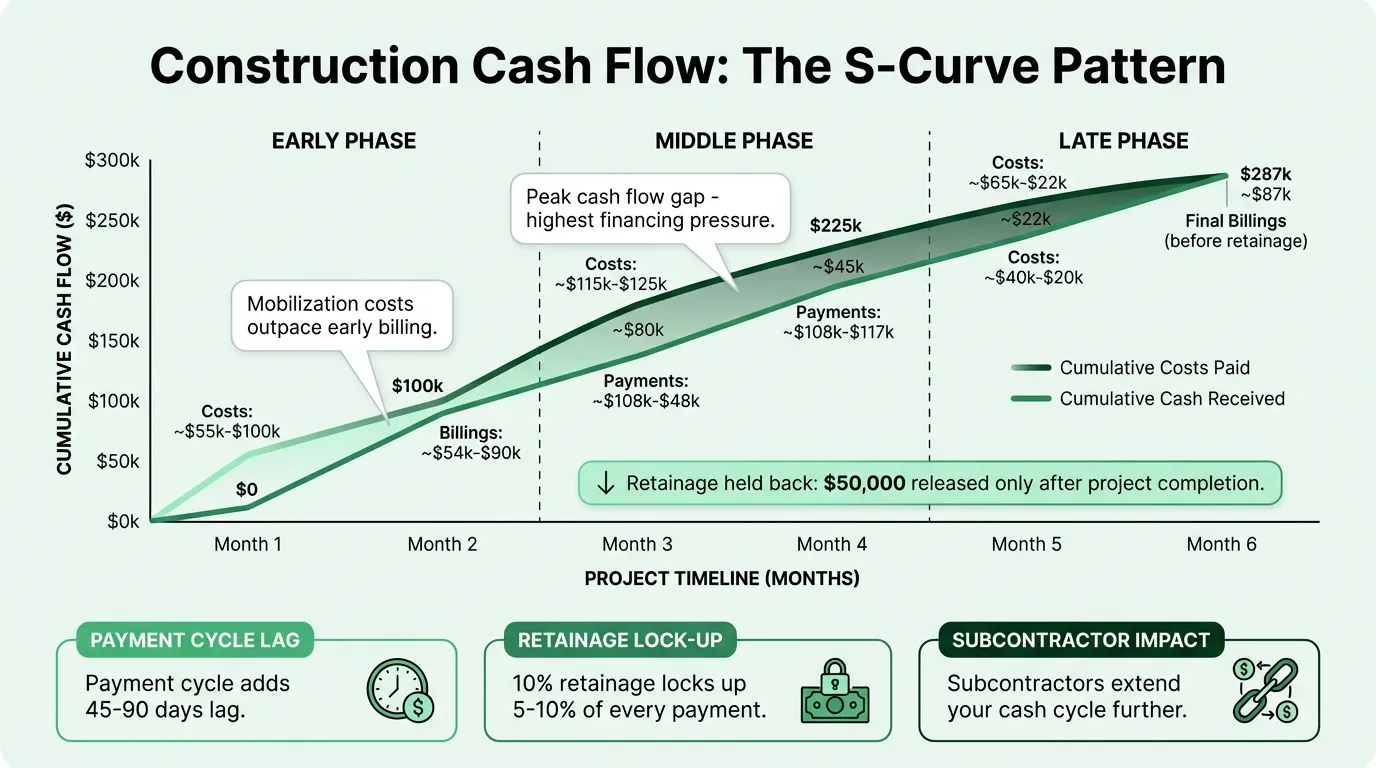
Examine the provided cash flow infographic, which illustrates the typical 'dip' in cash at the start of a construction project. You are tasked with creating a billing proposal for a new $100,000 electrical contract. Which of the following proposed Schedule of Values (SOV) structures best achieves a front-loaded cash flow while ensuring that every dollar billed is defensible in an audit by accurately reflecting the sequencing of early costs (such as permits, planning labor, and material storage)
Referencing the provided 'Construction Cash Flow Example' infographic, an electrical contractor observes a significant 'dip' in Net Cash Flow during the early phase of a project. To manage this, the contractor decides to front-load their billing by assigning higher values to mobilization and site setup.
If this billing is later challenged by a project auditor, which of the following justifications would be evaluated as the most 'defensible' application of front-loading?
An electrical contractor is preparing the billing schedule (Schedule of Values) for a new $100,000 warehouse renovation. To avoid the initial 'dip' in cash flow shown in the provided infographic, which strategy should the contractor apply when assigning values to early project tasks like 'Mobilization' and 'Project Setup'?
Referencing the provided 'Construction Cash Flow Example' infographic, an electrical contractor observes a steep 'dip' in early funds. They decide to use 'front-loading' in their first progress billing to improve their cash position. Analyze the following billing items and match each one to the specific reason why it is classified as either a defensible front-loading strategy or unsupportable overbilling.
An electrical contractor has finished the 'rough-in' conduit and wire-pull phase for an office renovation. This phase is assigned a value of $12,000 in the project's Schedule of Values (SOV). According to the principles of 'front-loading', how should the contractor handle the progress billing for this completed work?
Learn After
When a contract allows monthly billing, submitting the pay application on the 1st of the month instead of the 20th gives an electrical contractor approximately ____ extra days of collection time before the next billing cycle begins.
An electrical contractor decides to strictly calendar and submit all monthly pay applications on the earliest permissible date (e.g., the 1st of the month) rather than waiting until mid-month. What is the primary business advantage of this practice?
An electrical contractor is setting up the billing schedule for a new commercial project. The contract allows for monthly billing. To ensure they can pay their suppliers using incoming project cash rather than dipping into company reserves, the contractor decides to schedule the pay application submission for the 20th of the month instead of the 1st. True or False: This scheduling decision effectively supports their cash flow goal.
An electrical contractor is restructuring their billing process to stop depleting their cash reserves. Arrange the following events in the logical causal sequence that demonstrates how shifting to an early-month billing strategy resolves this cash flow issue.
An electrical contracting business is auditing its billing procedures for contracts that permit monthly billing with defined cutoff dates. Evaluate the following billing scheduling decisions by matching each action to the correct assessment of its financial impact.
When a contract permits monthly billing with a defined cutoff date, what is the primary benefit of an electrical contractor submitting a pay application on the 1st of the month rather than waiting until the 20th?
When a contract allows monthly billing with a defined cutoff date, waiting until later in the month to submit a pay application helps an electrical contractor protect their company reserves.
As an electrical contractor, your billing timing directly impacts your ability to pay suppliers without dipping into your own pocket. Match each administrative action regarding monthly progress billing (with a month-end cutoff) to its most likely operational outcome.
Analyze the cause-and-effect relationship of early progress billing. Arrange the following events in the chronological order that demonstrates how submitting a pay application on the earliest permissible date protects an electrical contractor's cash reserves.
You are evaluating the performance of your electrical firm's billing manager. They argue that as long as a monthly pay application is submitted before the month ends, the exact submission date does not matter. You reject this argument and mandate submission on the 1st of the month, justifying your decision by explaining that the earliest permissible date maximizes the company's collection ______, which is critical for paying suppliers from project cash rather than dipping into reserves.
You are establishing a new 'Financial Stability Policy' for your electrical contracting business to ensure you can pay for materials using project revenue instead of dipping into your personal reserves. For an active project billing $80,000 monthly with a month-end cutoff, which company-wide strategy should you create and implement to most effectively manage your cash flow?
If a contract allows monthly billing with a defined cutoff date, how many additional days of collection runway does an electrical contractor typically gain by submitting their pay application on the 1st of the month instead of the 20th?
You are designing a 'Cash Flow Protection Standard Operating Procedure (SOP)' for your new electrical contracting business. Based on the cash flow pressures shown in the infographic, sequence the following steps to create a functional project-onboarding workflow that ensures you pay suppliers from project revenue rather than your personal reserves.
You are designing a 'Cash Velocity Operating System' for your new electrical contracting business. To ensure this system successfully automates the protection of your cash reserves, match each 'Software Feature' you are creating to the 'Operational Logic' it must follow based on the cash flow principles in the infographic.
When establishing a billing schedule to maximize cash flow, which contract provision must an electrical contractor identify to determine the earliest possible date they can submit a pay application?